
In July, a post on Reddit's r/AusLegal forum described a family going through a mother's superannuation as she approached retirement. Her insurance premiums had risen from about $5,000 a year to $25,000, prompting questions about how the cost of high levels of TPD cover can change as people get older.
Over a decade, the family calculated that roughly $116,000 of her retirement savings had gone to premiums she never realised she was paying.
The Reddit thread split into two camps, with one user calling it extortion and wanting someone held to account. Another pointed out something harder to hear: the fund had almost certainly disclosed every single increase in annual statements nobody opened.
While this woman’s case might seem specific, in truth, it’s common for people to see the cost of their TPD cover rise as they get older, particularly if they have a high level of cover.
Most working Australians carry insurance inside their super, usually without ever choosing to do so. The Productivity Commission's 2018 review of superannuation found that, by 2016-17, funds were collecting $9 billion a year in insurance premiums, with around 80% of policies issued automatically.
The same review found that for many members, those premiums could reduce a retirement balance by 14%, or about $85,000. For some disadvantaged members, the figure passed $125,000.
That report triggered major reforms. Yet Australians still pay about $6.5 billion a year in premiums through super, according to data collected by APRA and published by ASFA.
And awareness amongst Australians remains low. ASIC's 2018 review of insurance in superannuation cited survey data showing 24% of members did not know whether they had insurance at all.
Six years and two Acts of Parliament later, a 2024 Super Consumers Australia survey found 27% of Australians still either didn’t know whether they held cover through super or were unsure what cover they were paying for.
That national picture matches what we hear directly. When our team asks people exploring a TPD claim whether they know what their cover is worth, the most common answer is a version of ‘I'd have to check’. In our own data, over a two-month period, roughly one in four callers couldn’t say whether they had TPD cover at all.
We hear the same comments from call to call. ‘It says I do have insurance, I'm just not sure what the insurance is.’ ‘I wouldn't have a clue, I don't have any paperwork.’ It’s not uncommon for a member of our team to wait while a client downloads their fund’s app for the very first time.
The insurance you never asked for
Most super funds automatically give members life (death) cover and total and permanent disability (TPD) insurance once they turn 25, on an opt-out basis. ASIC's Moneysmart explains that funds offering MySuper products are required to offer this default insurance, with premiums deducted directly from the super balance itself.
Let’s be clear: for most people, that arrangement offers reasonable value. Group insurance through super is often cheaper than an equivalent standalone policy, and it covers people who would never buy insurance on their own.
The 2019 reforms fixed the worst of the waste. Under the Protecting Your Superannuation Package changes, cover is cancelled on accounts inactive for 16 months, and the follow-up changes in the Putting Members' Interests First amendment stopped default cover for new members under 25 or with balances below $6,000.
Analysis by the Association of Superannuation Funds of Australia found those reforms stripped insurance from around 5 million accounts, most of them small, duplicate or forgotten. What they did not touch is the account that keeps receiving contributions. An active account keeps its cover, and keeps paying for it, usually until the holder reaches 65 for TPD and 70 for death cover.
The cost curve that bends against you
Most insurance inside super is priced on what Moneysmart calls variable age-stepped premiums. The premium is recalculated every year based on your age, because the odds of a claim rise as you get older.
In your 30s and 40s, the annual increases are small enough to ignore. However, from your mid-50s, the curve steepens sharply, exactly when balances are at their largest and the years left to recover the money are fewest.
There is a built-in protection in most default arrangements: the amount of default cover automatically tapers off as you age, helping to keep the premium relatively stable.
Despite this safeguard, Super Consumers Australia found the system still gets expensive and uneven at the top end. Default death and disability cover at age 60 ranged from about $115 a year at one major fund to over $1,080 at another. At age 65, the same level of cover can cost 16 times more from one fund to another.
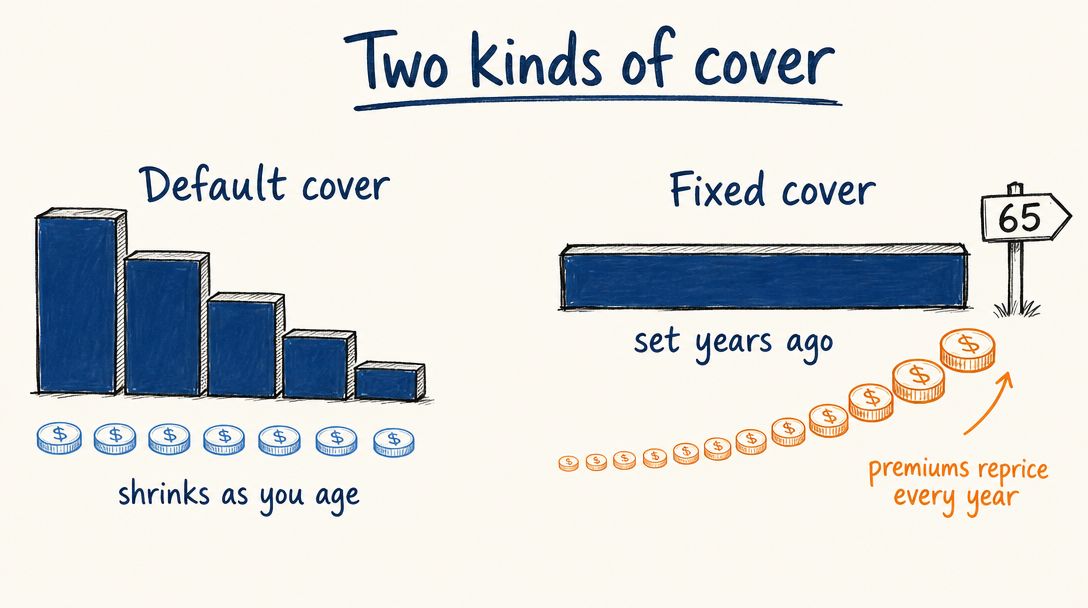
We watch this play out on real accounts from people who’ve contacted us. Many we’ve spoken to have seen their cover taper by thousands of dollars overnight simply because they had a birthday. One person discovered during a call with us that cover they believed was still worth around $200,000 had quietly fallen to about $60,000. We’ve also verified policies that had dwindled to just a few thousand dollars by the time their owners reached their 60s.
Where it goes wrong: cover that was fixed years ago
The Reddit case had a detail many commenters skipped past. The cover was not the fund's default. It appeared to have been set up through a financial adviser years earlier, at a much higher fixed amount.
This is a really important distinction. Serious erosion cases like this one almost always trace back to a deliberate decision that often seemed sensible at the time. Perhaps cover was increased or fixed years earlier, sometimes on sound advice, sometimes just by ticking the highest option on a form, back when the person had a mortgage, dependants and a long working life ahead.
With fixed cover, the amount you’re insured for stays the same. But as you get older, your premium can rise significantly, sometimes multiplying several times over a decade. The difference between default super TPD cover and policies set up individually is one of the least understood corners of the system.
Callers have described exactly this scenario. One summed his policy up as premiums that keep going up while the cover goes down. Another had ticked the maximum cover option years earlier without realising the premiums would keep climbing. A third had held a large self-selected policy for years and halved it purely because of the cost, months before the injury that ended their working life.
After all, there’s no law requiring anyone to check whether the advice you were given over a decade ago still makes sense. While the 2019 reforms protect inactive accounts, young members and small balances, nothing in them reviews the suitability of large, advised cover sitting on an active account as its owner ages toward retirement.
That is how $5,000 a year becomes $25,000 a year legally, with every increase documented.
‘The fund did tell you’ argument
The least popular comments in the r/AusLegal thread mentioned above were also the most accurate ones. Super funds are required under the Corporations Act 2001 (Cth) to give members at least 30 days' notice of any increase in fees or charges. They must also send periodic statements showing every transaction on the account, including each premium deduction.
In most of these cases, the paper trail is complete and the information arrived each year, but it simply was never read.
If you’re considering a complaint, then this detail is important. The Australian Financial Complaints Authority says in its own guidance on premium increases that it cannot geneally do much with a complaint about the level of a premium and that stepped premiums are very common in Australian life insurance. And, of course, a complaint that the pricing itself is unfair rarely goes anywhere.
Complaints have succeeded, though, especially when:
- disclosure failed
- where the premium was calculated or applied incorrectly
- where an increase was disproportionate with no justification
- or where a member was put in the wrong risk category
Take, for example, one caller's cancellation notice that had gone to a postal address they had left years earlier. Undoing it meant applying for the cover all over again.
When it comes to ‘wrong risk category’, ASIC's 2018 review found that some funds had incorrectly transferred members to rates normally applied to smokers. It's worth checking any old account to make sure you weren't charged the higher rate by mistake.
Thankfully, there’s one more door that AFCA leaves open to those who’ve exhausted all other routes. It can consider a complaint about the original advice to take out the cover, including whether that advice was in the client's best interests and whether its costs, projected over time, were properly disclosed.
What you can actually do with your next statement
You’ll be pleased to know that to fix things takes just one evening a year, not a finance degree.
Open the annual statement and find the insurance section. It will show what types of cover you hold, the sum insured for each, and what you paid for them over the year. Then answer three questions.
- Is the cover amount age-based default cover or a fixed amount someone chose years ago?
- Is the premium structure stepped or level?
- And does the sum insured still match your current lifestyle, or the lifestyle you had when it was set up?
If the premium has jumped sharply, or the cover was based on advice you have not revisited in years, this is a red flag. Get the original statement of advice out and have the arrangement reviewed by a licensed financial adviser before making any changes.
The check runs in both directions. We have sat on three-way calls with funds where someone who assumed they were covered, because contributions were flowing in, turned out to hold an account that never carried insurance at all.
Never panic and just cancel your cover. It may be the only disability cover that you hold.
ASIC's 2019 review of TPD claims found around half a million Australians were covered only under restrictive ‘activities of daily living’ definitions. These policies declined around 60% of claims, five times the average rate. That is worth understanding before you assume you can rely on the cover or pay another year for it.
Another finding by the regulator was that people who don’t know what they hold do not claim when they should. One caller we spoke to spent two years living off savings after illness stopped them from working, unaware the whole time that an entitlement existed inside a fund they had lost track of.
Plenty of Australians are sitting on TPD cover they could claim against after serious illness or injury has ended their working life, but they never claim, simply because they never knew what their TPD insurance covered in the first place.
If illness or injury has already stopped you working, checking whether you qualify to make a TPD claim matters just as much as checking what the cover costs.
The timing of this matters. When, due to illness, your contributions cease, the clock starts running on the cover itself. We’ve taken calls from people who found out their insurance had been cancelled, or was close to being cancelled, only when they rang about a claim.
The woman in the Reddit thread lost $116,000 to a policy nobody was watching. The insurance inside your super deserves an evening of your attention each year: enough to know what you hold, what it costs, and what it would actually pay if the unthinkable happens. Easily the most expensive mistake you can make is not being clued up about the details.
This article is general information about superannuation and insurance, not financial or legal advice. Consider speaking to a licensed financial adviser before changing any insurance arrangement.