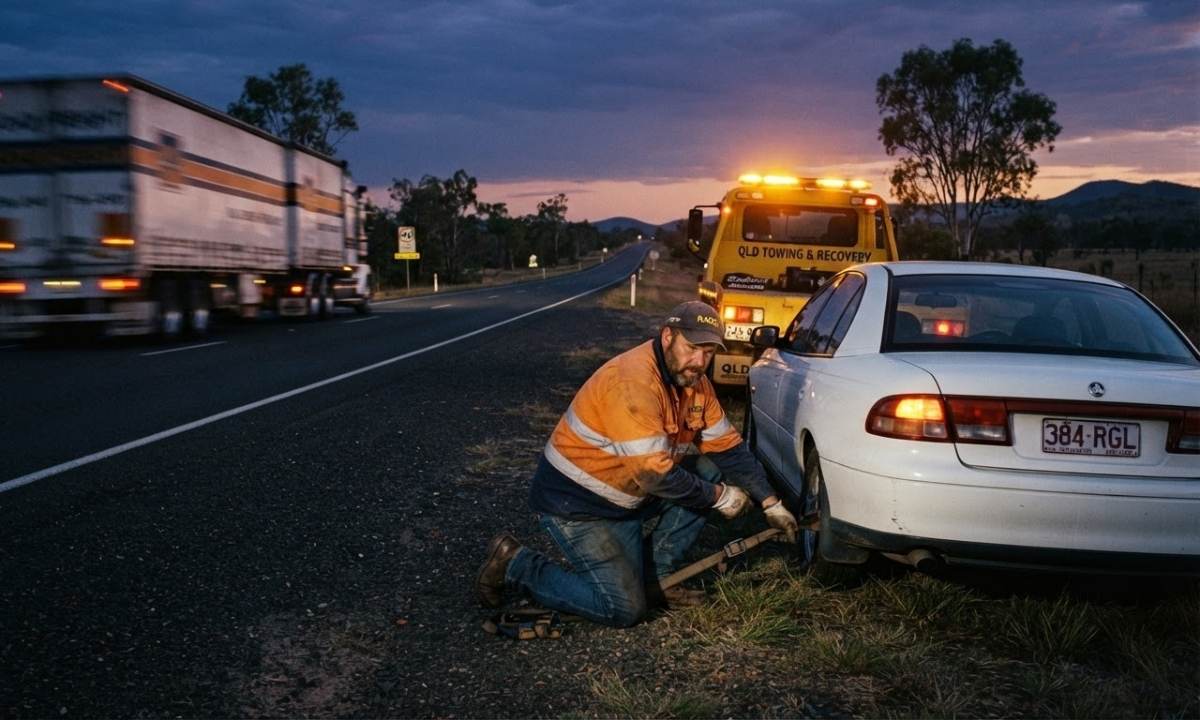
A tow truck driver crouches at the rear of a stranded sedan on the Bruce Highway, changing a tyre as traffic passes a metre from his shoulder. His amber lights are flashing. The law says every car should slow down and move over, but not everyone does.
That driver is part of a workforce almost nobody thinks about until they themselves are stuck on the side of the road. The mechanic who arrives when your car dies on the M1 during rush hour. The patrol officer who jump-starts your battery in a servo car park. The tow operator who loads your damaged car from the shoulder of a regional highway at night.
They work centimetres from moving traffic, relying heavily on the public to follow laws that were designed to protect them. But are drivers following the rules?
The law and the drivers who ignore it
Queensland gave roadside workers legal protections nearly four years ago. Since 16 September 2022, drivers passing a stationary vehicle with flashing lights have been required to move over and slow to a safe speed.
What many drivers don’t seem to realise is that these protections are in place not only for the police and ambulances, but also for roadside assistance vehicles, such as those of RACQ.
Queensland’s StreetSmart site states that laws are in place for:
- Emergency services (flashing blue or red lights)
- Transport enforcement (flashing magenta lights)
- Breakdown assistance providers (flashing yellow lights)
For this reason, the breakdown mechanic and the police officer parked behind them are protected by the same Queensland legislation. The problem is not the law. The problem is when drivers don’t obey it.
More near-misses, not fewer
New figures from RACQ show a worrying trend.
In the six months from November 2025 to April 2026, there were 29 dangerous near-misses involving tow trucks assisting motorists. That’s more than triple the figure recorded in the same period the previous year. That works out to more than one life-threatening incident a week.
'The law is simple,' RACQ Deputy Chief Executive Glenn Toms said in the same release. 'If you see flashing lights on the roadside, move over and slow down.'
The frustration in that statement is justified. RACQ flagged the same danger back in an article in 2022, warning that its roadside officers were 'frequently involved in near misses or even struck by passing motorists'. In fact, RACQ has been pressing for changes to the law ever since 2017.
Not only did it take 5 years for the law to change, but now, in 2026, it’s clear that this wasn’t enough to ensure the safety of workers.
Also read: Driver Near-Misses: A Road Safety Epidemic
Why the roadside is one of the deadliest places to work
The danger these workers face is of paramount importance. It sits at the heart of Australia’s workplace safety landscape.
Vehicle incidents were the single most common cause of worker deaths in 2024, accounting for 42% of all work-related fatalities, according to Safe Work Australia. That is more than triple the next most deadly cause, ‘falls from a height’.
The same data set found that at least one vehicle was directly involved in 66% of the 188 workers who died at work that year. A statistic like this is a stark reminder of just how dangerous roads can be for workers.
An office protects its workers with distance and structure. A roadside does the opposite. It exposes workers directly to fast-moving traffic, multi-tonne vehicles controlled by drivers who may be tired, distracted, or unaware that the hazard they are approaching is another human being.
What sits behind the flashing light
Most drivers process a breakdown on the shoulder as a minor inconvenience. They see that the lane is blocked, the traffic has slowed, and so they simply edge past and go on their way.
For the worker, that same moment is a calculated risk taken dozens of times each shift. Tow operators and patrol crews position their vehicles as a barrier, working with their backs to traffic because the broken-down car demands it. They rely entirely on strangers to ease off the accelerator and be understanding.
There is also a quieter group exposed here: the motorists themselves. The driver standing beside their broken-down car and any passengers waiting on the verge are in the same firing line as the worker who came to help. A near-miss with a tow truck is a near-miss with everyone gathered around it.
What the rest of the country is doing and where Queensland sits
In New South Wales, drivers must slow down when passing stationary emergency or incident response vehicles with flashing lights. On roads with a speed limit of 80 km/h or less, the limit drops to 40 km/h. These rules apply to police, ambulance, fire, tow trucks and roadside assistance vehicles, and normal speed should only resume once fully past the scene.
Since 1 July 2025, Victoria has broadened its 40km/h passing rule to explicitly cover roadside assistance workers, tow truck drivers, their customers, and incident response crews. Drivers who break that rule face fines of up to $961.
Queensland, like Victoria, has set a clear penalty: $500 and three demerit points for failing to move over and slow down. What Queensland has not solved, though, is compliance. And, after all, a rule only protects a worker if drivers actually follow it.
What drivers and injured workers should know
For drivers, the rule is straightforward and applies to all roads in Queensland. When you see flashing lights ahead – blue, red, magenta or yellow – slow down, move over within your lane if safe, and, on multi-lane roads, leave a clear lane where possible. A tow truck's amber light carries the same weight as a police car's blue and red.
For the workers themselves, being injured while working is a workplace injury like any other. A tow operator, patrol officer or breakdown mechanic hurt while attending a roadside job in Queensland has rights under the state's workers' compensation system, governed by the Workers' Compensation and Rehabilitation Act 2003 (Qld). Where another driver's negligence caused the injury, a separate claim against that driver may also be possible.
The point is that a roadside strike is rarely just bad luck. It usually involves a driver who failed to follow a legal duty that has existed in Queensland since 2022.
The gap that still needs closing
Queensland did the legislative work years ago and the protections exist. The penalty is set, and tow and roadside workers are squarely inside the protection.
What RACQ figures show is that a law on paper and a law obeyed on the road are not the same thing. Until drivers treat an amber flashing light with the same instinct they give a police car, the people who come to help when your car dies will keep putting themselves at risk every day.
The next time you pass a flashing light on the shoulder, remember that there’s a person behind it who is trusting you to do the right thing and slow down.