At least once every five years, Queensland law requires the government to check how its workers' compensation scheme is working.
This year, one issue is front and centre: the growth in psychological injury claims.
Deputy Premier Jarrod Bleijie announced the independent review on 24 March 2026. Written submissions closed on 31 May, and the Office of Industrial Relations (OIR) expects the review to be finalised in the second half of 2026.
What stakeholders told the reviewers is harder to see. The OIR has said submissions will not be published, leaving much of the debate over how Queensland compensates psychological injury out of public view.
But despite these omissions, we’ll try to dig down into the information that is available.
What the Review Has Been Asked to Look At
The review is required by section 584A of the Workers' Compensation and Rehabilitation Act 2003 (Qld). It obliges the Minister to ensure the scheme's operation is reviewed at least once every five years. The last review was completed in 2023, and its recommendations led to an amendment that received assent in August 2024.
This time around, the terms of reference name specific concerns. On the workers' compensation side, the reviewers have been asked to consider:
- the growth of primary and secondary psychological claims, and its impact on injured workers, employers and the scheme as a whole
- whether the fraud offences, and the way the scheme prevents and manages fraudulent claims, are still fit for purpose
- whether self-insurance arrangements are still working as intended
- relevant laws and reforms in other Australian jurisdictions.
One area is expressly out of bounds, though. According to the OIR, any change to common law under the Act is excluded from the review's scope. That means we won’t see the review tackling claims of this nature or proposing changes to that part of the scheme.
This refers directly to claims for damages a worker can pursue through a lawyer where negligence was involved.
The review is led by Glenn Ferguson AM, a lawyer and former WorkCover Queensland chair, with Gary Black, a former commissioner of the Queensland Industrial Relations Commission.
The review also covers the Industrial Relations Act 2016 (Qld), which mainly governs the state public sector and local government.
What the Numbers Show
WorkCover Queensland accepted 4,110 primary mental injury claims in 2025-26, up 13.1% on the year before, according to its 2025-26 annual report. The picture was very different across the scheme as a whole: accepted claims of all types rose just 0.6%, to 75,462.
Primary mental injury claims are still a small share of the total, about one in 18 accepted claims. That said, their cost is far from small. They made up 16% of WorkCover's statutory payments, totalling around $334 million.
The difference shows up in time away from work, as well as the return-to-work rate:
| Primary mental injury | Primary physical injury | |
|---|---|---|
| Average paid days | 123 | 47.1 |
| Return-to-work rate | 71.4% | 93.2% |
Those figures cover WorkCover's own policyholders only, not the 27 employers that held self-insurance licences as of 30 June 2025.
This is not a one-year spike. WorkCover's annual report describes the shift towards primary and secondary mental injury claims as a trend running over the last five years, in line with what is seen nationally.
How the Law Tests a Psychological Injury
Under section 32 of the Act, an injury is covered if employment is 'a significant contributing factor'. Since an amendment in late 2019, that test has applied to psychological injuries in the same way as physical ones.
Before then, the bar was higher. For a psychiatric or psychological disorder, employment had to be the major significant contributing factor.
Psychological injuries also face an exclusion that physical injuries do not.
Section 32(5) excludes a disorder arising from reasonable management action taken in a reasonable way.
The Act’s examples include:
- Transferring someone to another role
- Demoting someone
- Disciplining someone
It also excludes psychological injuries arising from a worker expecting or believing that reasonable management action will be taken against them. For example, a worker might become psychologically injured after being told they are likely to be demoted, even though the demotion has not actually happened.
The same exclusion applies to injuries arising from the Regulator or an insurer’s handling of the worker’s compensation claim.
That exclusion carries a lot of weight.
In 2024-25, 48.3% of psychological and psychiatric claims were rejected across the scheme, according to OIR's statistics report. Of those rejections, 97.3% relied on the reasonable management action exclusion. Interestingly, for physical injuries, the rejection rate was only 4.5%.
In the background sit two further provisions worth mentioning.
Under section 36ED, post-traumatic stress disorder diagnosed by a psychiatrist in a first responder or an eligible employee is taken to be a work injury, unless certain circumstances are proved.
There is already provision for insurers to support workers with psychological injuries while their claims are being assessed. Section 232AC extends that approach to workers who initially make a claim for a physical injury.
Once that claim is accepted, the insurer must take all reasonable steps to minimise the risk of the worker developing a secondary psychological injury as a result of the physical injury.
That second duty is now being audited. According to Workers' Compensation Regulatory Services, part of the OIR, 5.1% of workers with a physical injury requiring time off develop an accepted secondary psychological injury. This rate has doubled in five years.
The audits cover every Queensland insurer, with the results due to be reported back to the scheme in December 2026.
The Case for Change
Two employer groups say they asked for this review. Master Builders Queensland and the Civil Contractors Federation Queensland said they had appealed to the Deputy Premier to examine the impact of rising psychological injuries on WorkCover. Both welcomed the announcement when it was made on 26 March.
Their argument is about sustainability. The CCF's chief executive said the scheme needed significant reform to stay sustainable over the long term.
He pointed to:
- a near doubling of primary psychological claims over five years, and
- claims that keep workers off work for longer and cost more.
Master Builders said industry had long supported WorkCover as a no-fault scheme. It said the aim should be to get the balance right for injured workers and employers, and welcomed the review’s focus on fraud and self-insurance as well.
WorkCover's own figures point to the cost pressure. Its average annual statutory claim cost rose 19% in 2025-26, to $16,666. Its annual report lists growth in mental injury claims, alongside wage growth and provider cost inflation, as pressures on its performance targets.
The government's stated aim is a scheme that is 'fair, balanced and sustainable', weighing appropriate benefits for injured workers against reasonable costs for employers.
It has frozen the average WorkCover premium at $1.343 per $100 of wages for a second year running, and has made fraud a priority. In 2024-25 the Regulator investigated 164 suspected fraud cases and launched six prosecutions.
The Case Against Narrowing Access
Lawyers who act for injured workers read the same numbers differently. In a supplementary submission dated 20 July 2026, the Australian Lawyers Alliance (ALA) argued there is no persuasive evidence that the legal definition of injury drives rising costs.
In its view, long claim durations, delayed recovery and poor return to work outcomes are more important factors to consider when it comes to expenditure.
The ALA acknowledges what it calls the review's interest in exploring alternative ways of defining psychological injury.
If the definition does change, the ALA said it could support:
- A recognised DSM diagnosis as part of the test for psychological injury.
- A return to a ‘major’ contribution test, rather than the current threshold.
- Rejecting Victoria’s ‘usual or typical’ work events exclusion, which the ALA argues would create more disputes and increase costs rather than reducing them.
Its preference is to fix how claims are managed rather than who is eligible. Where the law does change, it favours procedural reform.
One example is letting a single psychiatrist assess permanent impairment, rather than the medical assessment tribunal that section 179 currently requires for psychological injuries.
The ALA also pointed to recommendations from the 2023 review on early intervention and return to work that it says are still outstanding or in progress.
Practitioners have raised particular concern about frontline workers.
Writing in Proctor, the Queensland Law Society's journal, a compensation lawyer warned that any move to wind back the PTSD presumption for first responders would be deeply concerning.
An ABC News report from November 2025 heard from Queensland police and a Griffith University researcher who said the claims process itself can add to psychological harm.
Fraud and Self-Insurance
Fraud against an insurer is already an offence under section 533, with a maximum penalty of 500 units or five years' imprisonment.
Where the fraud risk mainly lies remains contested ground:
- Statements from the government have stressed a zero-tolerance approach to fraudulent claims.
- The ALA's submission argues the higher cost comes from employers under-declaring wages and from sham contracting.
When it comes to self-insurance, the review is asking whether the current arrangement is still fit for purpose for the 27 employers that carry their own workers’ compensation risk.
The OIR lists the suitability of self-insurance as one of the trends that emerged after the 2023 review, but does not explain what prompted the question.
What Happens Next
Once the review is complete, section 584A requires the Minister to table the report in the Legislative Assembly as soon as practicable. The government then decides which recommendations to accept.
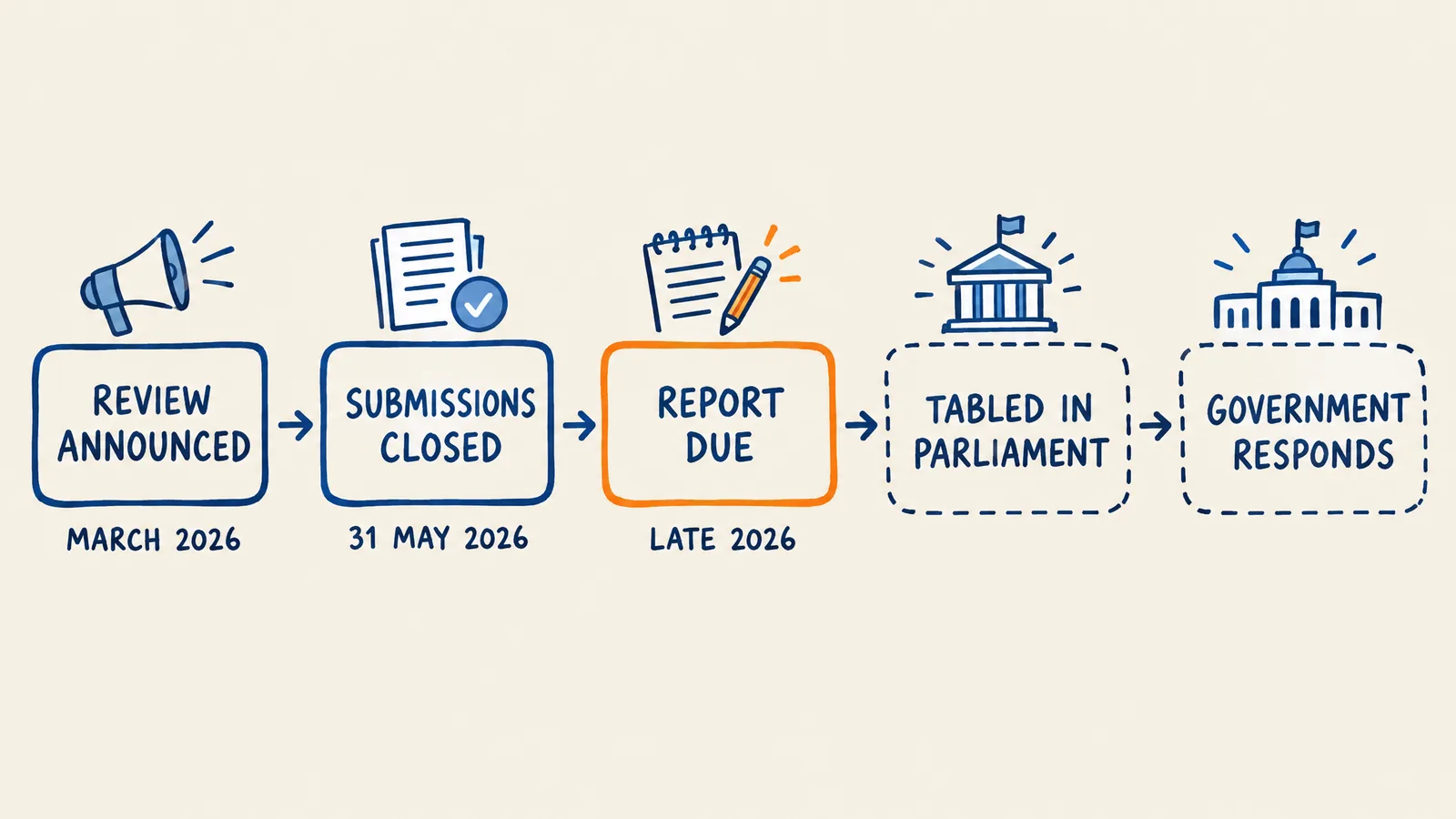
Changing the definition of injury in section 32 would require Parliament to pass amending legislation. Until that happens, the Act continues to apply as it does today. And, as of early October 2026, the review had not yet released its report or recommendations.
The previous review shows that recommendations can move from report to legislation within months, although the outcome depends on what the government decides to adopt.
Whatever the reviewers recommend, the question beneath it all stays essentially the same as it did in the original amendment in 2019: Should an injury to the mind, caused at work, be tested the same way as an injury to the body?