
On 1 December 2025, Australia finally finished a job it started in 2022. With Victoria's psychological health regulations commencing that day, every state and territory now has an enforceable law requiring employers to manage psychosocial hazards.
And even though prevention became national, compensation ended up going the other way.
The half of the story most people know
The prevention side has been building for four years, jurisdiction by jurisdiction, and it has landed in the same place everywhere.
Psychosocial hazards are the parts of work that cause psychological harm through how the work is designed and managed. This includes unreasonable workloads, low control over how the job gets done, poor support, role confusion, bullying, harassment, and exposure to traumatic material.
The obligation is the same shape as the one covering an unguarded machine, where an employer needs to identify the hazard, assess the risk, control it, and review the controls.
The commencement dates tell the story of how recent this all is:
Sources for the table: Safe Work Australia and a jurisdiction-by-jurisdiction review published in December 2025.
Victoria took a different route to the same destination, legislating standalone psychological health regulations under its own Occupational Health and Safety Act 2004 rather than adopting the model work health and safety framework used elsewhere.
The practical effect is that an employer in Perth and an employer in Melbourne now owe their staff a comparable duty of psychological safety, which was not the case two years ago.
The numbers behind the reform
Safe Work Australia's Key Work Health and Safety Statistics Australia 2025, published in October 2025, recorded 17,600 serious workers' compensation claims for mental health conditions in 2023-24, a 14.7% rise in a single year.
Those claims now make up 12% of all serious claims and are the highest share recorded. They grew over the decade to 2023-24 by 161%.
The cost profile is what makes them different from other injuries. Safe Work Australia put the median time lost for a serious mental health condition at 35.7 weeks, against 7.4 weeks across all serious claims. Median compensation ran to $67,400, compared with $16,300 for serious claims generally.
Queensland tracks the same pattern. WorkSafe Queensland's 2024-25 annual report recorded 3,633 accepted primary mental injury claims, an increase of around 8% on the previous year, at an average statutory claim cost of $23,600 against $13,000 for physical injuries.
A psychological injury keeps someone out of work roughly five times longer than a physical one, and that’s what’s driving both halves of the reform.
Where the states have split
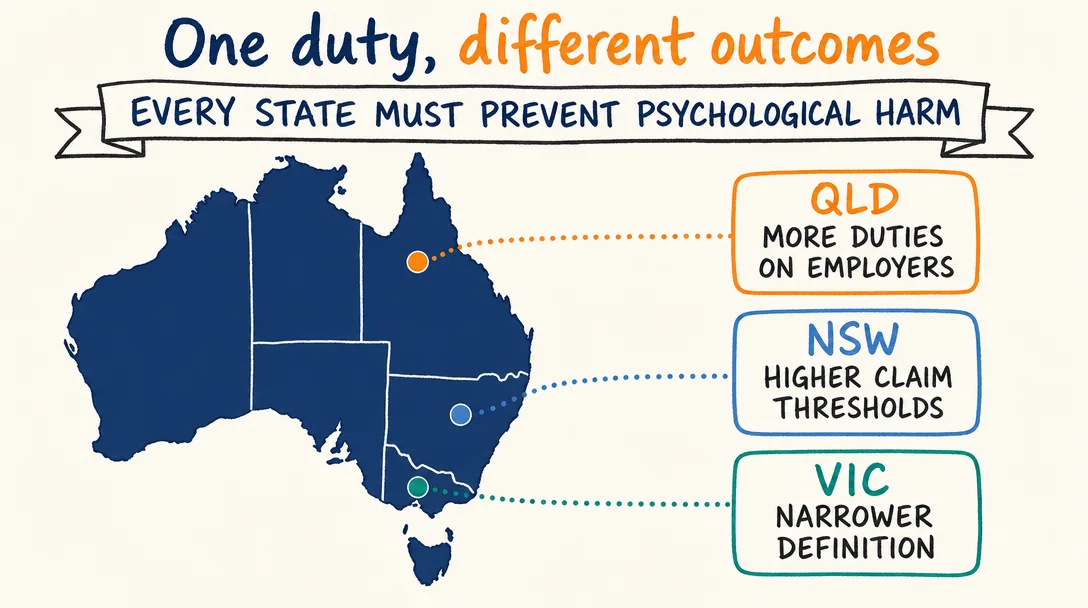
What’s been catching people out, however, is that even though the duty to prevent psychological harm converged, what you are entitled to when prevention fails did not.
Three jurisdictions moved in three different directions inside two years.
Victoria narrowed what counts as a mental injury
Victoria's Workplace Injury Rehabilitation and Compensation Amendment (WorkCover Scheme Modernisation) Act 2024 took effect on 31 March 2024. It introduced a new statutory definition of mental injury and, more significantly, a new exclusion.
Mental injury predominantly caused by work-related stress or burnout arising from events that are usual or typical in that job is no longer compensable in Victoria.
Injuries caused by repeated bullying or harassment remain covered, as do injuries from traumatic events that are inherent to the work, which matters for emergency services, health, and similar roles.
Victoria also retained provisional payments, where a worker can access up to 13 weeks of reasonable treatment for a work-related mental injury while a claim is being decided, and keeps that support even if the claim is ultimately rejected. A 2025 amendment also extended provisional payments to family members of a worker who has died by suicide.
New South Wales tightened long-term entitlements
New South Wales passed workers' compensation reform in two stages, the first bill in November 2025 and a second bill on 4 February 2026.
For primary psychological injury, the reform raised the whole person impairment threshold a worker must meet to keep receiving weekly payments beyond 130 weeks. Analysis by Lockton sets out the phasing: above 25% from 1 July 2026, rising above 26% from 1 July 2027, and reaching at least 28% from 1 July 2029.
Workers assessed between 21% and 25% gain an additional year of weekly benefits at 60% of pre-injury average weekly earnings from 1 July 2026.
The reform also strengthened the reasonable management action defence available to employers and created a new pathway requiring the Industrial Relations Commission to determine whether alleged conduct qualifies as relevant conduct before certain disputes proceed. A return to work programme for psychological injury adds a further year of medical benefits and income support.
Queensland expanded what employers and insurers must do
Queensland moved in the opposite direction to New South Wales, focusing on obligations rather than thresholds.
The Workers' Compensation and Rehabilitation and Other Legislation Amendment Act 2024 commenced on 23 August 2024. Among its changes, insurers must take reasonable steps to reduce the risk of a worker developing a secondary psychological injury out of a physical one and must have a written rehabilitation and return to work plan in place within 10 business days of accepting a claim.
The Act also introduced an obligation on host employers to cooperate with labour hire providers on return to work, closing a gap that had left labour hire workers poorly served.
Queensland's Managing the risk of psychosocial hazards at work Code of Practice 2022 has applied since 1 April 2023, and its legal weight is easy to underestimate.
A code of practice is admissible in proceedings, so a failure to follow it can be evidence that an employer knew or ought to have known about a risk.
What this means if it happens to you
The first practical point is that where you work now shapes your options as much as what happened to you.
A worker in Melbourne experiencing burnout from a heavy but ordinary workload faces a statutory exclusion that a worker doing the same job in Brisbane does not. A worker in Sydney with a long-term psychological injury faces impairment thresholds that rise again in 2027 and 2029. None of that is intuitive, and none of it is something an employer is likely to explain.
The second point is that the prevention duty creates a record. Because every jurisdiction now requires employers to identify and control psychosocial hazards, there is usually documentation about what the employer knew. Risk assessments, consultation records, incident reports, and hazard registers all exist because the law now requires them.
That makes contemporaneous notes worth keeping. Dates, times, what was said, who was present, what you reported and what response you got. A report made in writing at the time carries weight that a recollection two years later does not.
The third point is timing. Statutory claim periods differ between jurisdictions, and they are shorter than most people assume.
The new normal
Australia spent four years agreeing that psychological injury is a safety problem rather than a personal failing. That argument is settled, and every regulator in the country now has the power to act on it.
The next few years will be spent arguing about the other half, not whether employers must prevent psychological harm but what a worker is owed when they experience it.
Workers' compensation is now state-based, but the insurance held inside most Australians' superannuation accounts is not. If you are unable to work because of a mental health condition, you may be able to claim on the total and permanent disability cover attached to your super, regardless of which state you work in.