It might sound reassuring to hear that "9 in 10 TPD claims in super get paid." And it is true.
However, that’s only for the claims insurers actually decided.
The latest figures from the Australian Prudential Regulation Authority (APRA) cover the year to 30 June 2026, and were released on 16 October 2026.
They show what the 9 in 10 headline leaves out: the claims that weren't decided at all, and a rise in claims that weren't paid in full.
That second group requires a definition. APRA's glossary counts a decided claim as "declined" whenever the full benefit wasn't paid out. Partial payments, settlements and premium refunds all count, as do claims where nothing was paid out.
This article calls all of them "not paid in full."
Everything below is about group Total and Permanent Disability (TPD) cover held through superannuation. It’s the kind a super fund arranges for its members, which APRA reports as "group super." It is Australia-wide data.
ASIC's Moneysmart says that most super funds provide their members TPD cover automatically, generally once they turn 25 and have at least $6,000 in super.
This means it is cover a member can hold without ever choosing it.
Where 31,784 claims stood on 30 June
According to APRA, insurers in Australia had 31,784 TPD claims in super on their books in the year to 30 June 2026.
That count includes claims carried over from the year before and claims that were re-opened.
APRA also starts counting early. A claim is "received" once the insurer has the first piece of information it needs to begin assessing, not once they have every required form.
By 30 June, this is where those claims stood:
- 19,363 (6 in 10) had been paid in full
- 2,521 (about 8 in 100) had been decided and not paid in full
- 2,401 (about 8 in 100) had been closed without a decision
- 7,499 (nearly 1 in 4) were still open
Insurers decided 21,884 claims, and 19,363 of them were paid in full.
That is 88.5% of decided claims, or nearly 9 in 10. When measured against every claim on the books, it is 6 in 10.
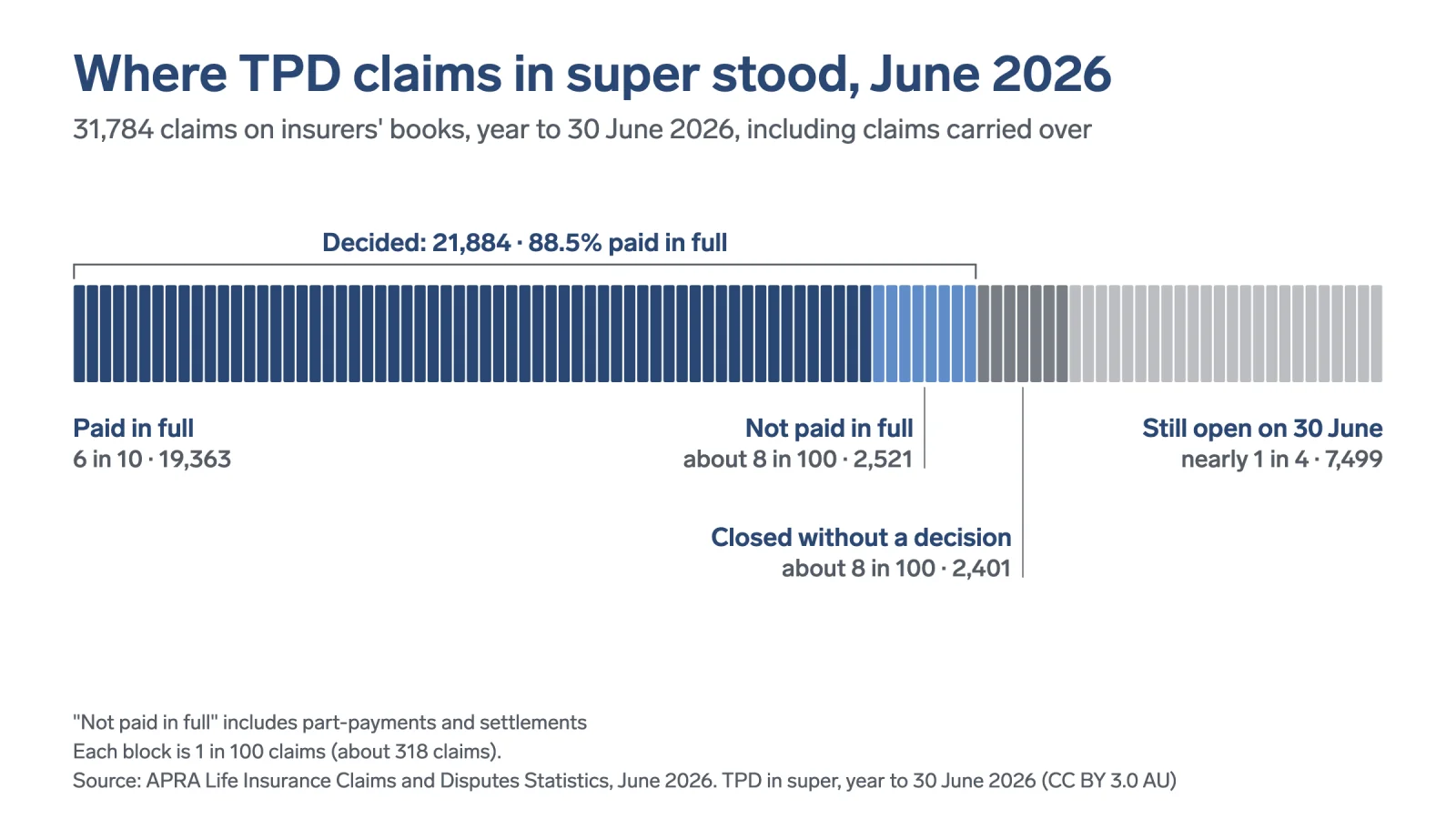
Of every 100 claims on insurers' books, 61 had been paid in full by 30 June, 8 had been decided and not paid in full, 7 had been closed without a decision, and 24 were still open. Source: APRA Life Insurance Claims and Disputes Statistics, June 2026. TPD in super, year to 30 June 2026 (CC BY 3.0 AU).
The short video below tells the same story for the year to 30 June 2026, with one file standing in for about 318 claims, then follows the claims that weren't paid in full to the reason most of them fell short.
The still-open figure is a snapshot taken on 30 June, not a measure of delay in deciding claims. It can include claims that arrived in June, and APRA's data doesn't say how long any open claim had been waiting to be decided.
The share not paid in full rose to 11.5%
APRA’s figures show that 11.5% of the claims insurers decided were not paid in full in the year to 30 June 2026 (2,521 of 21,884).
A year earlier the share was 8.5% (1,976 of 23,258), so it rose by 3 percentage points.
That happened while insurers were deciding fewer claims. Decisions fell from 23,258 to 21,884, which is a 6% decrease.
The 11.5% figure is the highest since late 2018, but the share was higher in the editions covering the years to June 2018 (13.7%) and December 2018 (12.0%).
The rise can’t be traced back to a single insurer, either. If you leave out the insurer that contributed most to it, the share not paid in full still went from 8.3% to 10.5%.

The share reached 11.5% in the year to June 2026, up from 8.5% a year earlier, and the highest since late 2018. APRA data is revised; long-run comparisons are indicative. Source: APRA Life Insurance Claims and Disputes Statistics, June 2018 to June 2026 editions. TPD in super, each a rolling 12 months (CC BY 3.0 AU).
One thing to keep in mind when reading this chart is that each edition covers 12 months and APRA publishes every six months, so neighbouring editions overlap by half a year. APRA also revises earlier figures and urges caution when comparing movements across more than two periods, which is why this article compares June with June.
Why these claims weren't paid in full
The video ends on a question answered by APRA's data.
APRA records the reasons claims weren't paid in full. For TPD in super, its reason table includes data on 2,520 claims, one fewer than the count above. For 2,294 of them (91.0%), the claim didn't meet the policy's definition of TPD or its eligibility rules.
The rest were spread thinly across several reasons. An exclusion in the policy applied to 163 (6.5%), information wasn't disclosed or was misstated by mistake for 38 (1.5%), and 21 (0.8%) fell under other reasons.

Nine in 10 of the 2,520 claims didn't meet the policy's definition of TPD or its eligibility rules. Fraud accounted for 4 claims. Source: APRA Life Insurance Claims and Disputes Statistics, June 2026. TPD in super, year to 30 June 2026 (CC BY 3.0 AU). "Not paid in full" includes part-payments and settlements.
There were 4 claims in super that involved fraud, fewer than 2 in every 1,000 not paid in full.
A TPD claim is assessed against the wording of the policy it's made under, and each policy defines TPD in its own words. For 9 in 10 of these claims, that wording is where the outcome turned.
Failing to meet the policy’s definition has been the top reason a claim wasn’t paid in full in every edition of APRA's data between June 2018 and June 2026.
2,401 claims closed without a decision
Another 2,401 claims were closed before an insurer assessed them, which APRA counts as being "withdrawn." That category includes people who returned to work before a waiting period elapsed.
For 1,723 of them, the insurer withdrew the claim under what APRA calls "claimant inactivity." That’s a category which covers claimants who didn't respond to a request for information, as well as claimants who died after the claim was lodged.
A further 561 were withdrawn by the claimant, and 117 closed for other reasons.
Those 1,723 cases are more than 10 times the 163 claims not paid in full because an exclusion applied. Insurers ask for information as part of assessing a claim, and the data can't say why any one of these claims might have been closed.
How long decided claims took
APRA estimates that it took 3.7 months on average to decide TPD claims in super in the year to 30 June 2026, compared to 3.6 months a year earlier. Just over half (50.4%) were decided within two months.
About 1 in 6 (16.2%) claims took more than six months to get a decision, and 3.6% took more than 12 months.
Those times come with three limits: they only cover decided claims, the average is APRA's estimate from duration bands, and the clock belongs to the insurer.
The countdown starts when the insurer has that first piece of information, and stops when the insurer informs the claimant of its decision. Any time a super fund trustee spends on the claim outside that window isn't counted.
TPD bought through a financial adviser is reported separately as individually advised cover held inside or outside super.
These claims took an estimated 7.3 months on average, and 42.0% of them took more than six months. It’s a different type of cover that’s underwritten person by person, so the comparison isn't the same.
The way claims are handled is also changing.
Life insurers have committed to several changes to the Life Insurance Code of Practice following an independent review, whose interim report was published on 10 April 2026.
Their action plan was published on 30 September 2026, and includes improved claims processes.
Disputes rose sharply, mostly with one particular insurer
APRA counted 3,919 disputes about TPD claims in super in the year to 30 June 2026, up from 2,489 a year earlier.
That is the highest count in any of the 17 editions since June 2018, although APRA's caution about long-run comparisons applies here too.
It works out at 47.6 disputes for every 100,000 lives insured, against 30.5 a year earlier.
APRA's dispute count is quite broad. It includes disputes raised with the insurer directly, as well as ones passed on by a super fund trustee, an external dispute resolution scheme, a tribunal, or a court. It also includes disputes still open from the previous year.
The majority of the year's rise in disputes came from one insurer, which accounted for 61% of them. Even without that insurer, disputes still rose by about a quarter.
Of the 3,283 disputes resolved, the original decision was maintained in 1,352 (41.2%), and was reversed in 69 (2.1%). APRA recorded "other outcomes" for the remaining 1,862 (56.7%), a category it doesn't specifically define.
A year earlier, 7.0% were reversed and 34.2% maintained. About 90% of the increase in maintained decisions came from the same insurer mentioned above, so that part of the shift mostly reflects one company rather than the industry as a whole.
What the numbers can't tell you
APRA's statistics are detailed, but they aren’t perfect:
- They are industry totals reported by insurers. The decisions counted are insurers' decisions. A super fund trustee's own steps aren't measured.
- "Not paid in full" covers part-payments and settlements, not just claims where nothing was paid.
- Each figure is a rolling 12 months, and APRA revises them. This edition revised the December 2025 count of open claims from 6,169 to 6,887.
- Channels differ. Unless stated, every figure here is TPD in super. Across all TPD cover in APRA's tables, 87.8% of decided claims were paid in full in the same year.
- There is no field for individual circumstances. The data can't say who had help with a claim, or anything about any one person's individual claim.
The next edition, which covers the year to 31 December 2026, is due in April 2027.
As a whole, most TPD claims in super that insurers decide are paid in full, but the share that fell short rose to its highest number since late 2018.
The policy's own definition of total and permanent disability, or its eligibility rules, decided far more of those that fell short than fraud, exclusions, or anything else.
For anyone whose TPD cover sits quietly inside their super, that definition matters more than any headline rate on declines, delays or disputes.