Many Australians worry about what would happen if an illness or injury left them unable to work permanently and how they would manage financially without an income.
Total and Permanent Disability (TPD) cover provides a lump sum payment if you become permanently unable to work due to illness or injury. Many Australians have TPD insurance automatically included through their superannuation fund, often without realising it.
The payout can help cover essential costs such as medical expenses, debts, home modifications and everyday living costs when returning to work is no longer possible.\
Quick Answer Box
Key insights:
- Most super funds provide default TPD cover automatically once you turn 25 and your balance passes $6,000, according to MoneySmart
- TPD pays a one-off lump sum, not an ongoing wage
- TPD cover held inside a super almost always uses the 'any occupation' test (any suitable job), which is harder to meet than the 'own occupation' test (your specific role)
- You can hold TPD cover across more than one super fund at the same time
- You do not go to court to claim TPD. You claim through your super fund and its insurer
Can I claim? Yes, if illness or injury has left you permanently unable to work and you hold TPD cover through your super or a standalone policy.
Which key condition must I meet? You usually need to have been off work for around three to six months before a claim can be assessed, depending on your policy.
What are the key timeframes to be aware of? Generally, there's no strict legal deadline, but policy time limits and the quality of your medical evidence make acting early important.
What's the first thing I should do? Check every super account you hold, including old ones, for TPD cover today.
Understanding TPD Cover
TPD cover is one of three types of insurance that most super funds provide to members.
According to MoneySmart, run by the Australian Securities and Investments Commission, ‘most super funds offer life, TPD, and income protection insurance for their members.’
What TPD actually pays for
TPD pays a lump sum if you become totally and permanently disabled, meaning illness or injury has stopped you working for good.
The payout can help with:
- Living costs
- Medical care
- Home adaptations
- One-off expenses
Unlike income protection, it is a single payment rather than a regular income.
The amount depends on several factors:
- Your policy
- Your age
- The level of cover attached to your super
Why so many people don't know they have it
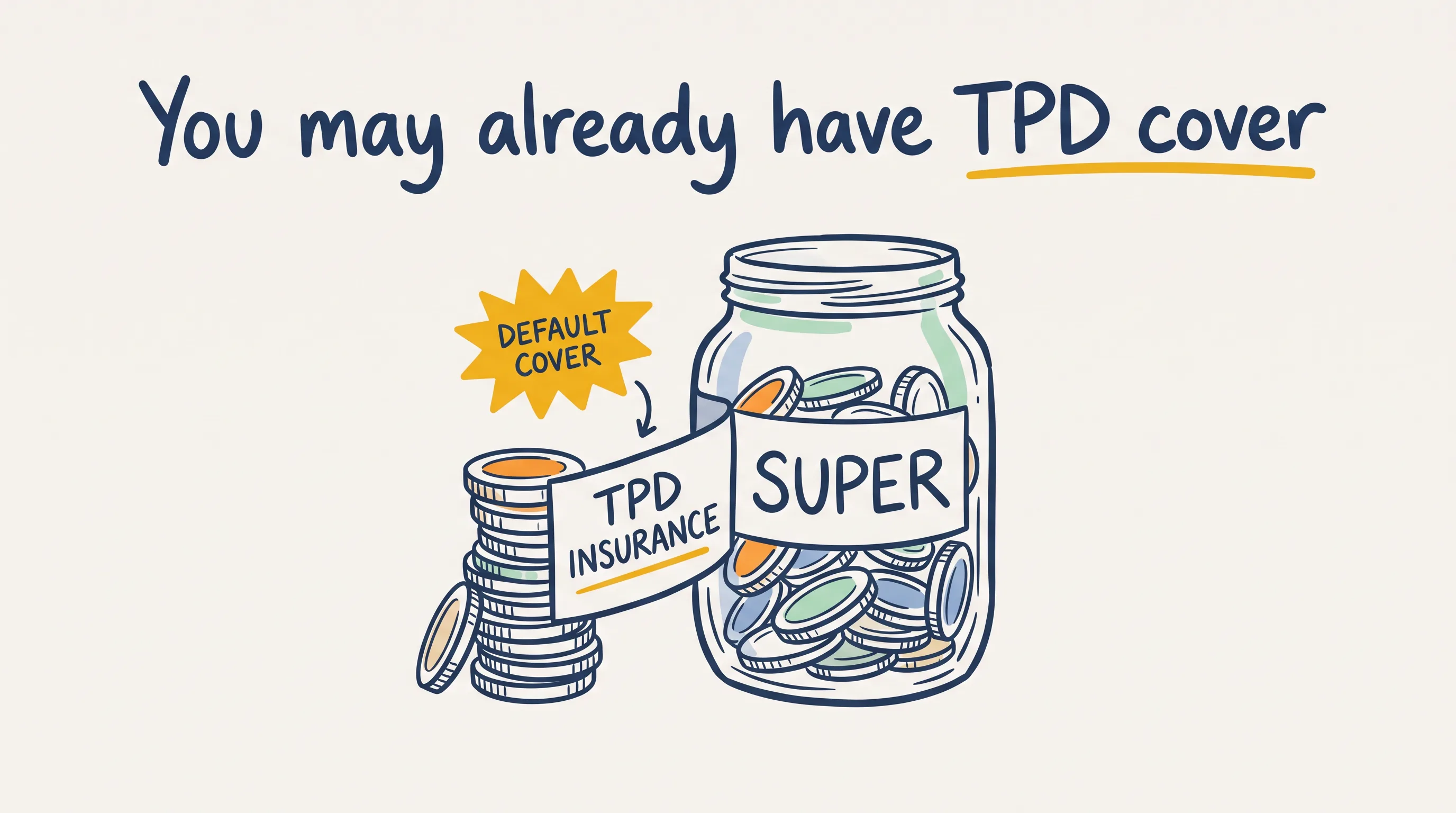
Many Australians have TPD cover automatically included through their superannuation fund, often without realising it. Because the premiums are deducted from their super balance rather than paid separately, many members never actively choose the cover or review what protection they have.
Default TPD insurance through super generally applies to eligible members aged 25 or over with a super balance above $6,000. These requirements were introduced as part of changes in 2019 designed to prevent unnecessary insurance premiums from reducing the retirement savings of members with low account balances.
What is the typical amount of cover?
The amount of TPD cover included through superannuation can vary between funds, but default TPD insurance commonly provides a lump sum payment in the low hundreds of thousands of dollars.
Most members can choose to increase their cover, or reduce or cancel their TPD insurance, by contacting their super fund.
However, default TPD cover may not provide enough protection for your personal circumstances. The right level of cover depends on factors such as your income, outstanding debts, mortgage, family responsibilities and ongoing living expenses.
Read our article on: How to Check and Claim Your TPD Cover
Any Occupation vs Own Occupation Cover
The single most important detail in a TPD policy is which disability definition it uses. This decides how sick or injured you must be before a claim will be paid.
The two main definitions are set out below. The table compares how each one is assessed.
| Feature | Any occupation | Own occupation |
|---|---|---|
| What you must show | You are unlikely to ever work again in any job suited to your education, training or experience | You are unlikely to ever work again in the specific job you had before |
| How hard to meet | Harder | Easier |
| Where it's usually found | With the terms of a standard super | Usually only outside a super fund, with a higher cost being applied |
The difference between any occupation and own occupation TPD cover comes down to the type of work you can no longer perform after an illness or injury.
Any occupation TPD cover applies when you are unlikely to ever work again in a job that suits your education, training or experience. By comparison, own occupation TPD cover applies when you can no longer work in the specific occupation you were performing before your disability.
The difference can have a major impact on a claim. For example, a qualified electrician who can no longer complete electrical work may not meet an ‘any occupation’ TPD definition if they could retrain for a different role, such as office-based work. However, they may meet an own occupation TPD definition because they cannot return to their previous profession.
Most TPD insurance held through superannuation uses an ‘any occupation’ definition, so it is important to check your policy wording to understand which test applies to your cover.
You can read more about this in our article, ‘Own Occupation vs. Any Occupation: Understanding Your TPD Policy Definition’.
Your Rights and Entitlements
If you hold TPD cover and illness or injury has left you unable to work, you have the right to lodge a claim and have it assessed fairly. Insurers owe a duty to handle claims honestly under Australian law.
What you're entitled to:
- A copy of your policy and the exact disability definition that applies to you.
- A proper assessment of your claim against that definition and your medical evidence.
- Written reasons if your claim is declined.
- A review or dispute process,including the Australian Financial Complaints Authority (AFCA), if you disagree with the decision.
What you need to do:
- Confirm you actually hold TPD cover and check the amount and definition.
- Gather medical evidence that shows your condition is permanent, not temporary.
- Meet any waiting period set by the policy before lodging.
- Lodge the claim through your super fund, which passes it to the insurer.
Common Scenarios and Questions
Do I have TPD cover if I've never bought insurance?
Very likely, yes. Most super funds attach TPD cover by default once you are 25 with a balance over $6,000, so you may hold it without ever having applied. Log in to each of your super accounts, or call the fund, and ask what insurance is attached.
Can I claim TPD across more than one super fund?
Yes. If you have several super accounts, you may hold separate TPD cover in each and can claim against multiple policies for the same condition. Check every current and old fund, because forgotten accounts often still carry cover.
Do I have to be physically injured to claim?
No. TPD cover can apply to serious illness and mental health conditions, not only physical injury, as long as the condition permanently stops you working. The test is your ability to work, not what the condition is.
What if my claim gets knocked back?
A declined TPD claim is not the end of the road. If your claim is declined, you can ask the insurer for written reasons, provide additional medical evidence, lodge a dispute with AFCA or seek legal advice about your options. A declined claim is an insurer's decision, not a court judgment, and there are established review paths for testing it.
How to Check and Claim Your TPD Cover
- Find all your super accounts. List every current and past fund. You can also check for lost or unclaimed super through your myGov account linked to the ATO.
- Confirm what cover you hold. Ask each fund whether TPD cover is attached, the amount, and whether it uses an any occupation or own occupation definition.
- See your doctors. Gather medical evidence that your condition is permanent and stops you working. This is at the core of any TPD claim.
- Check the waiting period. Most policies require you to be off work for a set time, often around three to six months, before a claim can be assessed.
- Lodge through your fund. Complete the claim forms provided by the super fund, which then refers the claim to its insurer for assessment.
- Respond to requests promptly. The insurer may ask for further reports or information. Delays here can slow the whole claim.
Read more about how to check TPD claim eligiblity.
What Documents Will I Need?
- Super fund statements: Show which funds you hold and confirm the insurance attached to each.
- Your policy or PDS: Sets out the disability definition, cover amount and waiting period that apply to you.
- Medical records and treating-doctor reports: Establish that your condition is permanent and prevents you from working.
- Employment history: Helps show what work you did and why you can no longer do it.
- Proof of identity: Standard requirement to lodge and finalise a claim.
Legal Framework
TPD claims are governed by federal law because superannuation and insurance are both national systems.
These two Acts are the most important regarding TPD claims:
The Superannuation Industry (Supervision) Act 1993 (Cth) governs superannuation, including the ‘permanent incapacity’ condition that lets you access your super benefit when you are permanently unable to work.
The Insurance Contracts Act 1984 (Cth) governs the insurance policy itself and requires insurers to act with the utmost good faith when assessing claims.
What this means for you:
Your claim is assessed against the wording of your policy and federal insurance law, not against state compensation rules.
This is why TPD applies the same way whether you live in Queensland, New South Wales or anywhere else in Australia.
Things to Be Aware of
If you experience any of these situations, consider them as red flags:
- The insurer relies heavily on surveillance or old medical reports rather than your current condition.
- You are pressured to accept the claim rejection without written reasons.
- The waiting period or definition is applied differently from what your policy states.
- You are told you have no cover before you’ve had the chance to check all of your super accounts.
Common mistakes to avoid:
- Assuming you have no insurance because you never bought a policy.
- Overlooking TPD cover sitting in old or inactive super accounts.
- Lodging with thin medical evidence that does not show permanence.
- Missing a policy time limit while waiting to feel ‘sure enough’ to claim.
When to Seek Legal Advice
Consider getting advice from a lawyer who handles TPD claims if:
- Your claim has been declined or delayed without clear reasons.
- Your condition sits close to the any occupation line and the assessment is contested.
- You hold cover across several funds and are unsure how to claim against each.
- The insurer is requesting information that feels excessive or repetitive.
Why early advice matters:
TPD claims are assessed based on how well your medical evidence and work history match the specific definition in your insurance policy. The insurer will review whether the evidence demonstrates that you meet the requirements for a Total and Permanent Disability (TPD) payout under the terms of your cover.
For an unrepresented claimant, understanding the policy wording and challenging a declined claim can be difficult. A lawyer can help frame the evidence against the correct definition from the beginning and guide a disputed claim through formal review processes, which can influence how the claim is negotiated.
APRA and ASIC data for the year ending December 2025 shows that most group super TPD claims are admitted and finalised in around three and a half months, meaning a well-prepared claim can often move through the process more efficiently.
Key Takeaways
Remember these essential points:
- You probably already have TPD cover. Most super funds attach it by default once you are 25 years old with a balance over $6,000.
- The definition decides everything. Any occupation cover is harder to meet than own occupation cover, and a super usually uses the any occupation definition as standard.
- Check every super account. Cover can sit in current and forgotten funds, and you can claim across more than one account.
- Evidence is the claim. A successful TPD claim relies on medical evidence that your condition is permanent and prevents you from working.
- A decline can be challenged. If your TPD claim is declined, you may have the right to challenge the decision through AFCA or other legal review processes. Around one in ten group super TPD claims are declined.
Get Help Today
If illness or injury has left you unable to work, Smith's Lawyers can review your TPD cover and handle your claim from start to finish.
- Call 1800 960 482 for a free, no-obligation consultation about your situation
- No upfront costs: We operate on a No Win, No Fee, No Catch® basis; you only pay if we secure compensation for you
- Or request a call back: Use the form below to have our experienced team get in touch at a time that’s convenient for you.
When you get in touch, we check every super account you hold for cover and explain your options in plain English before you commit to anything.