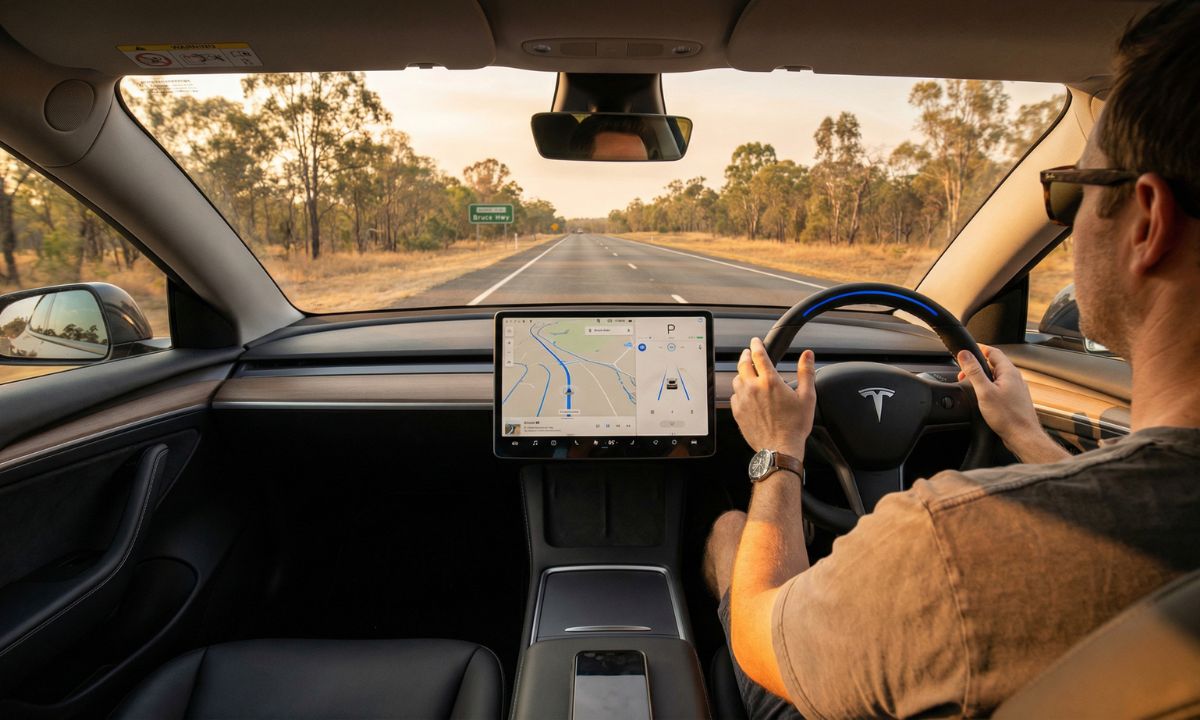
You're heading north on the Bruce Highway in your Tesla Model Y, with Full Self-Driving Supervised engaged. The car handles the curves, traffic thins, your phone buzzes with a message. You glance down, just for a moment.
Then: impact.
When the police arrive, their first question won't be about Tesla's software. It'll be about you. Were you paying attention? Were you properly supervising? Under Queensland law right now, that distinction matters less than you think. Because while your car might drive itself, the legal system has no idea what that means for liability, insurance or your future.
The ‘Supervised’ Illusion
Tesla's Full Self-Driving isn't autonomous. It's Level 2 automation under industry standards, requiring constant human oversight. The car steers, accelerates and brakes, but you're supposed to be ready to take control instantly.
Yet ‘supervised’ remains legally undefined in Queensland. Queensland Transport and Main Roads (TMR) states drivers must ‘monitor the driving task and environment and be aware of other road users’ and remain ‘attentive and free from fatigue, tiredness and distractions.’ That's it.
Compulsory Third Party (CTP) insurance and comprehensive policy are written for a world where humans make every steering decision, and Queensland law assumes exactly that. TMR classifies current vehicles, including Teslas with FSD, as Level 0-2 systems requiring full driver control.
Under the Transport Operations (Road Use Management) Act, it could be considered dangerous to check your phone while ‘supervising,’ with a maximum penalty of six months imprisonment for dangerous driving.
Queensland's Regulatory Blind Spot
While New South Wales runs supervised trials for Level 3+ vehicles, Queensland has exactly one research vehicle operating under special permit: the ZOE2 Level 4 platform, driven exclusively by expert operators.
The State-by-State Reality:
Queensland: Drivers must maintain control at all times. Trial permits exist for formal autonomous vehicle testing, but consumer FSD use exists in a regulatory grey zone.
New South Wales: Supervised trials allow Level 3+ testing under automotive technology permits.
Victoria and South Australia: Victoria states a special permit is needed during testing, while South Australia permits driverless trials under controlled conditions.
Chaos arises when you realise states retain control over road access, vehicle registration and human driver regulations, while the federal government handles vehicle type-approval. The National Transport Commission is developing an Automated Vehicle Safety Law (AVSL) to harmonise this mess, but that won't arrive until the end of 2026.
The Liability Maze
A crash happens. FSD was active. You were watching the road, hands hovering near the wheel. Who's responsible?
The Driver (You): Queensland law says you must maintain control. Even if you were watching the road, proving you could have prevented the crash becomes your burden.
Tesla: Product liability exists under federal consumer law, but Tesla's ‘beta’ disclaimers and supervised FSD warnings create legal shields. Claims against manufacturers face a six-year limitation period and require proving that a defect directly caused the crash. Tesla will argue the system worked as designed, and you simply weren't supervising properly.
The Software Engineers: Australian law doesn't clearly establish liability for code writers when automated systems fail. That's a federal gap the AVSL aims to address, eventually.
This creates a nightmare scenario. You're liable as the driver, but you weren't fully driving. You might have a product liability claim, but Tesla's disclaimers and your ‘supervision’ duty muddy the waters. Read our article on how to report an unsafe product in Queensland.
Insurance Policies Built for the Human Era
Your CTP and comprehensive insurance policies assume human drivers make human errors. While they cover your negligence, they don't contemplate sharing fault with artificial intelligence.
When FSD-involved crashes occur, insurers face questions such as:
- Was the driver properly supervising?
- Did the system malfunction?
- Who's primarily at fault?
Insurers will deny coverage, citing policy exclusions for ‘misuse’ of vehicle systems. Drivers fight back, arguing they followed manufacturer guidelines, and nobody wins except lawyers.
For Total and Permanent Disability (TPD) claims, the complexity multiplies. Proving permanent disability when insurers argue, “you were supervising, so you caused this,” becomes a burden. TPD insurance typically covers injuries preventing a return to work, but establishing liability first determines whether your claim succeeds or languishes in dispute.
Voices from the Frontline
Different stakeholders see this chaos differently:
The Queensland Regulator's Position: TMR's policy is clear: drivers must remain engaged, licensed, sober and attentive while operating vehicles with advanced driver assistance systems. No commercial Level 3+ vehicles operate on Queensland roads without special permits. The infrastructure for managing transitions between human and automated control doesn't exist.
The National Regulatory Perspective: The National Transport Commission acknowledges that we need federal law governing automated vehicles. The AVSL framework will move responsibility from individual drivers to ‘Automated Driving System Entities’ (manufacturers) for vehicles with engaged autonomous systems.
The Insurance Industry View: Shared fault models between human supervision and system operation are coming, but they'll hurt drivers short term through premium increases and coverage disputes. Assessors struggle with ‘supervised’ claims because there's no clear standard for adequate monitoring.
The Compensation Lawyer's Warning: The loopholes favor manufacturers. When crashes occur, victims face dual claims, one against the driver under traditional CTP frameworks and another against the manufacturer under product liability law. Both are harder to prove in supervised automation cases.
Three Futures by 2030
Automated vehicle policy could evolve in several directions. Here are three plausible scenarios based on current regulatory trajectories.
Scenario One: Supervised Stagnation (most likely)
- Queensland maintains the driver-liability model through the end of the decade.
- The AVSL framework stalls in federal-state negotiations.
- Consumer FSD use continues to grow, but legal clarity doesn't.
- Premiums increase 25 percent.
- Crash litigation explodes as drivers and manufacturers each argue the other was primarily responsible.
- TPD claims face systematic denials based on ‘supervision’ defences.
This is the path of least regulatory resistance. It requires no new infrastructure, no difficult liability shifts and no federal-state compromise. It also creates the most individual financial harm as drivers pay more for coverage that delivers less certainty.
What influences this outcome is funding shortfalls for automated vehicle infrastructure, state resistance to federal harmonisation and manufacturer lobbying for liability protection.
Scenario Two: Federal Harmony Breakthrough (second most likely)
- The AVSL framework launches on schedule in 2027, establishing clear definitions for ‘supervised’ versus ‘autonomous’ operation.
- Liability moves to manufacturers when systems are engaged within their operational design domains.
- Queensland adopts complementary state laws defining driver duties during supervision.
- Insurance policies evolve to reflect 50/50 shared fault models, stabilising premiums.
- Crash rates decline as standards clarify and manufacturers improve systems to avoid liability.
This requires federal-state cooperation and sustained industry engagement. The payoff will be safer roads, clearer rules and functional insurance markets.
What influences this outcome is federal funding tied to state compliance, public pressure following high-profile crashes and international regulatory precedents (particularly from European Union standards).
Scenario Three: Full Chaos Escalation (least likely)
- Border inconsistencies combine with FSD system failures to create a crisis.
- Multiple serious crashes involving interstate Tesla drivers expose the regulatory patchwork.
- Criminal prosecutions of drivers proliferate despite evidence of system malfunctions.
- TPD claim backlogs overwhelm insurers and courts.
- Public backlash leads to state-level FSD bans while federal law remains incomplete.
- Driver imprisonment for ‘failing to supervise’ autonomous systems becomes routine.
This is the worst-case scenario, driven by system failures and reactive policymaking. What influences this outcome is high-fatality crashes involving children or emergency responders, economic recession reducing regulatory budgets, manufacturer bankruptcy or withdrawal from the Australian market.
What You Can Do Right Now
Waiting for regulatory clarity is a luxury Queensland Tesla owners don't have. Here's how to protect yourself today.
Audit Your Insurance Coverage
- Contact your insurer directly with specific questions. “Does my policy cover accidents while Full Self-Driving Supervised is active?" Then get the answer in writing.
- Review your CTP and comprehensive policies for ADAS exclusions or limitations.
- Ask about available endorsements or add-ons specifically for semi-autonomous systems.
- Compare quotes from multiple insurers because coverage approaches vary significantly.
If insurers can't provide clear answers, document that uncertainty, as it becomes evidence if you later need to dispute a claim denial.
Document Every Drive
- Install a dashcam if you haven't already.
- Preserve footage showing you actively monitoring the road during FSD operation. This is critical evidence if liability disputes arise.
- Beyond video, maintain a log of FSD activation, traffic conditions and any unusual system behaviour.
Tesla vehicles store detailed operational data, but it can be overwritten. This data often determines fault in complex claims.
Understand Your Legal Position
- Know Queensland's requirements. You must hold the appropriate licence, remain sober, follow all road rules and monitor the driving environment continuously.
- ‘Supervision’ legally means active attention, not passive observation. Phone use, fatigue or visible distraction could support dangerous operation charges regardless of FSD status.
If a crash occurs, report it as both a traffic incident and a potential product issue. File CTP and product liability claims simultaneously. Don't assume you have no claim because the vehicle was in automated mode.
Engage with the Regulatory Process
- Queensland needs automated vehicle trials to develop infrastructure and policy. Support petitions for expanded testing programs. Comment on TMR consultations when they occur. The regulatory void persists partly because public pressure for clarity remains diffuse.
- Monitor the AVSL development through the National Transport Commission website.
Federal law will eventually govern manufacturer liability, but state laws will still determine driver duties. Both matter for your legal protection.
The Road You're Actually On
Your insurance company genuinely doesn't know what supervised self-driving means for coverage. Neither do magistrates, police prosecutors or claims assessors. That uncertainty costs you money in higher premiums and potentially in denied claims when incidents occur.
The federal government promises clarity by 2027. That's potentially two more years of legal ambiguity, during which every FSD-involved crash writes new precedents.
Document your FSD use meticulously, understand your supervision duties under Queensland law, audit your insurance coverage and get specific answers about ADAS claims. Preserve evidence immediately if anything goes wrong. Engage with the policy process, pushing for regulatory clarity.
The future of automated vehicles in Queensland depends partly on the choices regulators make. But your financial security depends on the choices you make today. The technology might drive itself, but the responsibility for protecting your interests is still entirely yours.