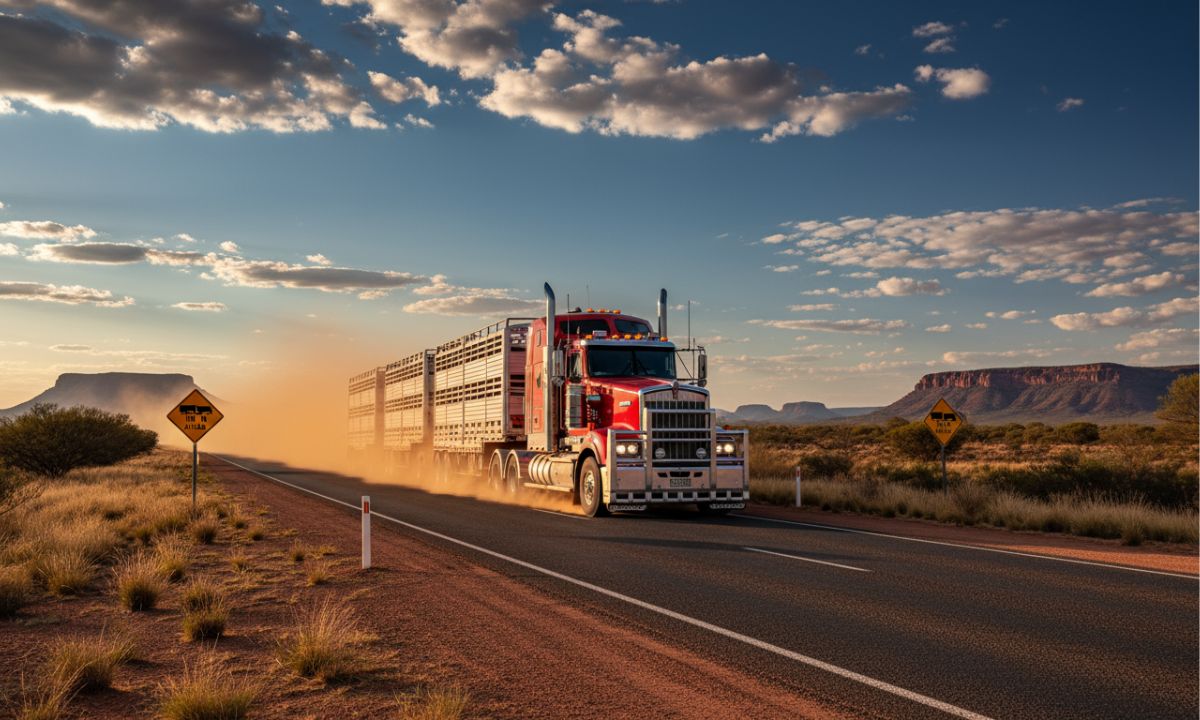
The Warrego Highway stretches out in front of you as you’re driving along. It’s quiet. You can sit back and listen to the radio. Suddenly, you spot something in your rear-view mirror. It’s a road train, a truck with three trailers, stretching back more than 50 metres. It thunders towards you at 100kph. Speed up? Pull over? Let it overtake you?
For thousands of Queenslanders and regional Australians, such scenarios are just part of their daily commute. For many, it’s a source of genuine anxiety every time one of these beasts merges onto a rural highway.
Road trains are the unsung workhorses of our economy, hauling everything from cattle to fuel across distances that would make European truck drivers weep. But as these Goliaths grow ever larger and heavier, a troubling question emerges: Are we asking too much of our roads, our drivers, and our fellow motorists?
The Backbone of the Outback: Why Road Trains Rule Australia
Let's be clear: without road trains, much of regional Australia would grind to a halt. These multi-trailer combinations, some stretching over 50 metres and weighing 124 tonnes when fully loaded, are the only practical way to move freight across vast distances when rail isn’t an option.
A road train is any truck towing two or more trailers, whereas a B-double, by comparison, is a more compact articulated truck with two trailers, maxing out at 26 metres. Both operate under strict regulations, known as the Heavy Vehicle National Law (HVNL), set out by the National Heavy Vehicle Regulator (NHVR).
Not every road is built to cope with vehicles of this size. Queensland’s Department of Transport and Main Roads (TMR), which oversees the state’s heavy-vehicle network, maintains approved route maps to balance freight efficiency with what the infrastructure can realistically support. It works up to a point, but as freight demand rises and vehicles get bigger, the cracks are beginning to show, both literally and figuratively.
The 'Size Creep' Phenomenon and Infrastructure Strain
‘Size creep’ may sound like an unusual way to describe it, but it’s an invaluable concept in how we assess the growing dangers of larger vehicles on our roads. What it refers to is how the size of heavy-goods vehicles is increasing over time, gradually and in direct correlation with demand and the ever-increasing economic pressures on companies.
Less than twenty years ago, the longest vehicles you’d see on the roads would be considered pokey by today’s standards. It goes without saying that the 50-metre, 124-tonne juggernauts now in use place far greater stress on roads and bridges; infrastructure that was never designed for anything of this scale.
After all, much of it was designed decades ago for much lighter loads. Bridges that seemed robust in the 1980s now groan under the weight of repeated crossings by vehicles carrying twice the weight engineers had calculated for.
Councils throughout Queensland, along with the TMR, maintain databases which detail load limits, and teams are regularly sent out to inspect rural crossings for signs of structural fatigue. Yet the funding available for upgrades hasn't kept up with the pace of freight growth. According to Australian road safety data, infrastructure constraints are increasingly recognised as a safety issue for heavy vehicles nationwide.
Drive through Central Queensland and you’ll see the warning signs everywhere: weight limits, slow-down zones and bridges closed for repairs. Every closure costs time and money. But the alternative, a bridge giving way under a loaded road train, is certainly something no one wants.
Overtaking Disasters: The Deadly Physics at Play
Unfortunately for us, physics doesn’t have a moral compass. It’s just there, acting constantly on everything. You might be a confident driver, or have been driving for 20 years, but the 124 tonnes of metal and goods that constitute a road train don’t care.
Road trains accelerate slowly, brake even more slowly, and need enormous stopping distances. These are not flaws in the design, but just facts of physics. Every year, crash statistics involving heavy vehicles tell the same heartbreaking story: misjudged overtaking manoeuvres, insufficient line of sight, and motorists who gambled on a gap that simply wasn't there.
The NHVR advise drivers never to overtake a road train unless they can see at least one kilometre of clear road ahead. Yet on single-lane highways with limited overtaking zones, drivers can become impatient, leading them to make split-second decisions that often have tragic consequences for them, passengers and other motorists.
Let’s look at an example: a family are driving along a highway and have been stuck behind a road train for 40 kilometres. The father, who is driving, gets impatient. He pulls out, accelerates, but midway through the overtake, he realises just how long 50 metres is. All too quickly, a vehicle is heading towards them. There’s nowhere to go.
Stories like this are all too frequent, as the statistics go to show: 1,361 road deaths in the past 12 months (October 2024-25), 6.9% higher than the same time the previous year.
Gaps in Driver Training and Fatigue Management
Operating a road train legally requires a Multi-Combination (MC) licence. You pass a test, demonstrate basic competency, and you're cleared to haul three trailers across some of the most challenging roads in the country.
Here's what's really concerning: although certain companies are beginning to introduce periodic training and invest in simulator access, there is no industry-wide requirement to do so. With no regulatory standard compelling ongoing competency checks, training quality risks becoming inconsistent and dependent on each company’s budget priorities. Compare this to Europe, where drivers must complete periodic training modules every five years, or face having their licence suspended.
Fatigue management regulations, established by the NHVR, set out maximum hours and minimum rest periods for heavy-goods drivers. Electronic work diaries help monitor compliance, and on paper, it all looks fairly robust. But in practice, people in the industry say the pressure to deliver quickly, run tighter schedules and push through fatigue still exists.
Learn how fatigue affects truck drivers in Australia.
What’s more, enforcing such rules is tough in remote areas for obvious reasons. A driver on a lonely stretch of the Flinders Highway at 2 PM, fighting to stay awake, is hardly going to be on the regulator’s radar.
Transport unions and safety advocates have long called for stricter oversight and better training standards. But economic pressures and a fragmented industry make it hard to enact lasting reforms.
Battling the Elements: Weather Risks You Can't Ignore
Queensland's weather is spectacular and savage in equal measure. Summer storms roll in with terrifying speed, bringing crosswinds that have the power to overturn a trailer in seconds. Dust storms reduce visibility to metres. Heatwaves transform highways into shimmering oases.
Road trains, with their length and height, are particularly vulnerable to what drivers call the ‘sail effect’. A sudden gust catches those long trailers side-on, and even experienced operators can find themselves wrestling for control, praying the whole thing doesn’t topple over.
The NHVR advises pulling over at the first safe opportunity when severe weather strikes. But safe opportunities on remote highways aren’t always readily available, as any motorist can attest to. And the economic cost of delays, the pressure from dispatch, the temptation to push on "just a bit further," all weigh heavy on the minds of drivers.
One veteran driver recounted being nearly blown off the Warrego Highway during a summer storm. "I've been driving 20 years," he said. "That day, I genuinely thought I was going to roll. The wind just took hold of those trailers like they were nothing."
Economic Squeeze: Safety vs. Profit?
They say that the answer to 99% of questions is money. It’s no different here. Research into heavy vehicle safety suggests economic factors play a significant role in risk-taking behaviour across the industry. Freight is a competitive, low-margin business. Operators face pressure to move goods faster, cheaper, and in greater quantities. That pressure filters down to drivers, mechanics, and the staff who have to arrange the schedules.
What are known as the Chain of Responsibility laws, expanded in 2018, aim to hold everyone accountable, from management to the very people loading the trailers. Overload your truck? Everyone in the supply chain can face penalties. Pressure a driver to exceed hours? That's a prosecutable offence. Sadly, in so many cases, breaches only come to light after an accident has already happened.
Are Australia's freight economics fundamentally at odds with road safety? It's an uncomfortable question, and one that doesn't have easy answers.
How Do Our Mega-Trucks Stack Up Globally?
Australia’s road trains are the largest and heaviest trucks legally operating on public roads anywhere in the world. Let’s put this into perspective.
In Europe, the maximum truck length is capped at 18.75 metres and weight at 40-44 tonnes. The United States allows a length of up to 25 metres and a weight of 36-40 tonnes, but with strict variation between states. Even New Zealand, with its own sprawling rural roads, limits most heavy vehicles to 23-25 metres and 44-50 tonnes.
You can easily see then how Australia's 53.5-metre, 124-tonne road trains dwarf international standards. Sure, it makes sense when you compare our unique geography and the need to haul goods and materials over vast areas, but it also means we're operating in largely uncharted territory when it comes to long-term safety and impacts on infrastructure.
Other countries are seeing the same push for bigger trucks, but most have taken a more careful path. They’ve tightened up infrastructure rules and lifted driver training standards, which have helped keep things in check and helped to offset any increases in vehicle size.
Tackling the Challenge: Best Practices and Emerging Solutions
The good news is that we’re not standing still. New technology is finally starting to make a real difference, especially in Queensland, where several upgrades are already in motion.
For starters, smart bridge-monitoring systems are being rolled out across key routes. These sensors keep an eye on structural stress in real time, giving engineers early warning signs and helping prevent the kinds of failures everyone fears. On the roads themselves, weigh-in-motion sensors are being installed on major freight corridors. Instead of relying on random checks or manual inspections, these systems pick up overweight vehicles automatically, without causing the traffic to back up.
Driver training is also getting a much-needed upgrade. Advanced simulators, which were once hard to find outside big cities, are now becoming part of mainstream training. They let drivers practise difficult scenarios, things like poor weather, emergency braking, trailer sway, without the real-world risk. Some operators are even trialling in-cab fatigue detection tech that uses eye-tracking and systems designed to alert drivers when concentration drops.
Also read: How Satellite Technology is About to Transform Queensland Road Safety Forever
The NHVR is pushing for broader use of Electronic Work Diaries, too. When they’re used properly, they make it much harder to hide regulation breaches. It’s just another simple way to use modern tech effectively.
Industry groups, including the Australian Trucking Association, continue to call for better roads, consistent training standards and firm but fair enforcement of Chain of Responsibility laws. Change won’t happen overnight, but the shift is underway and every small improvement adds up.
Building a Culture of Safety
Technology and stricter regulation can only achieve so much. At the heart of road safety is culture: how people think about their role as a road user and the care and consideration they hold for fellow motorists.
Research suggests that the best operators practice what safety experts call a ‘just culture’, where drivers feel safe reporting near-misses, fatigue, or equipment concerns without fear of punishment. Regular safety meetings, peer mentoring, and anonymous reporting channels help embed this mindset into everyday work practices.
In a report by the NHVR, most operators said they saw safety improvements and a drop in incidents after implementing Fatigue and Distraction Detection Technology (FDDT). One manager noted a “significantly improved year-on-year downward trend of accidents and breaches.”
Could this be the answer to building a culture of safety? Leadership that prioritises safety, despite investment in time and money in the short term? A top-down commitment to change? Only time will tell.
Where to Next? The Road Ahead for Truck Safety
Road trains aren't going anywhere. Nor should they, given their essential role in our economy. But the way things work currently, where vehicles keep growing in size and weight and infrastructure struggles to keep up, is unsustainable.
The path forward requires honest conversations and shared commitment. Infrastructure investment must match the growth in the size of vehicles. Training standards need to rise, with ongoing competency checks for all heavy vehicle drivers. Fatigue management must be enforced across the board.
This commitment is required by everyone involved. Motorists can support safer roads by understanding the limitations of road trains and backing investment in local infrastructure. Policymakers can come up with and advocate for ways to maximise freight efficiency with substantive safety reforms. Operators and drivers, meanwhile, must uphold high standards even under economic pressure.
Australia's mega-trucks will keep rolling. The question is whether we're prepared to invest in the roads, the training, and the culture needed to keep everyone safe while they do.