On 1 July 2026, Queensland's new e-mobility laws took effect, and police launched a statewide blitz the same morning. But what became clear was that most of the machines causing public alarm were already illegal, which has caused genuine disagreement.
Did these reforms hand police the tools to remove the devices actually killing people, or do most of the new rules land on riders who were already following them?
A blitz, and the powers behind it
The Queensland Police Service opened Operation Yankee Surety, a statewide enforcement operation, on the day the laws commenced. It means officers can now do two things they could not do the week before:
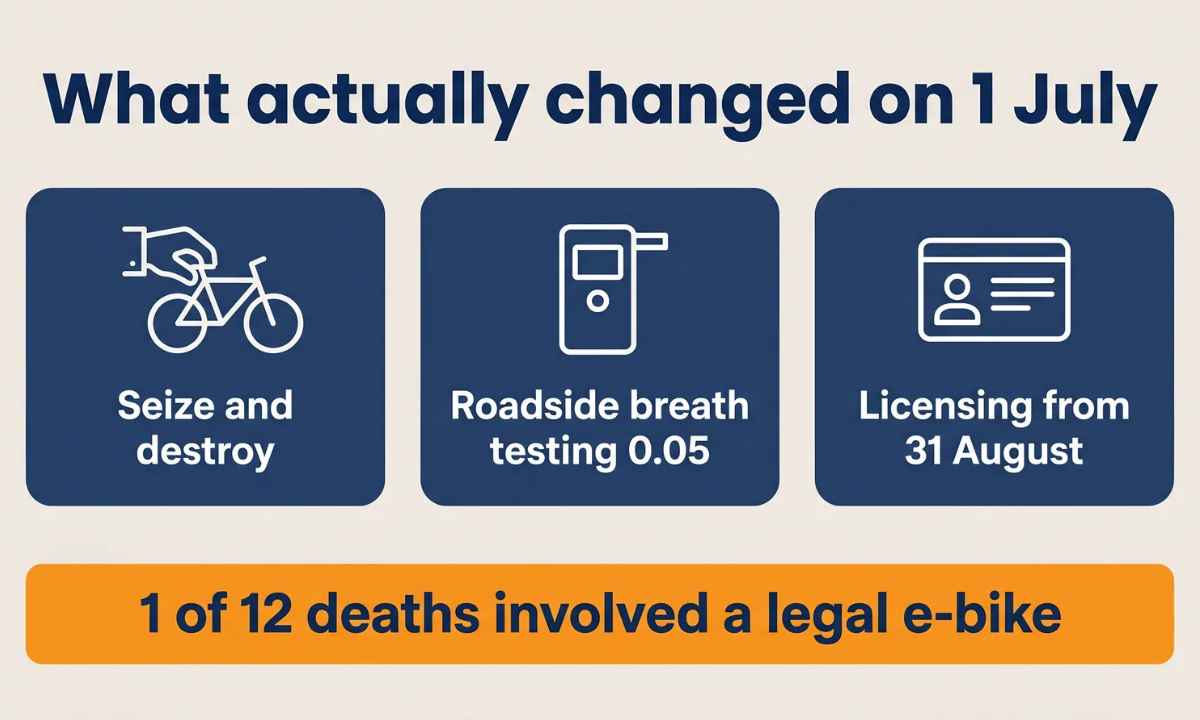
- They can seize an illegal device and, if it goes unclaimed inside a 30-day window, destroy it.
- They can also breath-test riders, with a 0.05 blood alcohol limit now applying to e-mobility users in public places, according to the Queensland Government.
Those two powers are the sharp new edge of the reform, with both targeting behaviour and machines that were already against the law. Neither one, on its own, changes what counts as a legal e-bike.
What was already illegal
A legal e-bike in Queensland has always been narrowly defined. The Queensland Government states that:
- It must run a motor with a maximum continuous rated output of 250 watts
- It is pedal-assisted, and the motor stops helping once the bike reaches 25km/h
- It carries an EN 15194 compliance label
- A throttle is only permitted up to 6km/h, as a walk-assist.
The high-powered machines dressed up as bicycles never met that test. A device that keeps driving past 25km/h without pedalling, or that runs a motor well beyond 250 watts, was not a legal e-bike before 1 July and could not be ridden on any Queensland path or road.
The 1 July changes did not make those devices illegal. They were already illegal. What changed is that police can now take them off the street and destroy them.
Read our article on: Understanding The Legal Definition Of E-Bikes: When Are They Considered Motor Vehicles?
The evidence both sides are reading
The Queensland Government reports 12 e-mobility deaths in Queensland in 2025, with a further four since the start of 2026, in the statement announcing the reforms. More than 6,000 e-scooter injuries were treated at emergency departments across 36 Queensland hospitals between 2022 and 2025.
Of the twelve deaths in 2025, only one involved a legal e-bike, as noted in the government's earlier announcement. The other eleven did not.
Read one way, that number is the argument for the crackdown. Read another way, it is the argument against much of the rest of the reform. Both readings are defensible, which is exactly why this is a debate and not a settled question.
The case for the crackdown
Start with the strongest version of the government's position. People are dying and being seriously hurt on these devices, and until 1 July, police lacked a clean way to remove the worst of them.
An officer who found an illegal high-powered device could issue a penalty, but the machine went home with its rider and back onto the road the next day. Seize-and-destroy puts a stop to this. If eleven of twelve deaths involved illegal devices, a power that physically removes them is aimed squarely at where the harm sits.
Random breath testing follows the same logic. Alcohol and a footpath full of pedestrians is a known danger on any wheeled device, and Queensland already accepts that principle for cars and bicycles. Extending it to e-mobility is not a radical leap.
On this account, the reform is enforcement catching up with a law that already existed. The dangerous machines were always banned, but now more is being done to ensure they stay off public footpaths.
The case for the compliant rider
Now the strongest version of the other side. If the deaths cluster around illegal devices, why does so much of the reform fall on people riding lawful ones?
Two elements draw most of the concern. From 31 August 2026, riders will need at least a learner licence, with a supervised pathway for 12 to 17-year-olds and a medical and disability exemption. And on footpaths, a 12km/h limit applies near pedestrians, under Queensland's personal mobility device rules, a speed that has been in force since late 2022 rather than something introduced this year.
Cycling advocates argue the licensing requirement is the wrong tool for the job. A compliant 250-watt pedal-assist e-bike is, mechanically, a bicycle, and Queensland does not licence bicycle riders. Groups including Bicycle Queensland have made the point that requiring a driver's licence to ride what is functionally a pushbike treats a compliant rider like a motorist.
Motoring body RACQ has pushed a related argument: the effective way to reduce harm is protected infrastructure and going after the illegal devices at the point of sale, not measures that risk pushing lawful riders off paths and into traffic with cars. There is a real safety tension here. A rule that slows riders near pedestrians can, for someone trying to keep pace, make the road look like the easier option.
The government did move on part of this. The 12 to 17 supervised pathway and the medical and disability exemption were added after public backlash, and licensing was pushed back to 31 August rather than starting with everything else on 1 July. That concession is itself evidence that the licensing question was genuinely contested, not obvious.
Where this leaves an injured rider
In Queensland, how your e-device is classified can shape what happens if you are hurt.
An e-bike that meets the 250-watt limit is treated as a bicycle, not a motor vehicle. That distinction matters because the compulsory third-party scheme under the Motor Accident Insurance Act 1994 (Qld) attaches to motor vehicles. A rider who comes off a legal e-bike in a solo fall is generally not covered by CTP because that scheme is built around motor vehicle accidents.
If a rider is struck by an at-fault motor vehicle, the position changes. They may be able to claim under that vehicle's CTP policy, the same avenue open to any injured cyclist or pedestrian in Queensland.
An illegal, overpowered device complicates all of this. A machine that falls outside the legal e-bike definition may be treated differently for registration, insurance, and any claim. It means riding one can affect a person's legal position after a crash. As a matter of how the law operates, the classification of the device is not a technicality. It can decide which door, if any, is open.
A grounded take
The honest answer is that both sides are partly right, and the reform does two different jobs at once.
The seize-and-destroy power and roadside breath testing are aimed at the real problem the data describes. Eleven of twelve deaths last year involved devices that were never legal, and giving police a way to remove them is a proportionate response to that evidence.
The licensing and speed elements are a harder sell. They ask the compliant majority to carry rules designed for a dangerous minority, and the government's own late concessions suggest it knew that.
Whether that trade is worth it will depend on something the law does not settle: do police use the new powers to clear the genuinely dangerous machines or simply to book the riders who are easiest to find? For anyone who rides one of these things or shares a footpath with someone who does, that is the question worth watching over the next few months.