A five-star safety rating looks like a clean promise. One badge, one number, one decision made easy.
But it isn't one number. It's four separate scores blended into a single star, and the one that covers everybody outside the car is the score most buyers never read.
The rating that helps sell a car measures how well it protects the people inside it. That is not the same as how much harm it does to the people it hits.
On current Australian roads, those two things are pulling apart. The vehicles selling fastest are the ones researchers link to the worst outcomes for pedestrians and people on bikes.
And the worst part? The star on the windscreen may not even be current anymore.
Deaths among people outside cars are climbing. The Bureau of Infrastructure and Transport Research Economics recorded 167 pedestrian deaths across Australia in 2024, up from 156 in 2023 and the highest count in more than a decade, while cyclist deaths rose from 34 to 38 over the same period.
In Queensland, the state recorded 303 road fatalities in 2024, 9.4% above the previous year.
What an ANCAP star rating actually measures
An ANCAP star rating is not a single safety score. Under the protocol used from 2019 to 2025, it combined four separate assessments: adult occupant protection, child occupant protection, vulnerable road user protection, and safety assist.
Vulnerable road user protection is the one that covers people outside the vehicle. It tests what happens to a pedestrian, cyclist or motorcyclist in a collision and whether the car's automatic braking detects them in time.
A car can carry five stars and still score modestly on that fourth measure, as the star is an overall result. From 2026, ANCAP is replacing the four pillars with four new stages of safety, however, every car already on the road keeps the rating it was given.
Why big utes and SUVs do more harm to people outside the car
The size and shape of the front of a vehicle changes how badly it hurts the person it strikes. Research from the Insurance Institute for Highway Safety, which analysed 17,897 pedestrian crashes in 2023, found vehicles with a bonnet higher than roughly one metre were 45% more likely to kill a pedestrian than lower cars with a sloped front.
A tall, blunt front tends to strike an adult higher up, around the chest and hips rather than the legs. That makes it more likely to push the person down and under the vehicle rather than up onto the bonnet.
Recent figures highlight the importance of this. Milad Haghani, an associate professor at the University of Melbourne, points out that four in five new vehicles sold in Australia are now SUVs or utes, more than double the share of 20 years ago.
People struck by an SUV are around 40 to 45% more likely to die than those hit by a smaller car, with children up to eight times more likely, according to the same analysis.
Geometry is a tendency, not a verdict on any one model. Australia's best-selling vehicle, the Ford Ranger, scored 74% for vulnerable road user protection in its 2022 ANCAP test, and the Toyota HiLux scored 82% in 2019. A large vehicle can be built to reduce the harm it does outside, but the market trend and the physics both run the wrong way.
Do ANCAP safety ratings expire?
Yes, in a specific sense. The rating attached to a car you already own never expires. What lapses is a manufacturer's right to promote that rating on newly built cars, six years after it was awarded.
From 1 January 2026, the ratings on a long list of popular models tested in 2019 lapse for newly built units, including the Toyota RAV4, Toyota HiLux, Mazda 3, Mazda CX-30 and Kia Seltos.
Those cars are not suddenly unsafe. The point is that a 2019 five-star result was measured against 2019 expectations and the bar has moved since.
The used-car gap most buyers miss
The Monash University Accident Research Centre, which built its 2024 Used Car Safety Ratings from more than nine million crashes, found the risk of death or serious injury for a driver in a 2022 model was 36% lower than in a 2002 model.
Electronic stability control, now taken for granted, was only mandated on all new passenger cars from November 2011. A cheap older car can carry real hidden risk that no forecourt sticker mentions.
Newer does not automatically mean safer, either. The MG5 built between March 2023 and September 2024 holds a zero-star ANCAP rating, though ANCAP's retest of units built from November 2024 returned three stars. Those earlier zero-star cars are now circulating on the used market.
Here is how a handful of common models compare on their published ANCAP results:
All results above are published by ANCAP. The Mahindra Scorpio, currently sold as a new model, received a zero-star rating in 2024 after being tested without autonomous emergency braking, lane support, or blind-spot monitoring.
What a Queensland buyer can actually check
There are a few checks you can do before signing anything.
Look past the star to the four scores. ANCAP publishes the full breakdown for every rated model on its site, including the vulnerable road user figure that covers people outside the car.
Check the build date the rating applies to. Ratings are tied to specific build periods, so a model name on its own does not tell you which result you are reading.
For a used car, check the Used Car Safety Ratings. MUARC rates 534 models on how well they protect the driver and other road users, along with crashing in the first place.
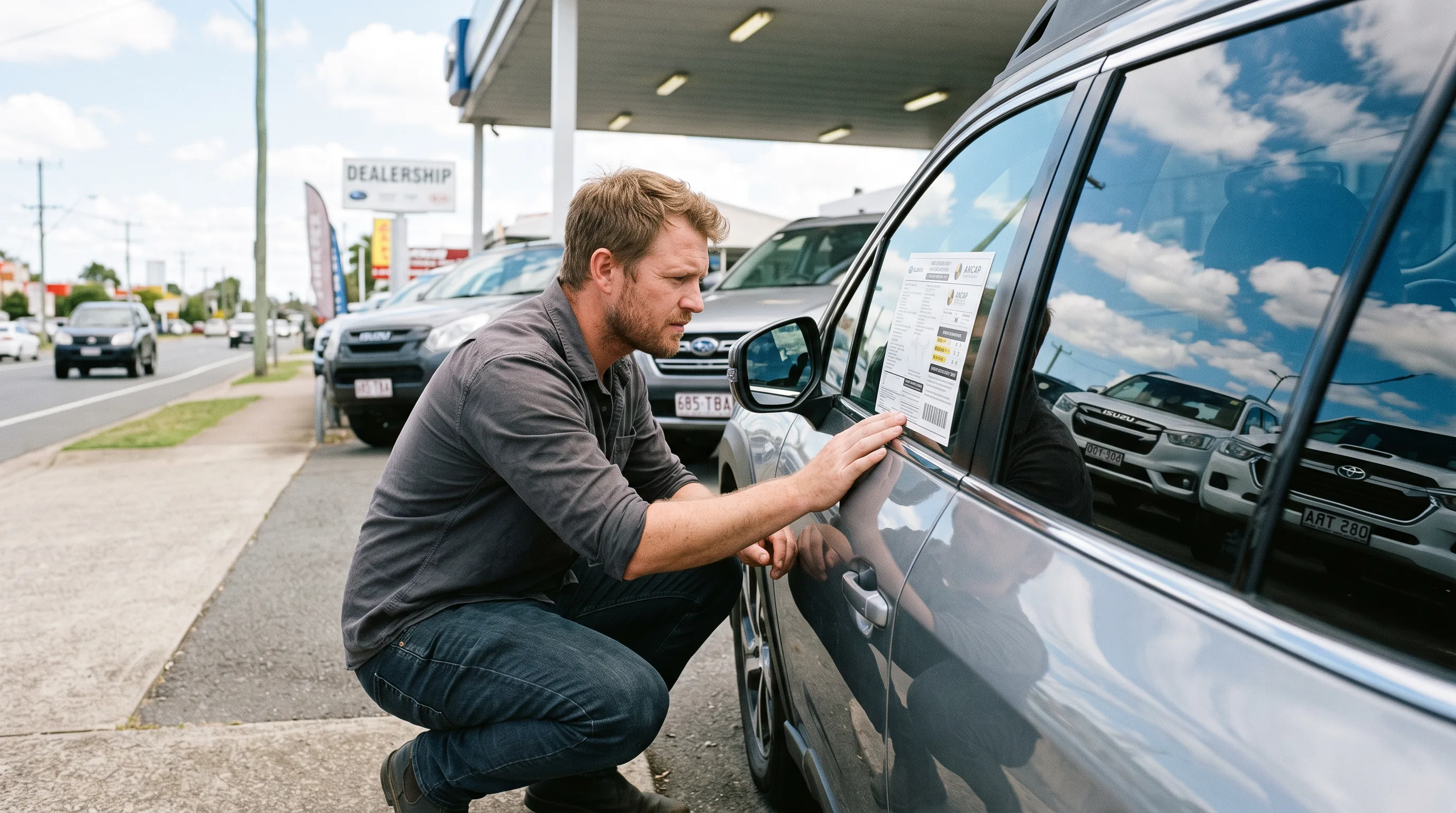
Weigh the shape, not just the badge. A higher, blunter front tends to do more damage to anyone in front of it, whatever the overall rating says.
A safety rating answers one question well: how likely you are to walk away from a crash. But it also contains the answer to a second question, hidden in a score that most people overlook. And it barely touches on a third: what happens to the person in front of it?
On Queensland roads, the person who carries the cost of that third answer is rarely the person who chose the car. It is the pedestrian at the crossing, the child on the footpath, or the rider in the bike lane.
The star tells you how protected you are. How much of that protection stops at the edge of your own bonnet is the part no badge advertises.