The lump sum from a TPD (Total and Permanent Disability) claim only becomes payable once the insurer admits the claim and your super fund's trustee is satisfied you meet a condition of release. This means you won’t be paid out anything while the claim is being assessed.
Any money you get during this period comes from other places, and one of them may already be sitting in the same super account.
Understanding where the money can come from
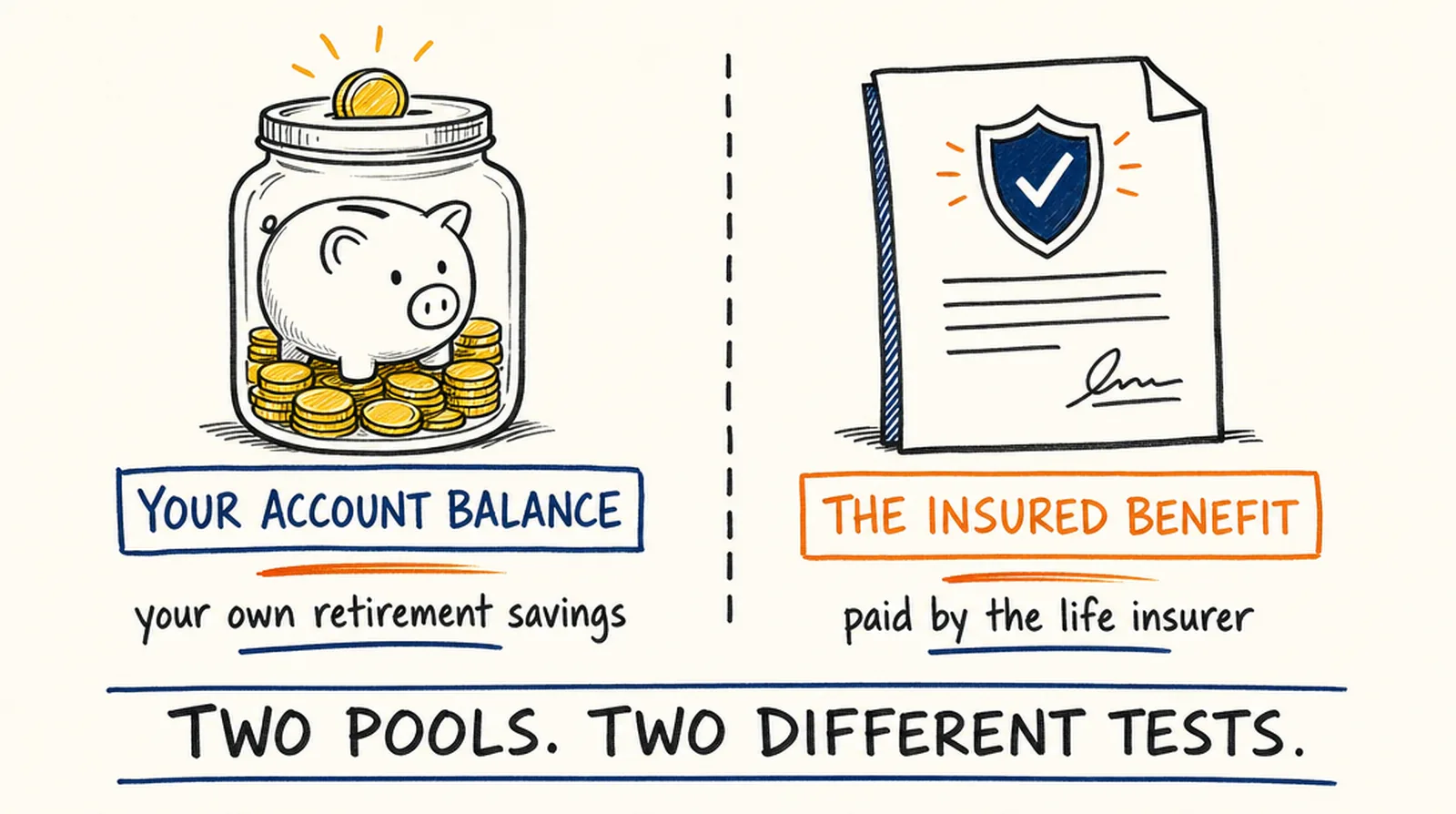
There are two separate pools of money involved in this process, and confusing them causes most of the issues.
Your account balance is your own retirement savings, and the insured benefit is paid by a life insurer under a group policy held by your fund's trustee.
This is why a TPD payment takes two decisions, not one. The insurer decides whether you meet the policy's disability definition, and your trustee must then be satisfied that you meet a condition of release, which is the legal test that allows super to be paid out. For a TPD payment, this is usually permanent incapacity.
Under regulation 1.03C of the Superannuation Industry (Supervision) Regulations 1994 (Cth), that means that a trustee of the fund must be reasonably satisfied that your ill health has made it unlikely you will be able to engage in gainful employment for which you are reasonably qualified by education, training or experience.
The trustee makes this decision, not the insurer, and it’s important to note that an insurer accepting a claim is not the same as the money being released. All of this is Commonwealth law or a national code, so it works the same way across Australia.
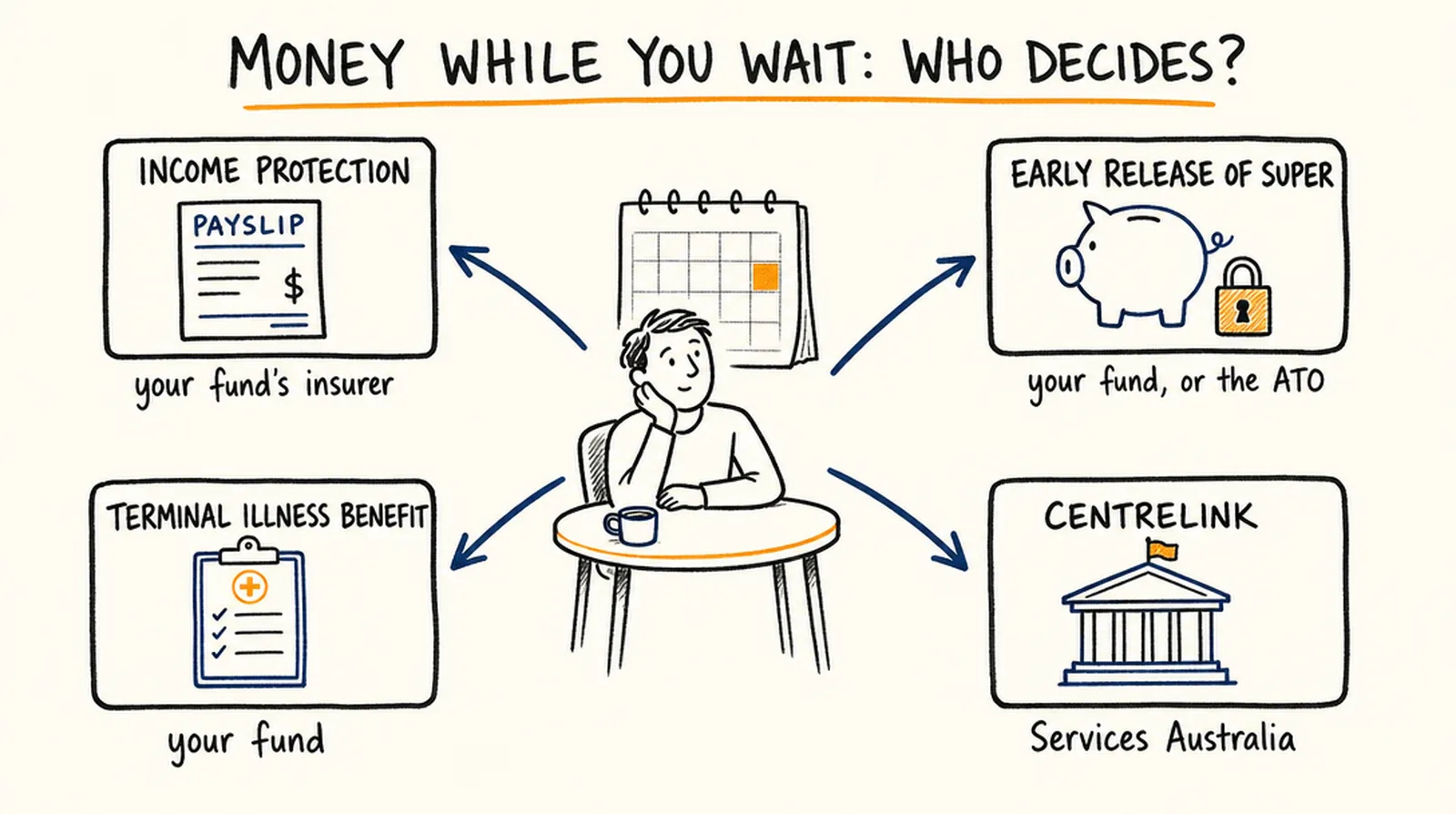
Compare your options by who decides and whether you repay it
The useful question is not which option pays out the most, but who decides if you get it and whether the money has to be repaid.
Only one of these six options is repayable, and each is explained below.
Income protection cover you may already have
Income protection, also called salary continuance, pays you a regular income for a set period in the event an illness or injury prevents you from working.
Many claimants have it without realising because it can sit in the same super account as their TPD cover. Check this before anything else in this article.
According to ASIC's MoneySmart, most super funds automatically provide life and TPD cover for members aged 25 or over, and some automatically provide income protection too. Your latest statement or your fund's insurance guide will tell you which you hold.
This is separate cover responding to a different thing, so claiming on one isn’t also a claim on the other. Whether receiving one changes the amount of the other depends on your policy’s specific wording, and our guide on claiming both TPD and income protection goes into detail on how the two interact.
What it pays, and for how long
MoneySmart says that income protection usually replaces a percentage of your pre-tax income, for example 75% or 90%, based on your earnings in the 12 months before the illness or injury.
Two things decide whether it helps you now:
- Waiting period. How long you wait before payments commence. MoneySmart says that most policies use between 14 days and two years.
- Benefit period. How long payments continue. MoneySmart says most policies pay for two or five years, or up to a set age.
How it is paid and taxed
This is a temporary incapacity benefit inside the super.
Regulation 6.01(2) of the Superannuation Industry (Supervision) Regulations 1994 (Cth) defines temporary incapacity as ill health, either physical or mental, that caused you to stop being gainfully employed without amounting to permanent incapacity.
It is required to be paid as a non-commutable income stream for the whole or part of the income you were earning before, for no longer than the incapacity lasts.
There are two consequences that follow on from this: this benefit arrives as regular income and cannot be taken as a lump sum, and it generally comes only from insured benefits or voluntary employer contributions, so meeting the temporary incapacity test doesn’t unlock your account balance.
When it comes to tax, be careful of what you may read elsewhere.
Under section 307-10(a) of the Income Tax Assessment Act 1997 (Cth), any amount payable under an income stream because of a temporary inability to work is not a superannuation benefit at all. It is considered ordinary assessable income taxed at your marginal rates, at any age, and you must declare it in your tax return.
Concessional superannuation rates do not apply to it, and there is no tax-free treatment at 60.
Early release of your own super
If you don’t have any income protection cover, the next question to consider is whether some of your own super can be released early.
There are two grounds for this and they’re decided by different people: severe financial hardship, which is decided by your fund, and compassionate grounds, which must be approved by the ATO first.
Neither is repayable, and both permanently reduce what you retire on.
Severe financial hardship
There are two tests, both in regulation 6.01(5) of the SIS Regulations, and they are alternatives rather than stages. Under the first test, your fund must be satisfied (based on written evidence from a Commonwealth department or agency) that:
- You have received Commonwealth income support payments for a continuous period of 26 weeks and were still receiving them at the date of that evidence.
- You cannot meet reasonable and immediate family living expenses.
If you fulfil these conditions, the fund may release a single gross lump sum of at least $1,000 and no more than $10,000 once in any 12-month period. Your evidence letter must be no more than 21 days old when you apply, which is where people most often come unstuck.
The second test is available once you have reached your preservation age plus 39 weeks. It requires a total of 39 weeks of Commonwealth income support after reaching preservation age.
You must also not have been gainfully employed on a full-time or part-time basis on the day you applied. As per regulation 1.03, part-time means at least 10 hours a week, so working for anything over that amount will result in you failing this test.
If you meet it, there is no cap on the amount, and no once-a-year limit.
The 26-week requirement is the one that catches most claimants out. Someone who stopped working because of illness or injury but never went onto a Centrelink payment does not meet it, however tight things may be.
Apply to your fund directly, and keep in mind that the ATO doesn’t process these requests. Services Australia's only role is supplying the income support evidence letter.
Compassionate grounds
You apply to the ATO for this, not your fund. If the ATO approves, it will write to you and your fund, and the fund then pays a single lump sum, withholding the tax.
Eligible expenses include medical treatment, medical transport, modifying your home or vehicle for a severe disability, palliative care, death, funeral or burial expenses for a dependant, and preventing foreclosure or forced sale of your home.
The ATO is explicit about the fact that compassionate grounds do not cover general day-to-day expenses. That is what the hardship route is for.
Expenses must generally still be unpaid, or have been paid with borrowed money you still owe. In addition, five conditions all have to be met, including that you have exhausted every other option. The amount paid out is limited to what is reasonably required.
Money released on either ground is taxed as an ordinary superannuation lump sum, so you will receive less than the amount released.
If your condition is terminal
There is a separate condition of release for a terminal medical condition, and a lump sum paid while the certification period is current is tax free.
Under regulation 6.01A of the SIS Regulations, all of the following must apply for this:
- Two registered medical practitioners have certified, jointly or separately, that you are suffering from an illness or have incurred an injury that is likely to result in your death within the certification period, which ends not more than 24 months after the date of the certification.
- At least one of them is a specialist practising in an area related to that illness or injury.
- The certification period has not ended.
That last condition is often left out, and it is very important because money withdrawn after the certification period expires may be liable for taxation.
Fresh certification starts a new period. There is no set limit on the amount, subject to your fund's rules. Your policy may also include a separate terminal illness insurance benefit, and our guide on terminal illness benefits and TPD explains how the two compare.
Centrelink payments while you wait
Centrelink is the most realistic source of income for a lot of claimants during assessment, and often the first step rather than the last. This is because hardship release depends on 26 continuous weeks of income support.
Two payments are relevant, and both allow an advance.
Disability Support Pension
Services Australia assesses Disability Support Pension (DSP) under two sets of medical rules, and you need to meet one, as well as the non-medical rules on age, residence, income and assets.
The manifest medical rules are a short list of severe conditions, including permanent blindness, needing nursing home level care and a terminal illness with average life expectancy of less than two years.
Otherwise the general medical rules apply, and all of these must be met. They are: your condition is likely to persist for more than two years; it is diagnosed, reasonably treated and stabilised; you have an impairment rating of 20 points or more; you meet Program of Support rules where they apply; and your condition will stop you working at least 15 hours a week in the next two years.
One point that is often missed is that Program of Support is not required if you score 20 points or more on a single Impairment Table. It is required where your 20 points are spread across more than one Table.
JobSeeker Payment while a DSP claim is assessed
JobSeeker Payments are available if you are between 22 and Age Pension age and meet the residence, income and assets rules.
If you are too unwell to work, you will need to give Services Australia a Centrelink Medical Certificate from a medical doctor, and will be assessed for a temporary incapacity exemption from your mutual obligation requirements.
There are two practical points here: handing in the certificate does not by itself grant the exemption, and you must keep meeting your requirements until it is assessed.
If you claim DSP online, you can claim JobSeeker as part of the same claim, which is usually the sensible option for someone with no income.
Advance payments
Both DSP and JobSeeker allow for an advance payment, which is part of your own future payments brought forward and repaid out of your next 13 payments.
You need to have been on the payment for at least three months first. For DSP, you can take one advance at the highest amount in any six months, up to two smaller ones, or three at the lowest.
On JobSeeker Payment, you cannot take another if you have had one in the past 12 months.
Currently, a single person on DSP can take between $570.10 and $1,710.30, and a couple between $429.75 and $1,289.25.
For JobSeeker Payments, the advance is between $250 and $500. DSP amounts move with pension rates each March and September, so check the current figures before you rely on them.
Does taking money out of super affect your Centrelink payments?
Services Australia's position on superannuation is worth reading closely.
While you are under Age Pension age, your super is not counted in the income and assets tests if the fund is not paying you a superannuation pension.
Taking money out of a super does not itself affect your payments, but what you do with the money might. Services Australia counts it if you put it in the bank or buy an income stream with it, so a hardship release that ends up in your account becomes an assessable asset.
Tell Services Australia about it, and see our guide on how a TPD payout affects Centrelink payments.
If your claim is taking too long
A delayed claim is its own problem, and there are published timeframes to hold the insurer to.
The Life Insurance Code of Practice, March 2025 version, is owned by the Council of Australian Life Insurers and monitored by the Life Code Compliance Committee. It binds life insurers that subscribe to it, not your fund's trustee, and it is not legislation.
Its commitments are still in writing and you can quote them.
- Two months for an income protection claim, six months for a lump sum claim such as TPD. Within that time, the insurer will gather all the information it reasonably needs, complete all reasonable enquiries and then make a decision.
- Fifteen business days to tell you the decision in writing once it has all the information it reasonably needs. That sits inside the six months rather than being added to it.
- Updates at least every 20 business days in cases where circumstances beyond the insurer's control mean it cannot meet the timeframe. It must also tell you in writing what those circumstances are before the deadline passes.
An important thing to keep in mind before you conclude your claim is overdue is that the clock starts on the insurer's claim received date, which is when the insurer records receiving the first piece of information that lets it begin its assessment.
Time the claim spent with your fund's trustee before that point expires.
The Code also requires insurers to assess a request for urgent access to benefits where you tell it, or it identifies, that you urgently need them because of a condition covered by your policy.
It may ask for evidence, and it must inform you of what help it can provide within five business days of receiving that evidence. It can prioritise your claim assessment and decision, which moves the decision forward, but as the Code itself notes for group policies, the law still limits when superannuation benefits can be released.
Complain, then go to AFCA
You can make a complaint about how your claim is being handled, including delays, and you don’t have to wait for a decision in order to do so.
Under ASIC's Regulatory Guide 271, you may lodge a complaint about insurance in superannuation with either the insurer or the trustee, and time starts running from the date it is first lodged with either of them.
The trustee has 45 calendar days in which to respond to you, which is not a deadline for you to be able to make a complaint.
The Regulatory Guide sets 45 calendar days as the maximum for a superannuation trustee to give its response, and there’s nothing in it which requires a member to complain within any period.
If that doesn’t lead to a resolution, or you don’t receive a response, you can take the complaint to the Australian Financial Complaints Authority.
The AFCA’s time limits are often longer than reported. If you permanently stopped working because of the condition you are claiming for, and the claim reached the fund or insurer within two years of you stopping work, the complaint must reach the AFCA within four years of the financial firm's decision.
If you did not permanently stop working because of that condition, the limit is six years from the decision. AFCA will not extend these limits.
Bills, loans and free help with the budget
The other half of the problem is the outgoings, and there is more flexibility here than most people expect. Smith's Lawyers is not a licensed financial adviser and cannot tell you whether to release your super early, so seek advice for that decision from someone who can.
There are three things worth doing in the first week.
- Ask your lender for hardship assistance. ASIC's MoneySmart says that when you ask for help, your lender must consider you for hardship assistance and give reasons if it refuses. A hardship arrangement does not affect your credit score, and the listing on your credit report is deleted after 12 months.
- Contact your utility providers. If you cannot pay an electricity, gas, phone or water bill, MoneySmart's guidance is to contact the provider straight away and ask about an extension, instalment plan or Centrepay deductions.
- Talk to a financial counsellor before you touch your super. It is free, confidential and you never need to pay for it. Call the National Debt Helpline on 1800 007 007, Monday to Friday, or Mob Strong Debt Help on 1800 808 488.
When to get legal advice
You can pursue most of the options above yourself, but a stalled or disputed claim is different because TPD claims are decided based on how closely your medical and work history matches the exact words of a policy definition, and insurers assess these claims with their own medical and legal teams.
It’s always a good idea to seek legal advice for TPD claims, especially if:
- Your claim has passed the Code timeframe with no clear explanation of why.
- You have been asked to sign a document you do not fully understand, at any stage of proceedings.
- The insurer or fund has asked you to attend more than one independent medical examination.
- You hold cover across several super funds and cannot work out which policy is relevant.
- Your claim has been declined (see common reasons for TPD claim denials) or you are being told something about a deadline that does not match what you have read here.
A lawyer can put the claim in the form the assessors need, chase medical evidence and press for a decision when one is overdue.
Key takeaways
Remember these essential points:
- The insured TPD benefit is payable only once the insurer admits the claim and the trustee is satisfied a condition of release has been met.
- Check your super statement for income protection or salary continuance cover. It pays as regular income while you are off work, and it is taxed as income at any age.
- Severe financial hardship release turns on 26 continuous weeks of Commonwealth income support, so a Centrelink claim usually has to come first.
- The ATO decides compassionate release, and your fund decides hardship release; different people and different tests with different evidence.
- Only a Centrelink advance payment is repayable. Early release of your own super is not repaid, but it permanently reduces your retirement savings, so speak to a free financial counsellor first.
Get Help Now
If your TPD claim has stalled or you are unsure what you can access while you wait, Smith's Lawyers can review your cover and the way your claim is being handled.
Call 1800 960 482 and a member of our team will talk through your situation and what happens next. You can also use the form below to request a free case review.
Smith's Lawyers acts for TPD claimants Australia-wide on a No Win, No Fee, No Catch® basis.