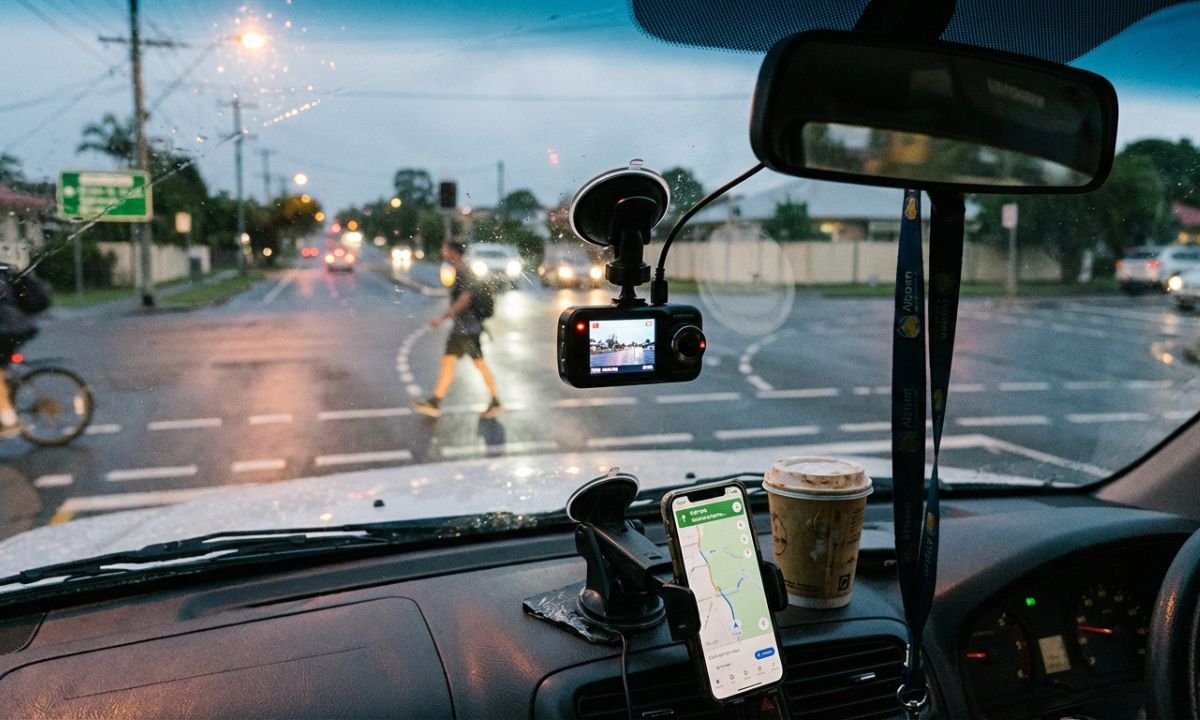
More and more Australians are recording their journeys, with a recent survey suggesting that roughly one in four Australians now use dash cams. Helmet cams have also become standard for serious cyclists, while body cams are increasingly worn by delivery riders navigating through heavy city traffic.
The logic seems sound at first glance: if something happens on the road while you’re driving, the camera sees everything and can help back you up in case of dispute.
But does it really?
In truth, things are a lot more complicated than "the footage speaks for itself." And understanding what cameras actually capture, as well as what they’re likely to miss, might change the way you think about that little lens on your windshield.
This article is a deep dive into the facts and myths surrounding dashcams, helmet cams and body cams, as well as how you can use them to your advantage to keep you safe on and off the road.
The Boom Nobody Predicted
It wasn’t too long ago that dash cams were mostly thought of as a Russian internet phenomenon, with grainy clips of meteorites and near-misses going viral on YouTube. In Australia and the rest of the world, they were just a niche product used by a few drivers and cyclists.
Fast forward to 2026, and the market has now completely exploded. Consumer research shows that dash cam ownership has grown massively since 2018, so much so that some insurers now offer modest premium discounts of around 4% on average when a dash cam is installed, with Queensland drivers using them saving the most.
The scorching Queensland summers have actually had a hand in shaping the evolution of the hardware itself, as budget dash cams that rely on lithium batteries tend to die when cars are parked in direct sun. Most Australian retailers now push supercapacitor models that can handle extreme heat without melting down as a result.
But it’s not enough to simply own and use a dash cam, you must also know what that camera actually proves in order for it to be used as admissible evidence in case of a dispute after a car accident.
What Footage Gets Right
Let's kick things off with the good news: camera footage is genuinely useful in several specific situations, and invaluable in certain others.
Establishing sequence. If two drivers have a disagreement about who moved first at an intersection, time-stamped footage from a dash cam can be used to settle it. Cameras are very good for recording when things happened relative to each other, such as brake lights coming on, indicators flashing or a vehicle entering a lane.
Capturing speed cues. While the majority of standard dash cams don't measure speed directly, the rate at which an object passes through the frame gives forensic analysts something to analyse. GPS-enabled cameras go a step further by logging your own speed as metadata baked into the file, which is very important.
Recording conditions. Rain, fog, sun glare and slippery road surfaces, a dash cam can capture the driving environment as it actually was at the time of an incident, not just as someone remembers it three months after the fact. Memory is often unreliable, but dash cam footage, in that narrow sense, is anything but.
Identifying vehicles. If you’re in a car crash but the perpetrator drives off without stopping, a forward-facing camera might be able to capture enough detail to identify them. Number plates and vehicle colour, make and model are all great for this. Rear-facing cameras double your chances of finding a hit and run driver.
Also read: How Dash Cams Are Changing the Way We Drive: Are They Making Roads Safer?
What Footage Gets Wrong (Or Misses Entirely)
This is where things start to get interesting.
Field of view is not the same as field of reality. The majority of dash cams only record between 120 and 170 degrees. That might sound wide, but it means that anything which happens directly beside or behind your vehicle is invisible to the camera. If a motorcycle filters up your left side, a pedestrian steps off the curb to your right or another car is in your blind spot outside the lens angle, it won't be visible on the recording.
Helmet cams are even more limited, as they only capture wherever the rider's head is pointing at the time, which might not be where the action is happening during a fast-moving, high speed incident.

Perspective distortion is real. The vast majority of dash cams use wide angle lenses, which compress distance. Two cars that appear close together on dash cam footage could be twenty metres away from each other in reality. What makes matters even worse is that objects at the edges of the frame look further away than they really are. This is incredibly important in cases where someone is trying to work out whether a gap was "safe" or "reckless."
Low light changes everything. Most dash cams struggle to take quality footage in the exact conditions in which accidents are most common: dusk, dawn, heavy rain and night driving with oncoming headlights. A camera might just show a dark shape that could be interpreted as a pedestrian, but it could just as easily be a shadow. The human eye might not be perfect, but it can adapt to low light far better than a $200 dash cam sensor.
Audio tells a story, but it's complicated. Many dash cams record cabin audio and pick up conversations, phone calls, music and sometimes things the driver might prefer stays private. In Queensland, you're generally allowed to record audio if you're a party to the conversation, but sharing that audio can create privacy issues that are important to consider before something happens, not after. This is a key distinction in these issues and must be taken seriously.
The Metadata Problem
Most people never consider the fact that footage itself is only as reliable as the device that it was recorded on.
If your dash cam's internal clock is wrong, and it’s very common for them to drift over time, then the timestamp on your footage is wrong too, which can lead to devastating results for your case. A recording that claims to show 3:47pm when the incident actually happened at 3:52pm creates a headache for everyone involved in the dispute.
GPS metadata can also be unreliable and patchy. Urban canyons (tall buildings on both sides of the road), tunnels and even heavy cloud cover can cause GPS drift, making location data unreliable and sometimes inadmissible.
And then we come to storage. The majority of dash cams record on a loop and overwrite the oldest files when the memory card fills up. If you don't save the relevant footage quickly and safely, either manually or through the camera's G-sensor impact detection, it can end up being deleted within hours.
The Australian Information Commissioner has published extensive guidance on data retention and privacy that's definitely worth reading if you're using cameras in any context beyond personal driving.
Cyclist and Rider Cams: A Different Equation
Helmet cams and handlebar-mounted cameras have become an almost essential piece of equipment for Queensland cyclists. This has largely been driven by growing frustration with close passes from drivers and inadequate cycle lanes.
Footage from these types of cameras has been instrumental in the Queensland Police’s enforcement of the minimum passing distance law, which is one metre in zones up to 60km/h, and 1.5 metres for anything above that. Without footage submitted from riders, enforcing that law would be nearly impossible because police can't be everywhere at once.
But rider footage has its own quirks and issues. Because the camera moves with the rider's head or the bike's vibration, footage is often shaky, disorienting and hard to accurately interpret. A pass that might have felt terrifyingly close to the rider might look less dramatic on camera due to lens distortion, and vice versa.
Body cams worn by delivery riders make things even more complicated. These riders often have to navigate shared paths, footpaths (where legally permitted) and driveways, which are all environments where the "road rules" framework is difficult, or even impossible, to apply neatly.
What Actually Matters More Than Footage
Camera footage is a tool to support drivers and riders, not a magic wand.
Independent witnesses still carry significant weight in crash investigations, as does physical evidence at the scene such as tyre marks, debris patterns and damage profiles, as well as professional accident reconstruction.
The most important thing you can do after an incident isn't to simply press "save" on your dash cam (although you should definitely do that too). It's this:
Write down what happened, in your own words, as soon as possible. Make sure you include details the camera is unable to capture, such as what you heard, what you smelled, what you felt and what you saw in your mirrors. Also ensure you note the time, the weather and the traffic conditions. It’s also vital that you get the details of any witnesses who were present at the time of the incident.
A camera only captures a slice of visual reality from one fixed angle, it’s your account that fills in the blanks for everything else.
Read our article on what to do immediately after an incident
The Bottom Line
Dash cams, helmet cams and body cams are definitely worth having as they add a layer of factual record to situations that would otherwise come down to memory, credibility and your word against someone else’s.
But they're not all-seeing and they aren’t infallible. They distort distance, miss peripheral action, struggle in low light and come with metadata that might be inaccurate.
If you've got one on your dash right now, the smartest thing you can do is understand its limitations. This way, if you ever need to rely on that footage, you know exactly what it shows and, just as importantly, what it doesn't.