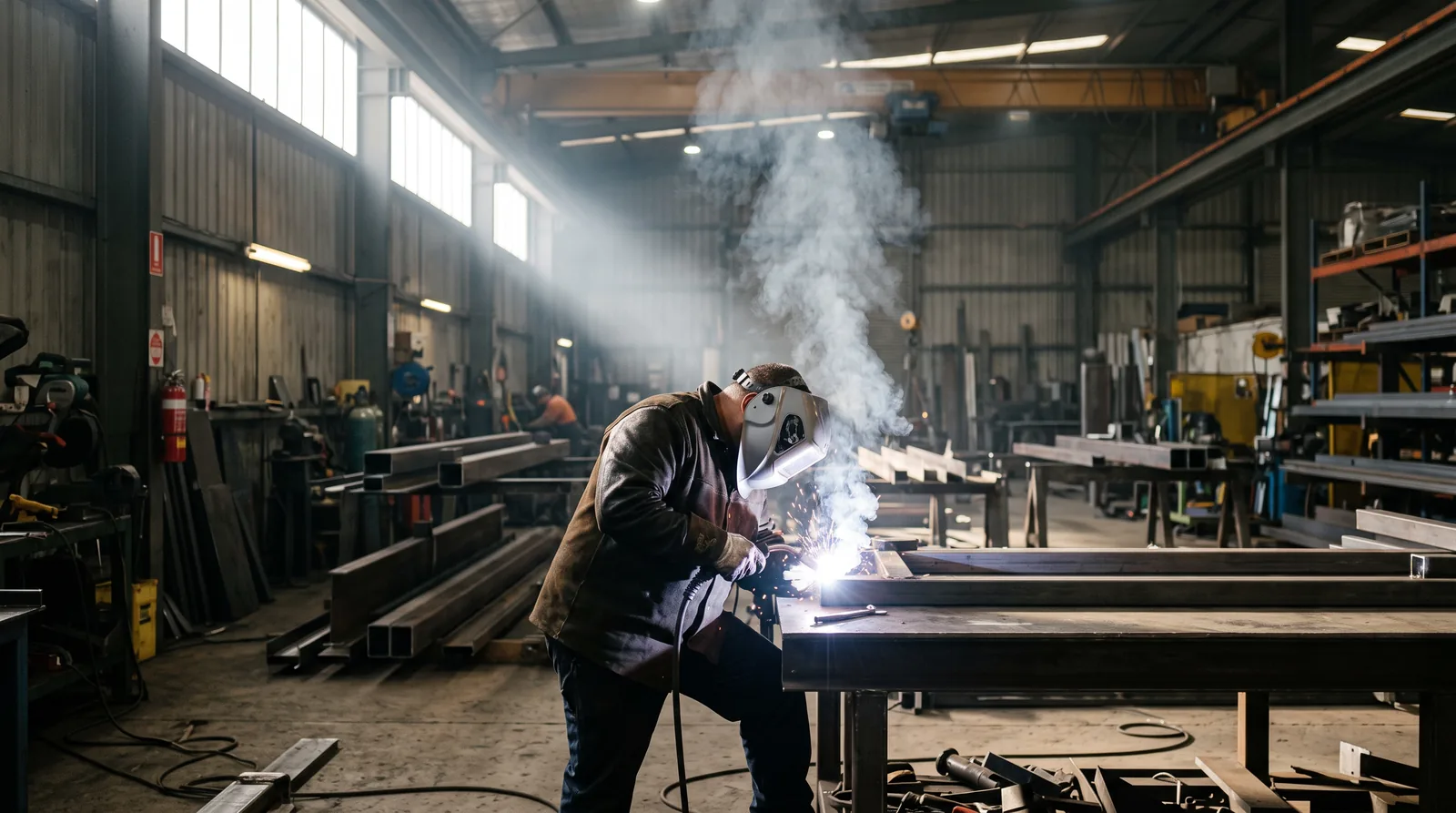
In 2017, the International Agency for Research on Cancer (IARC) moved the fumes produced when welding (welding fume) into Group 1, its highest category: a known human carcinogen. That put the haze that rises off an ordinary weld in the same group as asbestos and tobacco smoke.
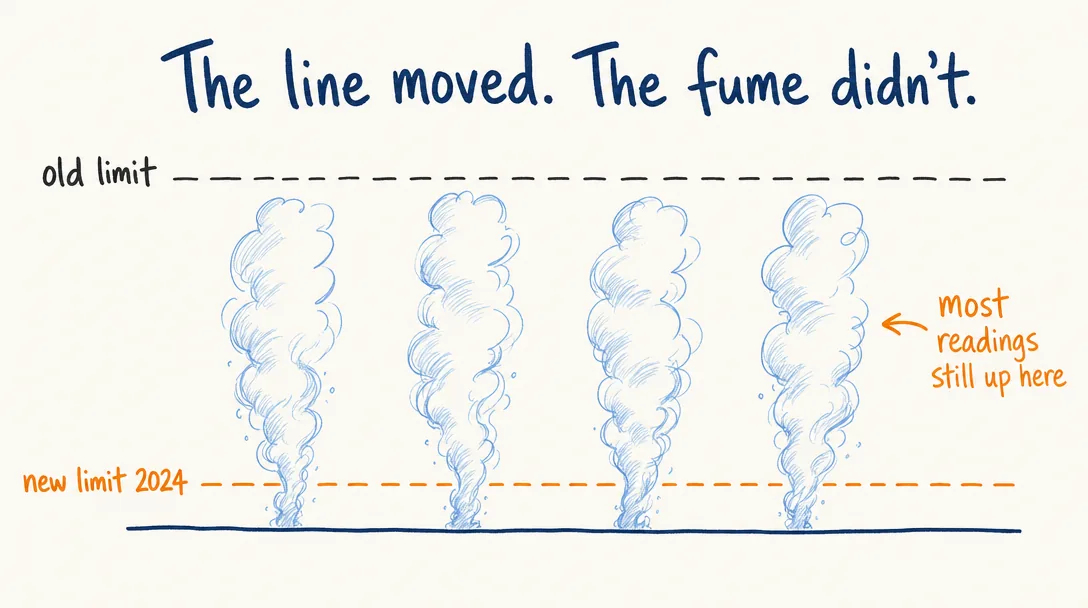
Australia eventually responded. On 18 January 2024, the legal workplace exposure limit for welding fume was cut by 80%, from 5 mg/m³ to 1 mg/m³, averaged over an eight-hour day.
Following this much-needed ruling, researchers then measured what was actually happening in workshops. The first Australia-wide exposure survey, published six months after the new limit took effect (August 2024), suggested most welders were still breathing in far too many fumes.
So, yes, the law made provisions, but little seemed to have changed. This is the story of how a known carcinogen remains an ongoing challenge for workers in Australian workshops, and what can be done to make those workplaces safer.
The Evidence, Layer by Layer
Let’s unpack some of the core numbers, starting with cancer rates. A meta-analysis for the WHO/ILO Joint Estimates, covering 23 studies and almost 58,000 participants, found welding fume exposure was associated with a 48% higher incidence of lung cancer. A separate 2019 meta-analysis in Occupational and Environmental Medicine (Honaryar et al.) put the increase at 43%.
The IARC classification, moving welding fume into Group 1, was based on evidence that held up after adjusting for smoking and asbestos exposure. Factoring in these helped to legitimise the cause-and-effect relationship between welding and the cancer risk.
The warning signs had been there for decades. Welding fume had been classified by IARC as ‘possibly carcinogenic’ since as far back as 1990. It took another 27 years for the evidence to push it into the highest category.
But what about the actual levels of exposure?
Census data cited by The Conversation indicate at least 60,000 people work as welders in Australia. The actual number of those exposed to the carcinogenic fumes is doubtless higher, though: boilermakers, fabricators, fitters, sheet-metal workers and maintenance crews all breathe the same air, whether or not the word ‘welder’ appears on their payslip.
In July 2024, researchers from Curtin University and the University of Sydney published the first national picture. From the 634 workers and employers surveyed, 91% were exposed to welding fume, and 76% of those were assessed as being exposed to ‘high levels’; that is, likely above the legal limit.
Scaled across the workforce, the University of Sydney estimated that at least 46,000 Australian welders may be exposed to dangerously high levels of carcinogens. That is an estimate built from survey data, not a headcount. But it’s the best national figure we currently have.
Survey assessments can be debated, but air sampling is harder to dismiss.
An Edith Cowan University analysis of 10,843 regulatory welding fume samples from Western Australian mining, published in 2025, found that of the samples taken between 2018 and 2024, 21.4% exceeded the old limit. Measured against the new 1 mg/m³ limit, 69.7% would fail.
It was already bad, then looked a lot worse with the new benchmark.
Why the New Limit Changed the Maths, Not the Air
The 1 mg/m³ limit applies in every Australian state and territory. Most apply it under harmonised work health and safety laws. Victoria applies the same number under its own occupational health and safety framework, for example.
Because the limit is an eight-hour time-weighted average, short periods of intense exposure can make a big difference. A few hours working in a poorly ventilated area can push the day's average over the limit, even if the rest of the shift is relatively clean in comparison.
Simply ‘staying under the number’ makes it sound easier than it is in reality. Safe Work Australia is explicit that employers must eliminate or minimise the risk from welding fume so far as is reasonably practicable, and must monitor the air, especially if they doubt that the standard is being met during that particular session.
The Control That Mostly Isn't There
If there’s one major weakness in Australia, it’s ventilation. In a survey by Curtin, it was found that only 19% of workplaces had any mechanical ventilation, such as welding booths or extraction hoods. Around 60% of those welding in non-ventilated areas had no air-supplied respiratory protection either.
Compare this with the United Kingdom. Since 2019, the Health and Safety Executive has required engineering controls such as local exhaust ventilation for all indoor welding, with respiratory protection on top, wherever ventilation cannot fully control the fumes produced. Australia has no equivalent blanket requirement. The researchers behind the national survey have made recommendations for a UK-style regulation moving forward.
And it’s not like we’re in need of a new invention. According to Breathe Freely Australia, a well-positioned extraction hood can capture up to 90% of the fumes at the source, and on-torch extraction now exists for site and workshop MIG work.
When proper equipment is lacking, workers often fall back on familiar habits. A dry rag over the face, or a disposable P2 mask that cannot seal under a welding helmet, is still a familiar sight in Australian workshops.
It Is Not Only Lung Cancer
Stainless steel work also generates hexavalent chromium, a Group 1 carcinogen in its own right with a far stricter exposure standard than the general fume limit. Where nickel, another Group 1 carcinogen, was among the metals most commonly found in the Curtin survey.
Manganese, present in nearly all steel welding fume, is linked to manganism, a progressive Parkinson's-like neurological condition that worsens with cumulative exposure. Zinc fume from galvanised steel causes metal fume fever. Occupational asthma, COPD and siderosis round out the list. Lung Foundation Australia offers a useful factsheet about these risks for concerned workers.
What Welders Can Actually Do?
Here are several things that are proven to help. Ticking off as many of these as possible and being consistent is really the key.
- Push for extraction first. Fume hoods, booths or extraction arms positioned at the weld, or on-torch extraction. Where fume cannot be fully controlled, add a powered air-purifying (PAPR) welding helmet, in addition to ventilation rather than instead of it.
- Ask for air monitoring. If there is any doubt exposure exceeds the standard, the employer has a duty to monitor and to make the results available.
- Stainless work should trigger health monitoring. Where work involves significant risk from chromium, cadmium or nickel, employer-funded health monitoring is a regulatory duty.
- Use your Health and Safety Representative. HSRs can require the business to address the problem, issue provisional improvement notices in most jurisdictions, and instruct that unsafe work cease in serious cases. Workers also have a legal right to raise safety issues with their employer without being penalised for doing so.
- Go to the regulator if it stalls. Every jurisdiction's regulator can file reports, from WorkSafe Queensland to SafeWork NSW to WorkSafe Victoria, and inspectors can test the air and issue improvement or prohibition notices.
- Document Your Exposure. The AMWU runs an active welding fume campaign and, in Victoria, a welding fume exposure register. Keep your own history too: employers, sites, years on the job, processes, materials and what controls were present.
- Tell your GP if you currently weld, or used to weld. Recording this history is vital for your records, especially when it comes to potential respiratory issues further down the line.
What If the Diagnosis Comes Decades After the Last Weld?
Occupational lung cancer typically emerges decades after exposure. A welder overexposed through the 1990s may be diagnosed in their sixties, long after leaving the trade.
That doesn’t automatically shut the door on a potential compensation benefit. Statutory workers' compensation is no-fault in every Australian state and territory: WorkCover Queensland, icare in NSW, WorkSafe Victoria and their counterparts elsewhere. Cancer Council Australia notes a claimant generally does not need to prove the employer did anything wrong, only that work was a contributing factor.
For disease claims, time generally runs from diagnosis or awareness rather than from exposure, and some diseases are presumed work-related for certain occupations. The detail differs between schemes, which is exactly why it’s worth keeping a ‘personal exposure record’.
Cancer Council Australia estimates that around 3.6 million Australians are exposed to at least one carcinogen at work. In this sense, welders are the sharp end of a much larger story.
December 2026: The Line Moves Again
The next tightening on fume regulations already has a date. From 1 December 2026, Australia's workplace exposure standards become workplace exposure limits, renamed deliberately to make clear these are ceilings not to be exceeded.
Limits for individual metals in welding fume are set to tighten sharply. Under Safe Work Australia's published changes, the manganese limit drops to a tenth of its current level, and lower again for the finest respirable particles. For workshops already failing the 2024 line, the December line will be harder still, but for worthwhile reasons.
The science was settled in 2017, when welding fumes were classified as a known human carcinogen. The law began to catch up in 2024, with the workplace exposure limit cut by 80%, and it tightens again in 2026. But the best available measurements suggest that the air workers are breathing has barely changed. The standards may be moving in the right direction; the question is whether workplace practice is moving with them.
The gap will close eventually. The question for anyone working under a welding helmet today is whether it closes through better controls and safer practices, or only after more workers have developed health problems.
A Safety Net Most Workers Never Check
Serious illness that permanently stops you working may also open a superannuation insurance (TPD) claim, separate from any workers' compensation entitlement. Most Australians hold this cover through their super fund without knowing it. The cover applies Australia-wide, and the illness does not have to be work-related. For an ex-welder facing a diagnosis decades after their last weld, it’s often the entitlement nobody thought to check