
To claim TPD insurance for a mental health condition, you need documented treatment history, specialist reports, and a clear prognosis. But what happens when your condition is so severe you can't make it to the appointment?
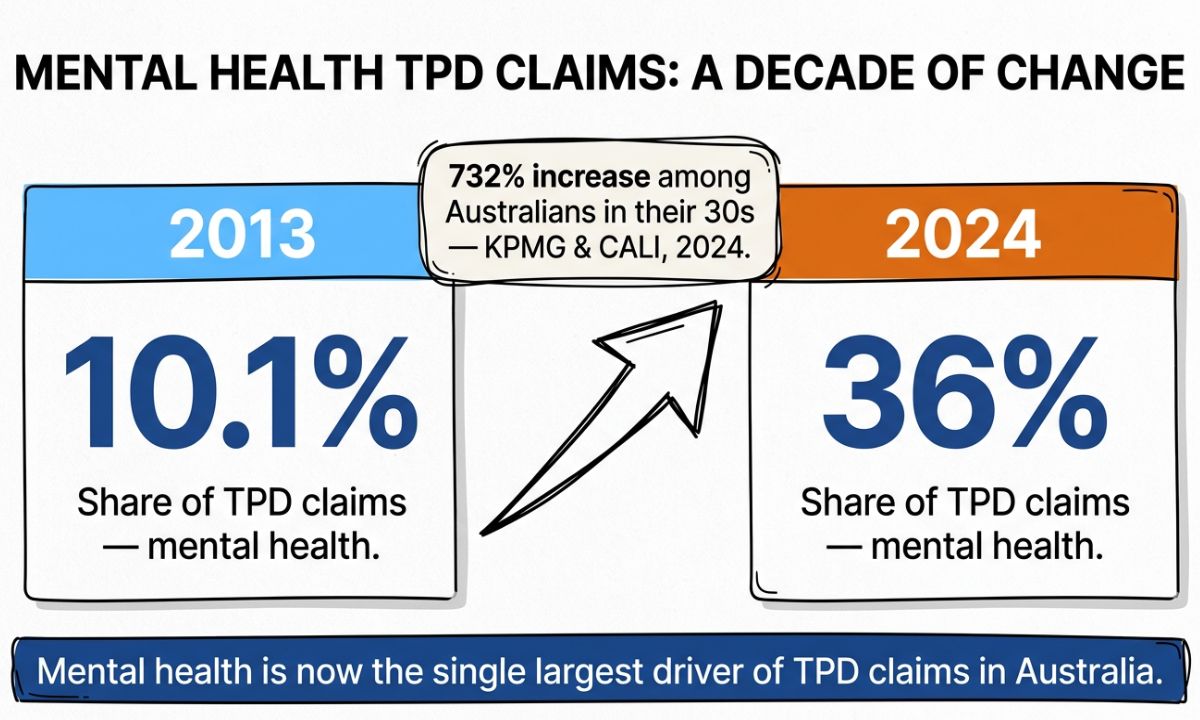
That question sits at the centre of a growing crisis in Australia's disability insurance system. Mental health is now the single largest driver of total and permanent disability claims, making up almost one in three TPD claims paid.
However, proving that a mental health condition is permanently disabling often requires the very kind of sustained, organised effort that severe mental illness makes hardest.
In other words, a complex claim system simply adds another layer of demand to an already demanding situation.
The scale of what's happening
The numbers are staggering. A joint KPMG and CALI report released in late 2024 found that TPD claims for mental health among Australians in their 30s increased by 732% over the past decade. In 2013, mental health accounted for 10.1% of TPD claims. By 2024, that figure had risen to 36%.
Across all age groups, insurers paid out more than $2.2 billion in mental health claims in 2024 alone. That is nearly double the figure from five years earlier.
The ABS National Study of Mental Health and Wellbeing (2020-2022) found that 21.5% of Australians aged 16 to 85 experienced a mental disorder within a 12-month period. Among those aged 16 to 24, the rate was 38.8%.
Far from being rare, these conditions are common, and the insurance system intended to protect those affected by them is fundamentally flawed.
The evidence trails the demands of the system
A TPD claim for a mental health condition requires layers of documentation. Insurers expect a formal diagnosis from a psychiatrist or clinical psychologist, alongside a treatment history showing consistent engagement with mental health services.
They also expect a prognosis confirming the condition is unlikely to improve enough for you to return to work.
In practice, that means regular appointments, progress notes, medication records, and a chain of referrals from GP to psychologist to psychiatrist, sometimes repeated with different professionals.
This is challenging enough for someone with a moderate physical injury, but for someone with severe depression, PTSD, or an anxiety disorder? We’re talking about a huge strain. Often, this strain is too much for many, and they would rather not have the hassle of what seems like a circular process of evidence gathering.
What practitioners consistently see is this pattern playing out in real cases. For example, someone with a severe mental health condition loses contact with their psychologist. It’s not because they chose to stop treatment, but because their condition made it impossible to maintain.
They miss one appointment, then another, and the gap grows. When they later try to claim TPD or apply for the Disability Support Pension, the insurer or Centrelink sees that gap and reads it as ‘if this were severe, the records would show more commitment to treatment’.
What mental health actually does to the process
The administrative demands of a TPD claim are substantial. Besides the forms, claimants are often required to gather records from multiple providers, follow up when documents don’t arrive, and chase departments through successive emails and phone calls.
For someone experiencing severe depression, even a phone call can feel like a big ask. After all, executive function, the cognitive ability to plan, organise, and follow through on tasks, is one of the first things that deteriorates with such conditions.
A CHOICE investigation into TPD insurance put it directly: ‘If you make the claims process difficult, there is a certain percentage of people who will say 'this is too hard,' particularly people with a mental illness. They might just disengage with the process.’
That same investigation found that half of TPD claimants said the claims process itself harmed their mental health.
ASIC's landmark report, ‘Holes in the Safety Net’, found that mental health claims, in particular, were far more likely to be rejected under the Activities of Daily Living test (a test that focuses on basic physical tasks like dressing, eating, and bathing). The data suggests that, where that test applied, 77% of mental health TPD claims were declined, compared to 15% under standard definitions.
The DSP and TPD overlap nobody explains
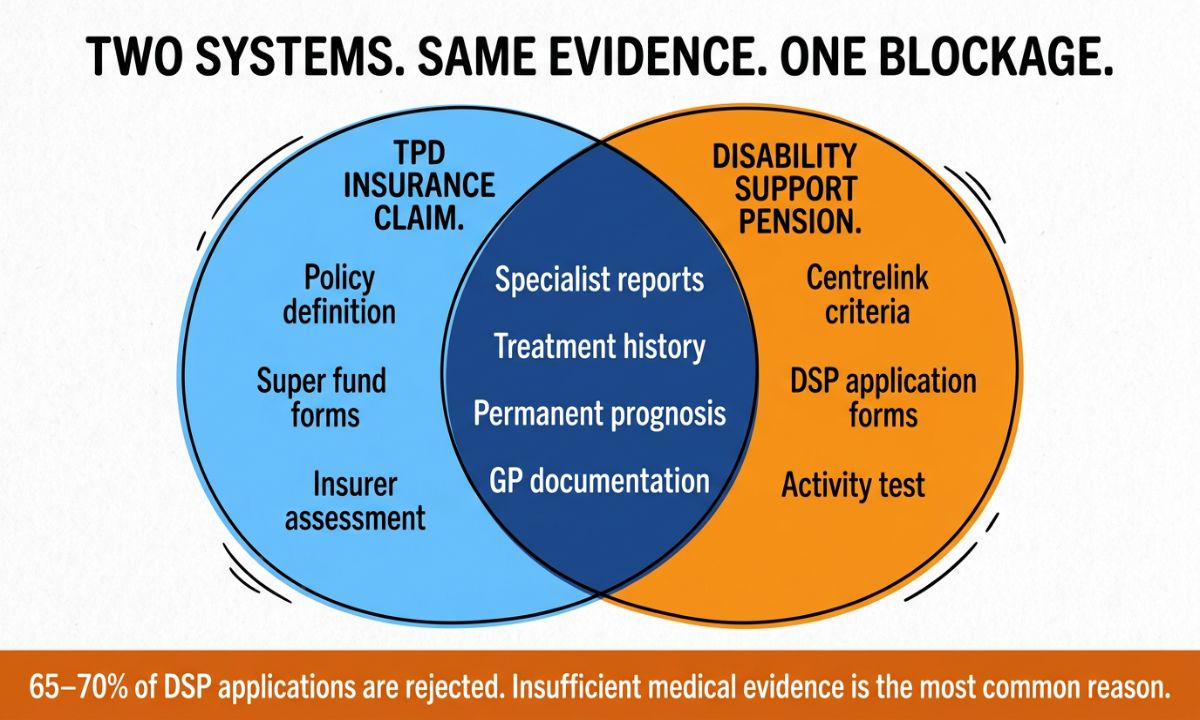
Here is something most people discover too late: the Disability Support Pension (DSP) and a TPD insurance claim require much of the same evidence, from many of the same doctors, using very similar criteria.
Both require:
- Proof that the condition has been diagnosed, treated, and stabilised
- Evidence that the condition is permanent and prevents the person from working
- Specialist reports confirming the long-term prognosis
For someone already struggling to get to one appointment, the prospect of duplicating the evidence trail across two separate systems is overwhelming.
And in many cases, people aren’t even aware that they have TPD insurance through their superannuation fund. They apply for the DSP, get rejected for insufficient medical evidence, and never think to check their super.
Around 65 to 70% of DSP applications are rejected, with insufficient medical evidence being the most common reason. For mental health applicants, the same documentation barriers that block a TPD claim also block the DSP application.
So, two different financial support programmes, a similar claims process, and ultimately the same blockage: a lack of evidence.
Community mental health: a path people don't know about
One of the biggest barriers to building a treatment history is cost. A private psychologist charges $200 to $300 per session, and even with a Medicare Mental Health Treatment Plan covering 10 sessions per year, patients often still have to pay $100 or more out of pocket for each session.
But there are alternatives most people never hear about.
Head to Health centres, funded by the Australian Government, are free walk-in mental health services. You don’t require a referral or a Medicare card.
Community mental health teams, accessed through GP referral, also provide ongoing support for people with moderate to severe conditions. These services are publicly funded and specifically designed for people who cannot afford or access private care.
Research from Monash University published in The Conversation found that Australians in the poorest areas received six times fewer Medicare-subsidised mental health services than those in the wealthiest areas. The scariest thing? This gap has widened between 2015 and 2019.
These community services are meant to fill that gap, but the people who need them most often don’t know they’re available.
What you can do
If you or someone you know is dealing with a mental health condition and considering a TPD claim, there are practical steps that can help break the cycle.
Start with a GP. A GP can create a Mental Health Treatment Plan, provide referrals, and serve as an anchor point for your treatment history. Even if you can't see a psychologist right away, regular GP visits create a documented trail.
Use community services. As mentioned above, Head to Health (1800 595 212) can connect you with free local mental health support.
Ask someone to help advocate. A trusted family member or friend can make phone calls, chase up referrals, and help with the paperwork. It might feel like you have to do everything alone, but having others help can really take a load off.
Start treatment before you claim. Insurers look at treatment history. If you are considering a TPD claim, establishing consistent treatment now, even through a GP or community service, strengthens your position later.
One appointment at a time. You don’t need to build a complete evidence trail in a week. A single GP visit is a starting point. The next appointment can come when you are ready for it.
The TPD system was designed around physical injuries, where medical evidence follows a more predictable path. Mental health conditions aren’t so straightforward. When the condition is at its worst, keeping up with treatment and documentation often falls apart, and the system ends up treating that lack of paperwork as if the condition is not serious enough.
That is not a reason to give up, but a reason to understand how the system works, to use the supports that exist, and to ask for help when the process itself becomes a barrier. A final, important thing to consider is how a conversation with a lawyer experienced in TPD claims can clarify what evidence you actually need and how to build it, even when your condition makes every step harder than it should be.