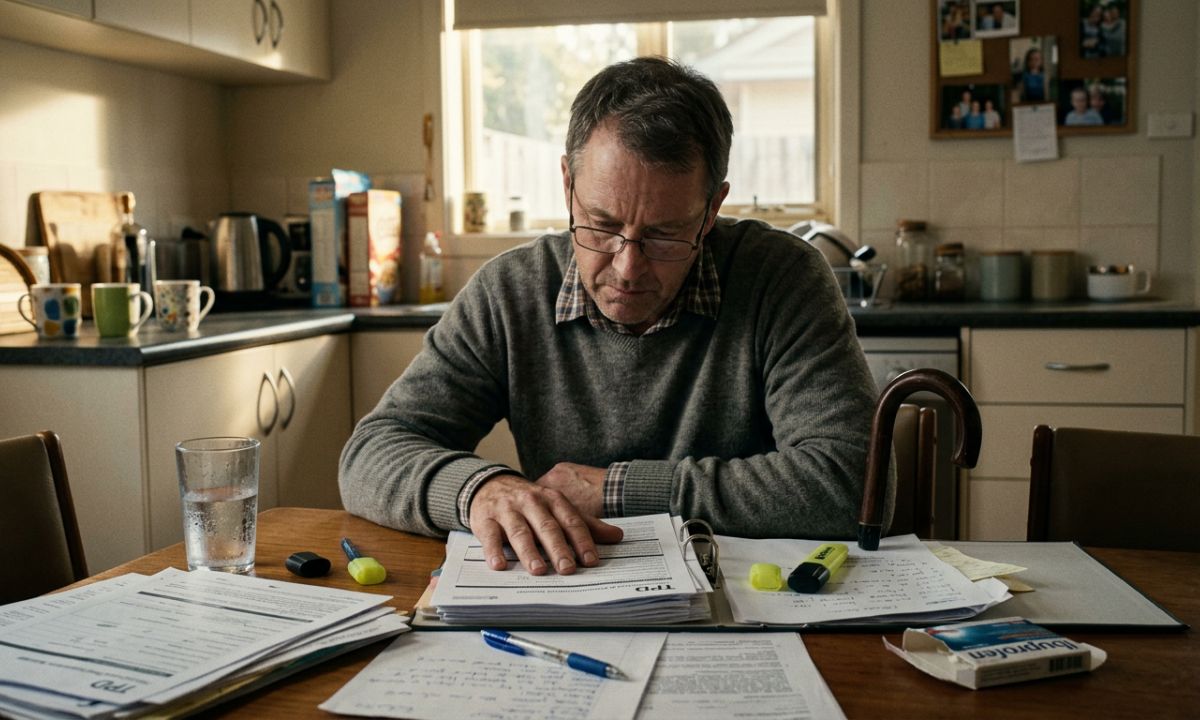
Most Australians with a serious illness or permanent disability have insurance they never chose, bundled inside a super fund they barely think about. The promise is that the money will be there when everything falls apart, and for most people it is, but that doesn’t always mean it’s enough.
The problem isn't that TPD insurance doesn't pay out. The problem is what happens after acceptance, when the benefit sitting inside a fund is $50,000 or $75,000, and the legal fees required to get it out would consume a quarter of the payout or more.
This creates a gap that rarely gets discussed, as there are people who are too sick or injured to work, who have insurance, but whose benefits are too low for professional help to make financial sense.
They're left with two options: pay fees that gut an already modest sum or try to lodge the claim themselves through a process that regularly defeats people who aren't legally trained.
Neither option is good.
The Numbers Behind the Gap
Insurance premiums inside supers can be highly regressive, hitting low-income earners, casual workers and people with multiple dormant accounts the hardest. These are also the same people most likely to end up with modest TPD benefits.
Consider the maths on three different claim sizes:
- $75,000 benefit: After $15,000-$25,000 in fees and disbursements, the claimant walks away with $50,000-$60,000.
- $60,000 benefit: After fees, the claimant may retain $35,000-$45,000, roughly half the insured amount.
- $20,000 benefit: Fees would consume the entire payout. Legal representation is not financially viable at any price.
These aren't hypothetical figures. They're the kind of conversations happening every week in law firms that handle TPD claims.
Also read: Most Common Types of TPD Claims in Queensland
Why Self-Lodging Is Harder Than It Sounds
The alternative to paying legal fees is doing it yourself. On paper, that sounds reasonable, but in practice, it’s a lot harder than it looks.
A TPD claim requires gathering comprehensive medical evidence that links your condition to a specific policy definition, usually either "unable to ever work in your own occupation" or "unable to work in any occupation for which you are reasonably suited by education, training, or experience." Getting that wrong, even slightly, is grounds for denial.
ASIC's landmark REP 633 report, "Holes in the Safety Net," reviewed 35,000 TPD claims and found that 12.5% were withdrawn before a decision was even made. Claimants gave up partway through.
The report identified an industry-wide problem. Insurers were subjecting consumers who are vulnerable due to life-altering illness or injury to a claims process that is often unnecessarily challenging and onerous.
That was in 2019. ASIC's 2021 follow-up found that "gaps remain" despite some progress.
In 2024, ASIC sued Cbus Super for systemic claims handling failures. The fund was later ordered to pay $23.5 million in penalties.
The system is difficult enough with a lawyer. Without one, many claimants simply stop.
Who Falls Into This Gap?
Casual and part-time workers accumulate less super and therefore less insurance cover. The Productivity Commission noted that insurance in super has a disproportionate impact on members with low income, intermittent labour force attachment, and/or multiple accounts.
Young workers who entered the workforce in industries like retail, hospitality or trades often hold age-based TPD cover that starts low and erodes further with every gap in contributions. Moneysmart confirms that members under 25 or with balances under $6,000 don't receive automatic insurance at all unless they specifically request it.
People who changed jobs frequently, particularly sole traders or contractors who moved between funds, may have had premiums deducted from multiple small accounts without building meaningful cover in any of them.
APRA's quarterly data shows 23.3 million member accounts across the system as at June 2025. That's significantly more than the working population, pointing to millions of duplicate and fragmented accounts.
According to Super Consumers Australia research, one in four Australians don't even know they have insurance inside their super. For those with low balances, the cover they don't know about may not be worth much anyway.

What Honest Firms Actually Do
Not every law firm takes every case. Some do the maths, tell the caller the fees would eat too much of the benefit, and explain how to self-lodge instead.
In practice, this means an intake agent might spend 20 minutes walking someone through the paperwork, explaining which medical reports they'll need, and warning them that the process will be slow and frustrating. They advise. They don't bill.
The reason this matters is that it highlights a structural failure. The legal system works well for claims above a certain threshold. Below that threshold, there's no scaled, affordable pathway for people who need help but can't justify the cost.
Also read: How much does it cost to make a compensation claim?
What You Can Actually Do
If your TPD benefit is too low for legal fees to make sense, you're not without options. The process is difficult, but it's not impossible.
- Contact your super fund's claims team directly. Ask for the TPD claim form and the exact policy definition you need to meet. Write down which definition applies to you: "own occupation" or "any occupation." This distinction shapes every piece of evidence you'll need.
- Get your medical evidence right. You need doctors’ reports that specifically address the policy wording, not just your diagnosis. Ask your GP or specialist to comment on your capacity to work in the relevant terms.
- Check for overlap with the Disability Support Pension. If you're applying for DSP through Centrelink, much of the medical evidence required is similar. Coordinate the two processes where possible.
- Use free services. Super Consumers Australia publishes plain-English guides to insurance in super. The Australian Financial Complaints Authority (AFCA) handles disputes at no cost if your claim is denied. Community legal centres can sometimes provide limited guidance.
- Don't let the process stall. Insurers have long assessment windows. Follow up regularly, document every call and email and set calendar reminders for deadlines.

A TPD claim with a lawyer typically takes 6 to 12 months. Without one, it may take longer. Persistence is the single biggest factor in whether self-lodged claims succeed or fail.
Having insurance is supposed to mean something. For Australians with TPD cover inside a modest super balance, the promise and the reality don't match.
The cover exists, but the cost of accessing it, whether through legal fees or the sheer difficulty of doing it alone, pushes too many people out of the system entirely. Until the industry builds a better pathway for low-balance claims, the gap between having insurance and being able to use it will keep growing.