Every weekday morning and afternoon, the same scene plays out at schools across Queensland.
Cars are double-parked in no-stopping zones. Parents are doing illegal U-turns across oncoming traffic. Kids are darting between vehicles. There are reversing four-wheel drives with zero rear visibility, and everyone is in a rush.
According to national crash data, in the first half of 2025, there was a 50% increase, compared to the same period the year before, of road fatalities among young children.
This is a design problem, a behaviour problem and a time-pressure problem, all compressed into the most chaotic 30 minutes of a parent's day.
The Numbers That Should Worry Us
While overall national road tolls have dominated headlines, it's the vulnerability of the youngest pedestrians that has emerged as one of the most concerning trends.
In Victoria alone, 52 pedestrians were killed in 2025, including four children aged 18 or under. And while not all of those deaths occurred in school zones, the pattern reveals that children near roads remain disproportionately at risk.
It is estimated that a pedestrian struck at 30km/h has roughly a 10% chance of dying. At 50km/h, that jumps to over 90%. The difference between a school zone speed limit and a regular suburban street is, quite literally, the difference between life and death.
Queensland's School Zone Setup
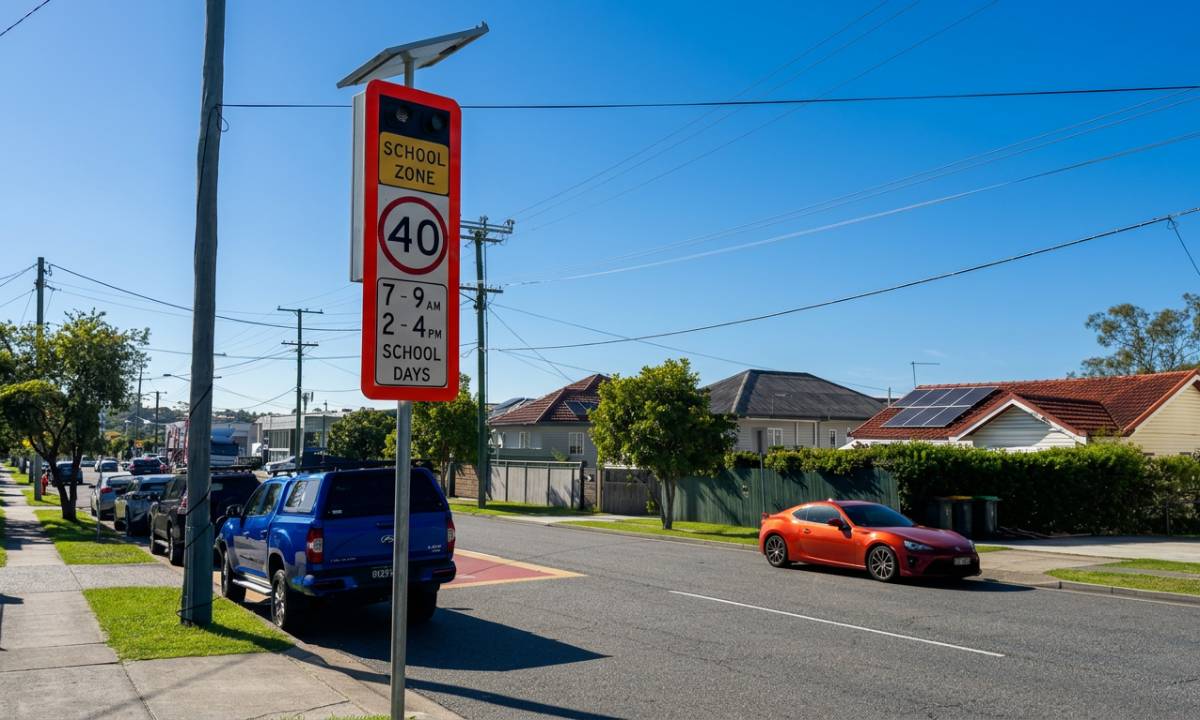
In Queensland, school zones operate between 7am and 9am, then again from 2pm to 4pm on school days. The speed limit drops to 40km/h where the normal limit is 50, 60 or 70km/h. On roads with a normal limit of 80km/h or above, the school zone limit is 60km/h.
Simple enough in theory, but in practice, there are a few wrinkles.
Private schools and some state schools can have different term dates and hours, meaning the school zone near your house might be active on days you don't expect. And the signage, while legally required, varies enormously in visibility from school to school. Some have flashing lights and digital signs. Others have a faded metal sign half-hidden behind a tree.
Queensland has been rolling out portable speed cameras in school zones as part of a pilot program, using hi-tech cameras attached to powered road signs. The fines aren't small either. Exceeding the speed limit by just 1–11km/h in Queensland will cost you $333 and one demerit point. Go 11–20km/h over, and it's $500 and three points.
Also read: Do Speed Cameras Really Save Lives? An Investigation
Why Drop-Off Is Worse Than Pick-Up
Both time windows are risky, but the morning drop-off has a particular combination of factors that makes it genuinely dangerous.
Time pressure: Parents are racing to get kids into school before the bell and to get themselves to work on time. This creates aggressive driving decisions, illegal U-turns, double parking and rushing through pedestrian crossings.
Cognitive overload: You're navigating a chaotic environment while simultaneously making sure your child has their lunch box, their hat and their reading folder. Attention is split in multiple directions, which is exactly when you miss the kid walking behind your car.
Reversing blind spots: Modern vehicles, particularly SUVs and utes, which now dominate Australian driveways, have enormous rear blind spots. A child standing directly behind a large vehicle can be completely invisible to the driver, even with a reversing camera. Cameras don't cover every angle, and sensors don't always detect small, stationary objects.
The kiss-and-drop lottery: Many schools have designated drop-off zones where parents are supposed to pull up, let kids out on the kerb side, and drive off without getting out of the car. When these work properly, they're efficient and safe. When they don't, because parents stop in the wrong spot, or get out to help with bags, or block the flow, the whole system breaks down, and cars congregate on the main road.
The Infrastructure Gap
Many Queensland schools were built decades ago, when fewer families drove, and the idea of a dedicated drop-off lane didn't exist. The road infrastructure wasn't designed for the volume of traffic generated by modern school runs.
The result is predictable. Narrow streets without turning lanes. No dedicated parent parking. Pedestrian crossings placed in locations that made sense in 1975, but don't account for the current traffic flow.
In many suburban and regional areas, pedestrian crossings near schools are limited or poorly signposted. Some school zones lack flashing lights or clear signage, leaving drivers, especially those unfamiliar with the area, unaware that children are nearby.
Councils have tried various solutions, such as one-way traffic flows around schools, staggered start times, park-and-walk schemes where parents park a few streets away and walk the last stretch. Some work well, but many get abandoned after a few months because parents revert to the easier option, which is usually the illegal U-turn right by the school gates.
What Other States Are Doing
South Australia recently overhauled its school zone system. Since November 2025, the state has introduced a new 40km/h time-based zone on major roads near schools during morning and afternoon peaks. The rollout is expected to cover about 150 schools statewide by the end of 2026, with new signs going up in stages.
In Victoria, some school speed zones are active 24/7, while others operate at certain hours. Electronic school speed signs are becoming increasingly common, and they must be obeyed even if no children are visibly present.
The Things Parents Can Actually Control
It takes time and money to create an effective infrastructure regarding road safety near schools, however, there are still things parents can do right now to play their part.
The kerb-side rule: Children should always exit the car on the kerb side, the side away from traffic. This sounds obvious, but watch any school drop-off zone for five minutes, and you'll see kids hopping out into the traffic lane.
The one-minute rule: In kiss-and-drop zones, you've got a short window to get your child out of the car and moving. Everything that can be organised beforehand, like bags packed and goodbye said, should happen before you reach the zone, not in it.
The three-car-length check: Before reversing out of any parking spot near a school, stop and visually check behind your vehicle. Walk behind it if you can. Cameras and sensors are helpful, but they are not a substitute for actually looking.
The speed check. Your speedometer in a school zone should read 40km/h, not 45 or 50. The margin between ‘a bit over’ and ‘a child's life’ is smaller than most people think.
The Bigger Picture
School zone safety isn't just a parent problem, a council problem or a police problem. It's all three, compressed into two half-hour windows, five days a week, forty weeks a year.
The kids walking through those zones are doing the most ordinary thing in the world for them, and that’s going to school. The least we can do is make sure that we, and other adults around them, are paying attention.