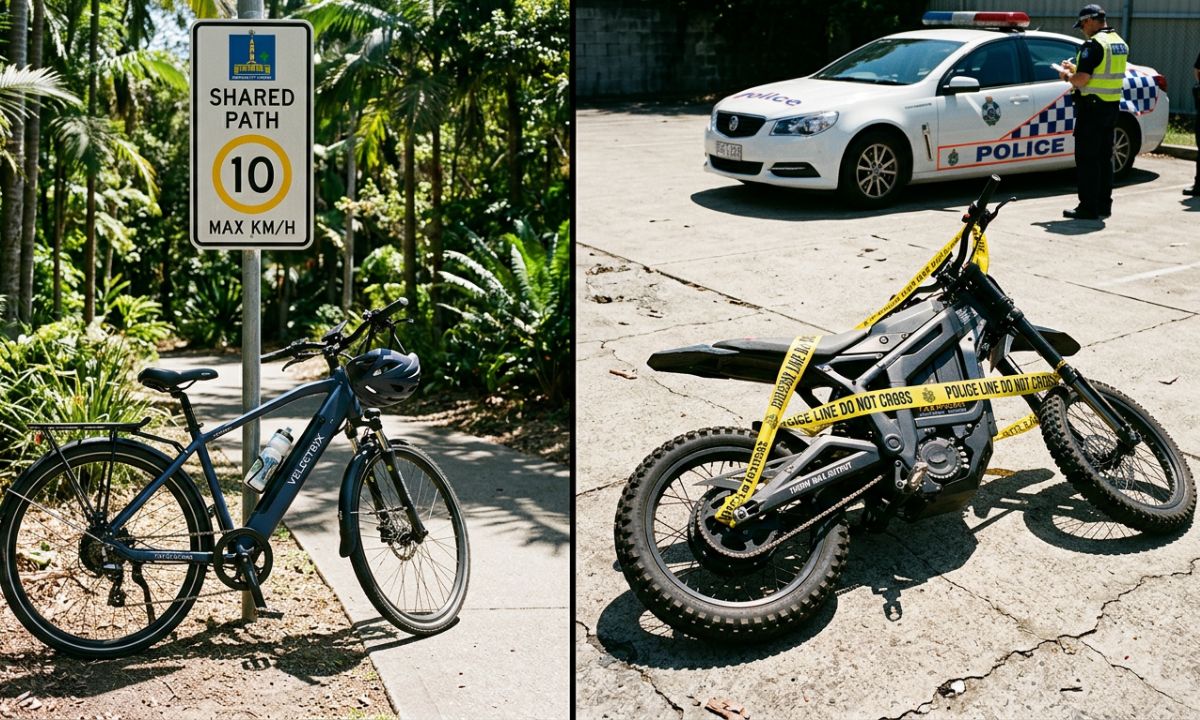
Fourteen people died on Queensland roads in 2025 in incidents involving e-bikes and e-scooters. The state government's response arrived on 25 March 2026, sweeping new laws that would require every rider over 16 to hold a driver's licence, ban under-16s entirely and drop the speed limit on shared paths to 10 km/h.
The question is whether those laws will stop the riders who caused the crisis or whether they'll mostly catch the ones who didn't.
What the new laws actually do
The Transport and Other Legislation (Managing E-mobility Use and Protecting Our Communities) Amendment Bill 2026 splits the rules by age.
Under 16: Banned outright from riding any e-scooter or e-bike on public roads, paths, or shared spaces. Parents and guardians can be held liable for fines.
Over 16: Must hold a valid driver’s licence of any type or class. Must obey a 10 km/h speed limit on footpaths and shared paths and a 25 km/h limit everywhere else. Subject to random breath testing.
The case for cracking down
Queensland Health data shows e-scooter presentations to emergency departments jumped from 1,626 cases in 2024 to 2,000 in 2025. Data also showed that peak accident times shifted from midday to midnight on weekends to midday to 6 pm on weekdays, indicating that many more commuters are involved in accidents.
Queensland recorded 14 e-mobility deaths in 2025 alone. Research from the University of Melbourne found that one in three Australian e-scooter fatalities from 2020 to mid-2025 were children. Two teenagers, a boy and a girl, died in a single crash at Greenbank south of Brisbane on 12 March 2026, riding an e-bike without headlights.
Operation X-Ray Surety, a 12-week police enforcement blitz that ended in January 2026, issued more than 2,794 infringements to e-mobility riders. Of those, 2,100 were for riding without a helmet. Police removed 142 non-compliant devices from the road.
Many of the serious injuries and deaths involved devices that were never legal in the first place, including high-powered electric motorbikes capable of exceeding 100 km/h, sold online and ridden by teenagers. As the University of Queensland noted, modification kits that turn a standard e-bike into an illegal motorbike are cheap and widely available. Read our article on the legal defination of e-bikes and when they are considered motor vehicles.
The case against overreach
The concern isn't that the government is acting, but rather that the laws may punish the wrong group of riders.
Start with the 10 km/h shared path limit. Some argue that bicycles become unstable at speeds below 11 km/h, depending on rider skill, bike design and path conditions. A speed limit that sits below the stability threshold for a standard bicycle creates an odd contradiction, as riders may be less safe travelling slower.
For context, non-electric cyclists regularly travel at 20 to 25 km/h on the same shared paths. Legal e-bikes are capped at 25 km/h. The new rule effectively makes shared paths unusable for e-bikes while leaving faster pedal cyclists unaffected.
Then there is the licensing requirement. Bicycle Queensland has argued that tying e-bike use to a car licence makes little sense. Andrew Demack, the organisation's Director of Advocacy, put it plainly, "The proposal was a blunt policy response that fails to address the real causes of unsafe devices."
The rule catches seniors who no longer hold a licence, people with medical conditions that prevent them from driving, international students and anyone who chose an e-bike specifically because they don't own a car. Even the Transport Minister, Bart Mickelberg, acknowledged in parliament that the law "will disadvantage some people who currently use these devices and are unable to drive."

The new laws have taken quite an effect on the Queensland public, with protests from Brisbane riders. An event took place on April 1st, where e-mobility riders came together to share their thoughts on the legislature. Kathryn Good of the Story Bridge Active Travel Alliance states, “The Government is trying to put the brakes on everyday riders instead of building safe infrastructure.”
Brisbane is investing in active transport, and the city council has committed to 1,700 kilometres of new bikeways by 2031. E-bikes are a key part of that equation, as they reduce car dependency, cut emissions and make cycling accessible to people who otherwise couldn't manage Brisbane's hills. However, regulating them like motor vehicles risks pushing commuters back into cars.
What happened interstate
In New South Wales, personally owned e-scooters are still illegal on public roads. NSW has focused on product standards instead, adopting the European safety certification for e-bikes and batteries and banning the sale of non-compliant devices.
Victoria allows privately owned e-scooters with a 25 km/h speed cap and a 45 kg weight limit. No licence is required and footpath riding is banned, but shared paths are permitted.
Where riders actually stand
If the laws pass as drafted, every e-bike and e-scooter rider in Queensland will need to hold at least a learner licence from 1 July 2026.
Riders injured in an e-mobility crash may still have legal options depending on the circumstances. Where another party was negligent, whether that is a motorist, a council responsible for path maintenance, or a manufacturer of a faulty device, an injured rider may be able to pursue a compensation claim.
But the legal position is more complicated than for standard motor vehicle accidents. E-scooters and e-bikes do not carry Compulsory Third Party (CTP) insurance. That gap leaves many injured riders without the automatic cover that car and motorcycle riders receive.
The real problem underneath
The crackdown on illegal high-powered machines is overdue. Devices capable of 100 km/h do not belong on shared paths or in the hands of children. The seizure-and-destruction powers for non-compliant devices, and the penalties for retailers who sell them, address a genuine enforcement gap.
But blanket restrictions risk stifling a transport mode that Queensland cities need. The 10 km/h shared path limit is just over a brisk walking pace for many commuters and sits below the instability threshold identified by the state's own transport authority. The licensing requirement excludes exactly the people e-bikes were designed to help.
Good regulation matches the response to the risk. These new laws will soon determine whether they make Queensland safer or just make it harder to get around.