Imagine being 50 metres up a wind turbine tower in Western Queensland dangling from a safety harness, when a loose panel shifts beneath your boot. For one heart-stopping moment, you're at the mercy of the wind whipping around you, and you may be left hanging there if things don’t go your way.
Welcome to Australia's renewable energy revolution, where the work may seem futuristic, but it actually feels like a rough day in the mining sector.
The numbers paint an uncomfortable picture. While Australia celebrated generating 36% of its energy from renewable sources in 2024, workers in the sector are paying a steep price.
Musculoskeletal injuries are the most prevalent, and electric shocks and remote-site fatigue are both continuing to climb and contribute to career-ending crashes. The renewables sector is making great progress towards an 82% target by 2030. However, recent injury patterns are uncomfortably close to the darkest days of construction, all while a "green halo" blinds regulators to the risks unfolding across Australia.
If you're working wiring battery arrays, installing solar panels or as a safety officer, here's a closer look at what the data says about the risks you face today, as well as three starkly different scenarios for where the industry could end up by 2030.
The Data Behind the Dangers
Solar farms and wind turbines might be heralds of a cleaner future, but the day-to-day work can be brutal and familiar to anyone who's worked in construction or down a mine. Heavy lifting, dizzying heights, high-voltage systems and punishing commutes create a perfect storm of danger.
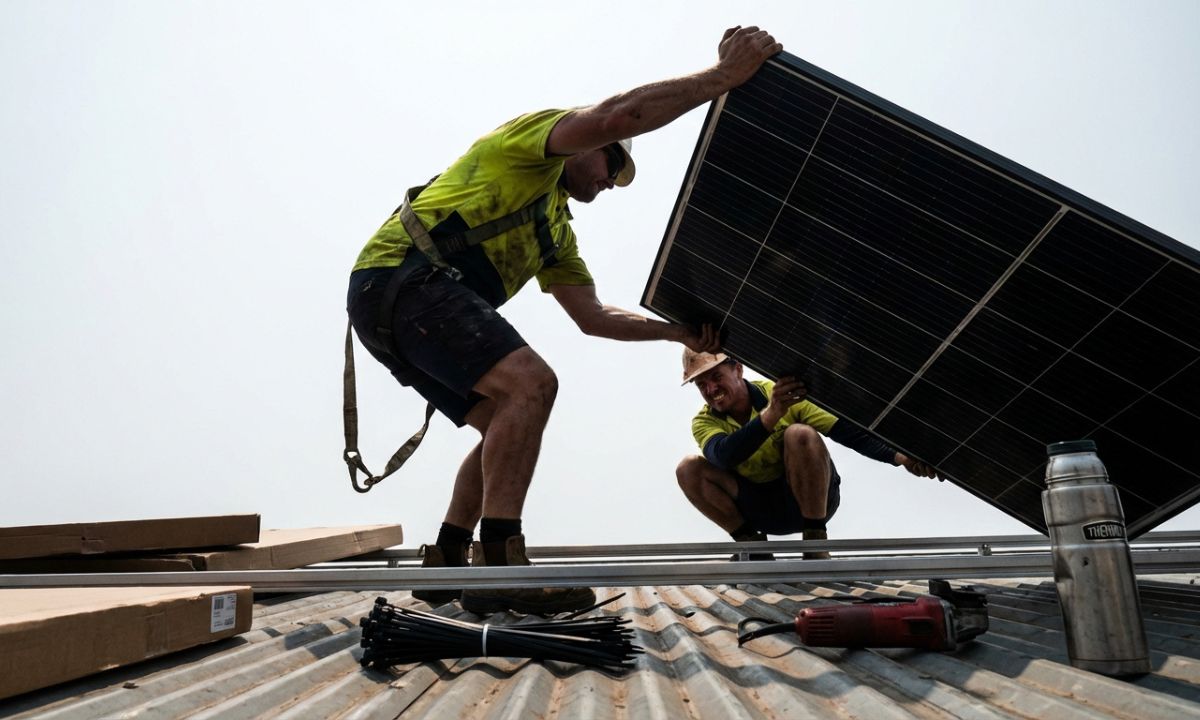
Half of all Queenslanders now have rooftop solar installations. Behind those gleaming panels is an army of workers hauling 100-kilogram modules onto roofs, scaling huge transmission towers and navigating electrical systems that can be deadly.
The injury breakdown paints a grim picture:
- Musculoskeletal disorders cause many injuries in the renewables industry. It’s common for panel installers to develop chronic back strains from repetitive heavy lifts, while wind technicians suffer knee injuries from going up and down ladders everyday. These are career-ending injuries that can qualify for Total and Permanent Disability claims.
- Falls from heights cause around a third of serious incidents. Working on 50-metre tall is inherently risky, but transmission work for connecting remote solar farms can be equally as dangerous. One slip can cause devastating spinal injuries and permanent disability.
- Electrical incidents and crashes caused by fatigue account for the remaining incidents. The 165,000 solar batteries added to the Small-scale Renewable Energy Scheme in the second half of 2025 are obviously a huge positive, but they also expose workers to electrical hazards. At the same time remote sites require long commutes that increase the risk of crashes.
These patterns aren't outliers, they're baked into how the renewables boom is currently operating.
When Everyone's Responsible, Nobody's Accountable
Safety issues on solar farms often lead to seemingly endless finger-pointing because so many contractors are involved in the process.
A typical build involves principals, EPC firms (Engineering, Procurement, Construction specialists) and labour hire companies. If a crane collapses or guardrails fail, accountability diffuses across this chain.
No single entity is in charge of the safety culture because crews are transient, supervisors rotate constantly and 12-hour shifts on Fly-In-Fly-Out (FIFO) rosters have become standard.
Queensland's renewables sector has been racing to keep up with the state's lofty targets, which only compounds these problems. What makes matters worse is that most wind farms and solar arrays operate far from major centres, extending workers' days before they even begin their actual jobs.
Unlike mining's FIFO operations, which require psychological testing and structured rosters, the renewables sector often skips these safeguards because they treat projects as "cleaner" and therefore safer.
Take a composite scenario based on emerging claim patterns: an electrician at a battery storage site ignores voltage checks because their project manager is pushing to meet commercial deadlines. One wrong move, and they’re dealing with nerve damage and facing months off work while navigating a TPD claim.
The principal blames the EPC contractor, the EPC contractor points the finger at the labour hire company, and the injured worker is left with an injury and mounting medical bills.
The numbers prove that this accountability vacuum is causing problems. While only 9 of 65 funded renewable projects under the government's Capacity Investment Scheme have reached a final investment decision, the pressure to accelerate builds grows fiercer, resulting in more and more cut corners.
The Injury Claims Starting to Flow
TPD claims made by renewables workers are painting a picture that super funds and safety advocates are no longer able to ignore. Musculoskeletal disorders are the most common because this type of work requires constant heavy lifting, especially when it comes to solar panel installation.
Fatigue crashes en route to sites like Kidston, which is around 600 kilometres from Cairns, increase the likelihood of high-impact claims involving crushed vertebrae and permanent spinal injuries.
These injuries often meet TPD definitions under "any occupation" policies, which is when an injury prevents a worker from working again. For example, a back injury might prevent someone from retraining for a sedentary role, so the insurer must pay out. Or an electrical burn from battery system work could create permanent hand impairments that sideline an electrician forever.
A particular concern is under-reporting of injuries. Many incidents go unlogged if a worker fears jeopardising contracts in an industry where the majority of the workforce comes through labour hire. Union representatives are always lobbying for better tracking, but near-misses often vanish into the gap between projects.
For workers considering a career in renewable energy, it’s vital to fully understand TPD coverage. Check whether your super policy covers "own occupation" (unable to work in your specific trade) or "any occupation" (unable to work in any job you're suited for by education and training).
The Green Halo Hiding the Human Cost
The uncomfortable truth is that the general public sees clean energy as inherently ethical, and that perception leads to dangerous blind spots. It’s common for regulators to apply lighter-touch audits to renewables in comparison to mining or traditional construction because they assume the risk profile is lower. This leads to insurance premiums under-pricing hazards because "green jobs" sound safer than coal.
Inspections for Queensland's renewable energy aren’t scrutinised anywhere nearly as closely as the construction sector, despite renewables now accounting for 36% of national electricity generation, while fossil fuels still dominate the primary energy mix. This rapid shift has created a regulatory lag because the rules have yet to catch up with the reality.
Unfortunately, it’s the workers who are worst affected by this gap. When a serious injury leaves someone unfit for any work they're trained for, but their TPD claim is delayed because insurers underestimated the risks involved with renewables, the green halo becomes a trap.
The industry needs Workplace Health and Safety frameworks equivalent to mining's hard-won protections, not assumptions that solar panels are somehow gentler than coal seams.
Three Pathways to 2030
Current data points toward several starkly different futures for safety in the renewables industry. Which path we go down largely depends on the choices policymakers, unions and industry leaders make in the next 18 months.
Scenario 1: Boom Without Brakes (40% likelihood)
Australia races toward its net-zero commitments of 82% renewable electricity by 2030. As a result, corners are cut as meeting deadlines takes priority over safety, causing injuries to surge as untrained crews become common onsites, labour hire companies prioritise speed over standards and remote fatigue blackspots multiply.
This leads to an explosion in TPD claims. Workers bear the cost of this transition, while executives celebrate reductions in emissions. Coal plant extensions, which are already happening in order to manage grid instability, create workforce chaos as experienced tradies bounce between dying fossil projects and cowboy renewables builds.
This is the darkest timeline, where we trade one form of worker exploitation for another.
Scenario 2: Regulated Renaissance (35% likelihood)
Federal and state governments mandate mining-level training for all renewables workers. WHS frameworks catch up, and sites will require heights certification, fatigue monitoring apps and principal-contractor liability chains that end finger-pointing. Drone technology is used to cut heights work by half, while coordinated consumer energy resources help manage demand peaks.
Injuries stabilise rather than skyrocket, with TPD claims shifting toward prevention wins as sites adopt proactive safety cultures. The industry meets 82% renewables with only modest cost increases, with CSIRO modelling suggesting around $91 per megawatt-hour by 2030, including transmission and safety buffers.
Workers benefit from genuinely ethical green jobs, not just ethical-sounding ones.
Scenario 3: Worker-Led Reset (25% likelihood)
Unions and safety officers force a renewables compact before the next major tragedy. Workers demand AI-powered fatigue monitors, contractors are blacklisted for repeat offences and profit-sharing models that reward safety metrics alongside build speeds come into play. Grassroots pressure creates standards that surpass those in the mining industry because workers refuse to repeat old mistakes.
Injury rates are slashed compared to current trajectories, and the industry becomes genuinely world-leading, exporting not just renewable technology but safety frameworks. Clean energy jobs deliver on their promise.
The influencing factors separating these scenarios include Queensland's 2027 WHS review, technology adoption rates, union organising strength and whether the Safeguard Mechanism's 2026-27 review addresses build pressures alongside emissions.
What Needs to Change Now
Simply waiting to see which scenario unfolds isn't good enough. Workers, safety officers and union representatives can all push for changes that shift probabilities toward better outcomes right now.
Demand equivalents to mining's hard-won protections. Mandatory heights certification with annual refreshers, fatigue monitoring apps that flag when commute times in addition to shift hours breach safe limits and principal-contractor liability chains that make the entity writing the cheques responsible for safety across all subcontractor layers are all great ways to achieve this.
Log everything. Near-misses, incident photos with timestamps and symptom trackers if you're injured; TPD claims requiring medical proof spanning a minimum of 3 months; and documentation built from day one can all make the difference between approved claims and rejected ones.
Push for site-specific WHS plans before the first shovel hits dirt. Union advocates report that proactive sites cut injuries by roughly 30% compared to reactive operations. That gap represents careers saved and lives saved from permanent injuries by preventable incidents.
Safety officers should treat renewables sites with mining-level scrutiny, regardless of regulatory expectations. Their job is to protect workers, not celebrate clean energy optics.
Your Move
You are the backbone of this transition. Every solar array wired safely, every wind turbine climbed with proper protocols and every near-miss that’s properly reported moves the needle toward Scenario 2 or 3.
It’s important to track fatigue logs religiously as they're evidence in the event of a crash. You should also verify your super coverage includes TPD and check if it's "own occupation" or "any occupation". This determines your future in the event of an injury.
Join your union if you haven't already, because training mandates and fatigue standards won't come from employer goodwill alone. The data shows that a proactive approach really works. Sites that prioritise safety culture see significantly better outcomes.
The renewables future is yours to shape, so you should demand that it's built on foundations that protect the people building it, not just the planet it's meant to save.