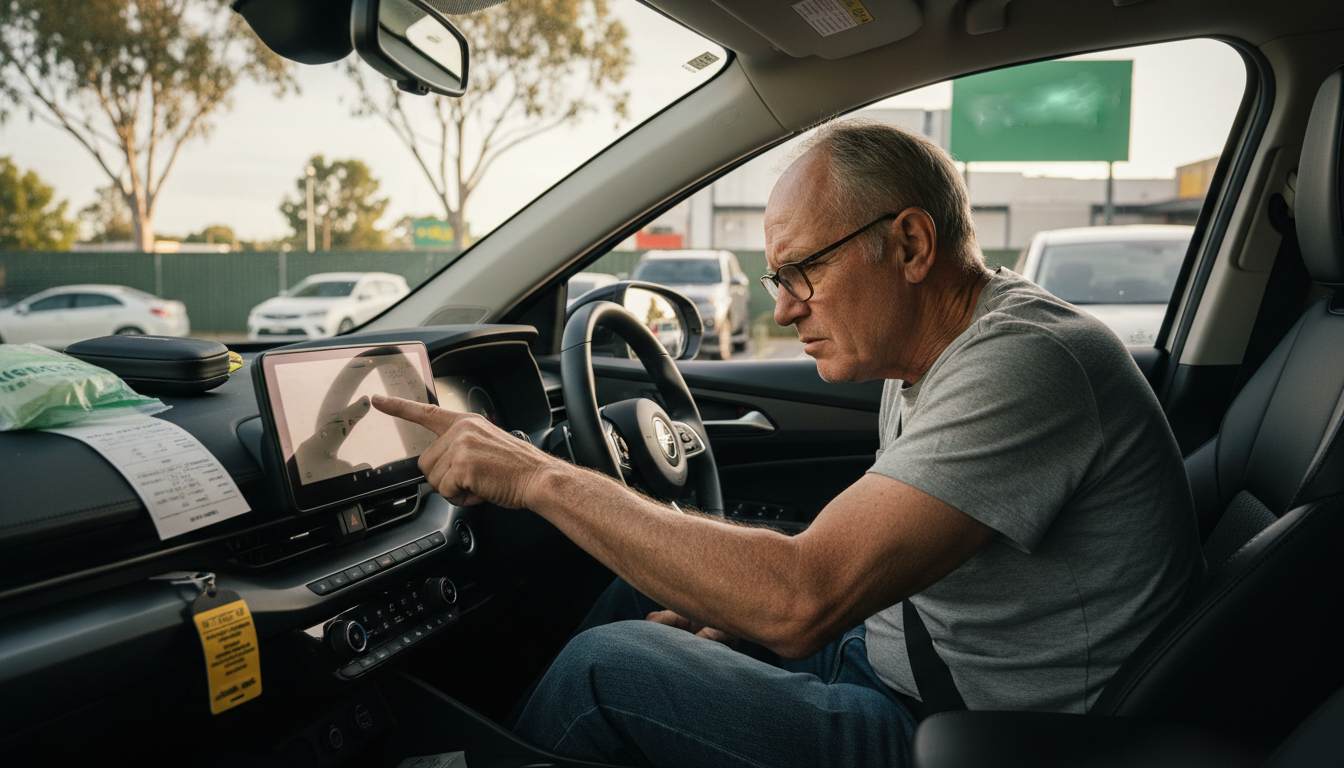
In recent years, we've come down hard on mobile phones behind the wheel, and rightly so. In fact, police in Queensland regularly hand out $1,251 fines and four demerit points for using your phone while driving. Yet car manufacturers have installed what are essentially massive iPads on the dashboard, calling it ‘premium design’.
The uncomfortable truth? These infotainment systems (the industry term for those sleek digital dashboards) might actually be just as or even more dangerous than using your phone while driving.
When Sleek Design Meets Dangerous Distraction
Modern electric vehicles (EVs) and newer petrol or diesel engine vehicles prioritise minimalist cabin aesthetics over physical controls. Tesla's 15-inch screen handles everything from climate control to windscreen wipers. BYD's 15.6-inch setup buries drive modes in sub-menus. Zeekr follows the same philosophy; fewer buttons, more clean lines.
The numbers tell a troubling story. Research from the AAA Foundation for Traffic Safety found that drivers using in-vehicle infotainment technologies were often visually and mentally distracted for over 40 seconds. This was when doing things such as programming navigation or sending messages.
At 100 km/h, that’s over a kilometre of blind driving. At 40 km/h, you’d travel the length of nearly three full cricket fields without properly watching the road. Your brain thinks you're safely using ‘integrated technology’, but your eyes are telling a different story.
Compare this to texting on a handheld phone, which takes about five seconds, still dangerous, still illegal, but significantly shorter than what these legal, manufacturer-approved systems require.
In fact, research shows that removing your eyes from the road for just two seconds doubles your crash risk. When systems routinely demand 40-second periods, it’s more than concerning.
Your Brain Wasn't Built for This
Physical buttons have a superpower that touchscreens lack: muscle memory. After a few drives, your fingers know exactly where the volume knob sits. You can adjust the temperature without a glance. That's because physical controls provide tactile feedback; you feel the click, the resistance, the confirmation.
Touchscreens are different. If the driver insists on using this feature, each interaction will require visual confirmation. And often it’s not just a single glance, but repeated glances as they find their way through the labyrinth of settings and sub-settings.
University of Washington and Toyota Research Institute studies found that pointing accuracy and speed of touchscreen use were reduced by more than 58% compared to when, say, using these at home on the sofa. Drivers struggled to tap accurately while processing the mental demands of driving. The result? Lane deviation increased by over 40% once touchscreen interaction was introduced.
This is a vicious cycle. The harder the touchscreen is to use while driving, the more mental resources you must divert from the road. The more resources you divert, the worse your driving becomes. The worse your driving becomes, the more you need to focus on the touchscreen to correct your mistakes.
Your brain is essentially trying to balance a cheque book while navigating traffic. Even hands-free voice commands don't fully solve this problem. AAA testing found that voice systems still create unnecessary cognitive load.
The Regulatory Blind Spot
Here's where things get absurd.
Queensland's Transport Operations Act treats your handheld phone as a serious threat. The logic is sound: phones distract you from driving.
But that same legal framework has nothing to say about spending 40 seconds programming your car's navigation system at highway speeds. Australian Design Rules mandate seatbelts, airbags, and stability control. To date, there is silence on infotainment systems.
There are no standards for establishing maximum task completion times, no requirement for physical buttons on critical functions, and no assessment of cognitive load before a vehicle is approved for Australian roads.
Meanwhile, European regulators are moving ahead. Germany's framework includes penalties for manufacturers whose designs require an over-reliance on screens. Euro NCAP safety ratings now dock points for this very same issue. Scandinavian countries conduct cognitive demand testing before vehicle approval.
NHTSA released voluntary guidelines back in 2012 recommending car manufacturers block access to texting, social media, and navigation programming while vehicles are in motion. Most systems tested in AAA research could be made significantly safer simply by following these recommendations. But, yes, you guessed it, these remain voluntary, not mandatory.
Australia is lagging behind, and that leaves Queensland’s motorway heavy road network vulnerable to what is, in effect, distraction through design.
Who Gets Left Behind
Not everyone adapts to touchscreens equally. For older Queenslanders, who make up roughly a quarter of all drivers, these systems often present challenges.
Age-related visual acuity decline makes precise taps difficult. Add in vehicle vibration, and you've got a recipe for frustration. Fine motor control decreases with age, turning simple swipe gestures into multi-attempt ordeals. When you're hunting through menu after menu for the demister while your glasses fog up, it can get, well, stressful.
Accessibility advocates have raised concerns about tech-savvy-only designs that can exclude drivers with visual impairments, motor disabilities, or different cognitive processing styles. By assuming a narrow set of driver capabilities, these systems can create barriers for a significant portion of the driving population.
What the Crash Data Hides
Here's the problem with measuring infotainment-related crashes: they're massively underreported.
Drivers who cause crashes rarely volunteer that they were fumbling with the climate control. Police reports often lack specific categories for ‘infotainment distraction’. Instead, these incidents get buried in wider contexts, such as driver inattention.
What we do know is that distraction is the main contributing factor in about 16% of Australia’s serious casualty road crashes. To compare, drink driving, the number one contributing factor in road deaths, is around 30%.
Nationally, distracted driving claimed 3,275 lives in 2023 in the United States, with another 324,819 people injured. That's nine deaths and 890 injuries every single day. How many involved infotainment systems versus handheld phones? Unfortunately, we don’t yet have clear data.
Paths Toward Safer Roads
The good news? Solutions exist. Some are immediate, others require industry and regulatory change.
For drivers right now:
Pre-programme your navigation before you start moving. Set your climate control, choose your playlist, and adjust your seat while parked. Use voice commands cautiously, recognising they're not a perfect solution, error rates climb in noisy environments, and every voice interaction also creates cognitive demand.
If you absolutely must adjust something while driving, wait for a red light or pull over. The radio station isn't worth a crash.
For families shopping for cars:
Test drive with intention. During your test drive, attempt real-world tasks: adjust the air conditioning, switch on the wipers, change the radio station, and program a destination. Compare it with what you’re used to, notice how often your eyes leave the road, and check out the differences between the models on offer.
Don't assume newer means safer. Sometimes that 2019 model with actual buttons will serve your family better.
For automakers:
The path forward involves reintroducing physical controls for frequently-used features. Volume, lighting, de-misters, wipers, and basic climate functions. These need tactile interfaces. Manufacturers like Volvo are already moving in this direction with haptic knobs that blend physical feedback with modern design.
Lock out genuinely dangerous features while the vehicle is moving. There's no legitimate reason drivers should be able to compose emails, browse social media, or program navigation at 100 km/h.
Future systems should detect increasing driver distraction through eye-tracking and physiological markers like pupil dilation and skin conductivity. When distraction is detected, interfaces should automatically simplify, with larger buttons, fewer menu levels, and suppressed non-essential functions.
For regulators:
Australian Design Rules need updating with specific usability standards. Maximum task completion times. Mandatory physical controls for critical functions. Cognitive load testing before approval. This is common sense catching up with technology.
Align Queensland's distraction penalties with the reality of modern vehicles. If a handheld phone warrants a $1,161 fine, assess the impact of a touchscreen on safety and penalise drivers accordingly.
The Road Ahead
The first major court case is looming. Picture a multi-car pileup on the M1 traced back to a driver hunting for wiper controls in their dashboard computer. Victims sue the manufacturer for ‘foreseeable distraction’. After all, precedents exist: U.S. cases against Tesla are building, and European class actions are brewing.
For Queensland families buying EVs and modern vehicles, this creates an opportunity. As a consumer, you’re voting with your credit card. Demand hybrid controls, ask dealerships hard questions about interface safety, and test thoroughly.
Nearly 70% of adults want new vehicle technology, but only 24% feel it works perfectly. This gap is indicative of the overreliance many consumers have on technology, even when they themselves are not confident about the benefits.
These infotainment systems demand longer interaction times, create greater cognitive load, and exclude vulnerable driver populations, all while carrying the manufacturer's implicit safety approval.
We banned handheld phones because the evidence was clear: distraction kills. While current research on the effect of dashboard entertainment and control systems is limited, it’s not unthinkable that soon we’ll have this valuable data. The real question is whether we wait for more people to get hurt before tightening the rules, or start now to close a regulatory gap that all too often favours design trends over safety.
Your next car purchase is a choice. Your attention to the road is non-negotiable. And that massive touchscreen? It might look impressive in the showroom, but on the Bruce Highway in the rain, give me a good old-fashioned button every time.