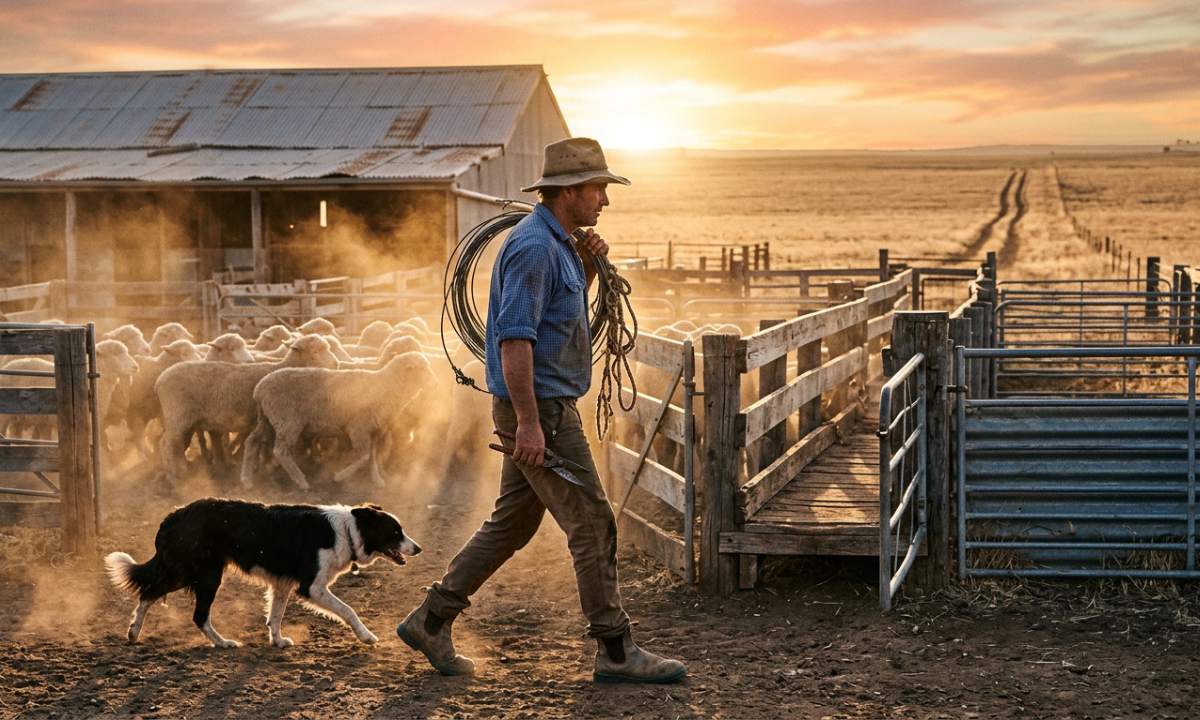
Agriculture kills Australian workers at a rate of 13.7 fatalities per 100,000, almost double that of the next most dangerous industry. And people seem to have no idea this is happening.
The industry that barely makes the news
When most Australians imagine dangerous work, they think of the mining industry. Hard hats, explosions and cave-ins always get the headlines.
But Safe Work Australia's 2025 national data tells a very different story. In 2024, 44 agricultural workers died on the job, making agriculture, forestry and fishing the second-highest industry for raw fatalities, with only transport seeing more deaths.
In terms of fatality rate, agriculture stands in a league of its own.
Transport, postal and warehousing saw 7.4 deaths per 100,000 workers, while mining recorded 3.4. Construction, the industry best known for safety campaigns, also came in lower.
Agriculture's fatality rate is more than 10 times the national average of 1.3.
188 dead in a single year
In 2024, a total of 188 Australian workers died from traumatic injuries while at work. Queensland’s 53 fatalities were the highest number of any state, closely followed by New South Wales with 48.
The leading causes are blunt force trauma and accidents involving mechanical machinery. Incidents involving vehicles accounted for 42% of all worker deaths (79 workers), while falls from height killed 24 workers (13%) and being hit by moving objects resulted in the deaths of another 17.
These aren’t freak accidents, they are a recurring pattern which repeats year in, year out.
The agriculture sector is also the leading cause of injury claims across the country. According to Safe Work Australia, agriculture saw 10.0 serious claims per million hours worked in 2023-24, which is 46.9% higher than the all-industry average of 6.8.
A 2025 study published in the Australian Journal of Rural Health found that on-farm fatalities across the nation jumped from 32 in 2023 to 74 in 2024, the highest figure in two decades. Injury claims involving farm workers cost roughly $190 million each year.
Read our article on: Farming in Focus: Cultivating Safety in Queensland's Agricultural Industry
Mining's quiet surge
Mining fatalities aren't close to the rate seen in agriculture, but the trend is heading in a worrying direction.
The 10 deaths which happened in the mining industry in 2024 were 39% above the five-year average, a significant spike in a line of work which receives far more regulatory attention, inspections and media coverage than farming.
Research from the University of Queensland's Sustainable Minerals Institute found that safety reforms in Australian mining have been stagnating for a decade. Despite huge investment in safety systems, the progress made in the early 2000s has plateaued.
The real question is whether regulatory attention is being distributed in proportion to actual risk, or if the industries that see the most worker deaths are the ones that actually get the least amount of scrutiny.
The prosecution gap nobody talks about
This is where the data starts getting a little uncomfortable.
Mining.com.au found that between 2020 and the end of 2023, Australia undertook 557 prosecutions for serious workplace injuries, and 185 for workplace fatalities. That is a 3:1 ratio of serious injury prosecutions to those for fatalities.
In 2024, 317 Work Health and Safety (WHS) prosecutions were recorded, with an average fine of $116,979 per prosecution.
But context is important here. There were 146,700 serious workers' compensation claims lodged in 2023-24, that’s more than 400 serious claims made every single day. Considering there were just 317 prosecutions for the entire year, the enforcement ratio is startling.
Construction accounted for 47% of all prosecution cases, while manufacturing saw 21% and transport accounted for 5%. Agriculture, the deadliest industry by rate, is not even among the top three in terms of prosecutions.
Just 16% of cases which led to prosecution in 2024 involved a fatal injury, and only 49% involved a serious injury. The remaining third involved breaches in which no injury had yet to occur.
The ACTU expressed their alarm that seven in ten injured workers across Australia were not receiving workers' compensation at all because of barriers in reporting and a culture of under-reporting that muddy the waters of the true scale of workplace harm.
All states now have industrial manslaughter laws. Does it matter?
Every Australian jurisdiction currently has an industrial manslaughter offence on their books. New South Wales and Tasmania were the last to introduce theirs.
Penalties are quite severe in theory. In NSW, individuals found guilty face up to 25 years in prison, and the maximum is 20 years in Queensland. Corporate fines range from $13.3 million in Queensland to $20 million in NSW.
But having the law and enforcing it are often vastly different things in practice. Victoria may have prosecuted 137 WHS cases in 2024, and collected $17.4 million in penalties, but just 17 of those were related to fatalities.
Unfortunately for all Australians, the gap between the volume of workplace harm and the rate of prosecution remains vast.
How Australia compares internationally
The UK recorded 138 fatalities in 2023-24, a fatal injury rate of 0.42 deaths per 100,000 workers. Australia's rate of 1.3 per 100,000 is more than triple that number.
New Zealand's non-fatal injury rate of 1,200 per 100,000 workers is significantly worse than Australia's 899 and the UK's 692. But when it comes to fatalities, Australia performs much worse against comparable economies.
The Netherlands, Sweden, Germany an d the UK have all consistently achieved workplace fatality rates below 1.0 per 100,000, but Australia has thus far failed to to do so.
Stronger enforcement appears to be a key part of solving the issue. The UK's HSE model combines proactive inspections with high prosecution rates relative to the size of the workforce. In comparison, the Australian state-by-state regulatory model seems to cause inconsistencies in how standards are applied, inspections are resourced and breaches are prosecuted.
The dimension that's growing fastest
While physical injuries dominate fatality data, mental health claims are quickly becoming the fastest-growing category of workplace harm.
Safe Work Australia's 2025 data shows that mental health conditions accounted for 17,600 serious workers' compensation claims in 2023-24, an increase of 14.7% from the previous year. Over the course of the past decade, serious claims for mental health conditions have risen by 161.1%, a shocking rise.
The median compensation paid for a mental health claim ($67,400) is more than four times the median across all serious claims ($16,300), while the median time lost (35.7 working weeks) is almost five times the overall average.
Harassment and workplace bullying (33.2%), work pressure (24.2%) and exposure to violence (15.7%) are the leading causes. This is not an insignificant category; mental health is now the fourth most common cause of serious workplace injury claims across Australia.
What injured workers can actually do
Australians injured in the workplace have the right to make a workers' compensation claim. This covers medical expenses, lost income and rehabilitation costs in most states, although time limits can vary by location and the type of claim in question.
In Queensland, for example, the general limitation period for a personal injury claim is three years from the date of injury, while a WorkCover Notice of Claim must be lodged within six months of the incident.
The most critical step is documenting the injury at the earliest opportunity. Report it to your employer, see a doctor and keep meticulous records. These steps will help you protect your ability to claim regardless of the industry you work in.
For workers in high-risk industries like agriculture and transport, where injury rates are significantly above the average, understanding your rights before things go wrong matters more than it does in most other jobs.
It’s always a good idea to speak to a lawyer as early as possible, before insurers make decisions about your claim, to give you a clear picture of exactly where you stand. Most personal injury lawyers offer free initial consultations, so the cost barrier is low and you have nothing to lose.
The full picture
Australia's deadliest industry doesn’t get the most safety campaigns, inspections or media coverage. In fact, the agricultural sector sees worker deaths at a rate that dwarfs every other industry, and the enforcement response fails to match the scale of harm.
The prosecution gap is not just a numbers problem, it’s a signal of which industries face real accountability for unsafe conditions and those that don’t. When 400 serious injury claims are filed every day and 317 prosecutions happen in a year, the system is failing to keep pace and do what it’s designed to do.
The laws are on the books and the data is clear. The question is whether enforcement will ever catch up.