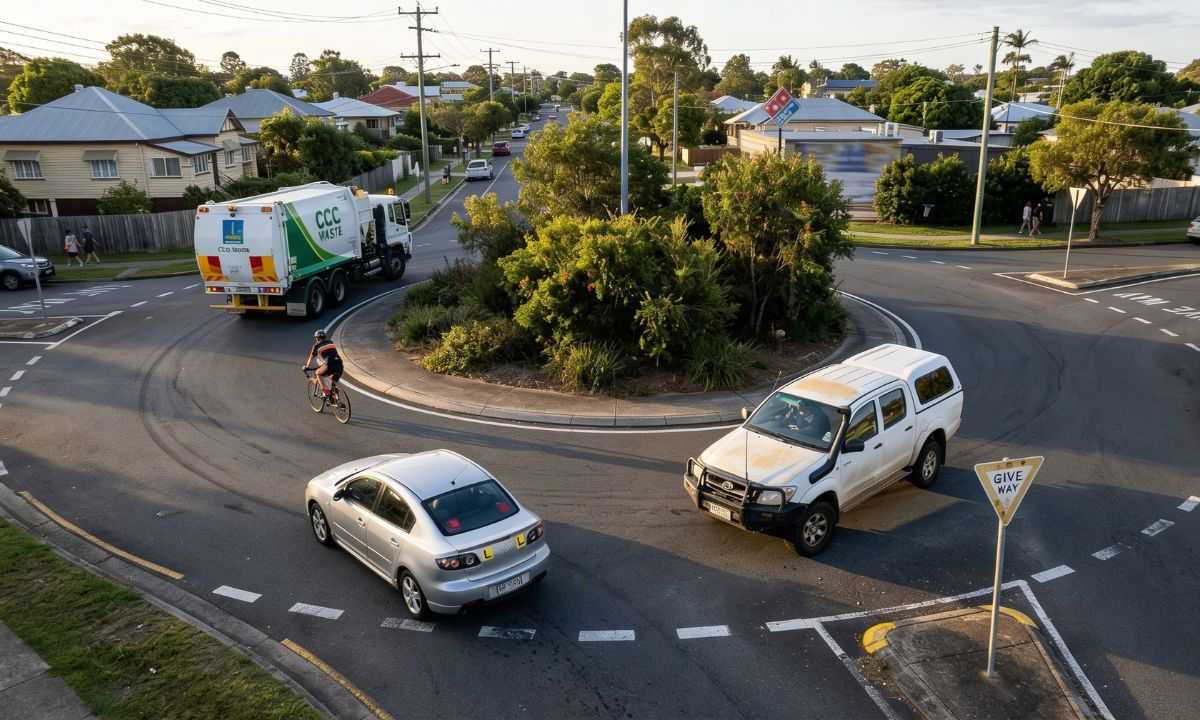
Here's a question that should be simple: Who gives way at a roundabout?
If you thought it’s simply 'give way to the right,' then I have to tell you, you're wrong. And you're in very good company, because this myth is arguably the most widely believed road rule in Australia.
The actual rule is slightly more nuanced: You give way to vehicles that are already circulating the roundabout.
But here's the thing: almost nobody follows this correctly, and at this point, the collective wrongness has become its own kind of system. It’s possible that fixing it could even make things worse on our roads.
Let’s call this ‘The Roundabout Problem’ and in this article, let’s explore why it’s important.
Australia's Favourite Road Feature (That Nobody Understands)
Australia’s not shy of building roundabouts, that’s for sure. In Sydney, there’s one roundabout for every 1,600 people. This increases to 1,700 for Adelaide. Queensland alone has thousands of them, from tiny single-lane circles in suburban streets to, often chaotic, multi-lane versions that test the nerves of even the most experienced of drivers.
They exist because, on paper, they're fantastic things. Research from BITRE shows that roundabouts massively reduce the severity of crashes when compared to traditional intersections. For high-risk intersections, they can reduce crashes that cause injury or death by more than 70%. Even crashes that cause property damage see a 50% reduction.
It really comes down to physics. Roundabouts make drivers slow down, and they get rid of those awful T-bone crashes, where one car slams into the side of another at an intersection. Instead, any contact tends to happen at lower speeds and at an angle, making the crash less severe.
Sound good? Well, it’s maybe not quite as simple as this. After all, ‘less severe’ doesn’t necessarily mean ‘less frequent’. This is where ‘The Roundabout Problem’ takes on a new perspective.
The Numbers Behind the Confusion
A landmark study of 100 roundabouts throughout Queensland found that the most common crash type was the 'entering-circulating' collision. This is where a vehicle pulls into the roundabout while another vehicle is already circulating. This single crash type accounted for more than 50% of all roundabout crashes that were looked at as part of the study.
The next most common? Rear-end crashes at the entry point (18.3%) and single-vehicle incidents (18.3%). These usually involve someone clipping a kerb or a centre island because they misjudged the geometry.
When it comes to failing a driving test, not giving way at a roundabout is often cited as one of the main reasons in Australia.
The Three Rules Almost Everyone Gets Wrong
1. 'Give way to the right' is not a roundabout rule.
This is the big one. The usual rule of giving way to the car on your right does not apply at roundabouts. At a roundabout, you must give way to any vehicle already circulating, stopping if necessary.
In practice, this can look like giving way to the right, since vehicles from that direction are often already circulating. But the distinction matters. If a vehicle from your left reaches the roundabout first and is already in it, it has priority.
2. You must indicate when exiting.
A survey by the RAA found that 21% of drivers didn't think you needed to indicatewhen exiting a roundabout straight ahead. You do. Every time you exit a roundabout, whether you're turning left, going straight, or turning right, you need to signal to other drivers.
When you don't indicate your exit, every other driver waiting to enter the roundabout has no idea when it's safe to go. They either wait too long (causing congestion or frustration) or guess wrong (causing crashes).
3. Multi-lane roundabouts have lane rules.
If a roundabout has two or more lanes, the lane you enter determines which exits you can take. Generally, the left lane is for turning left or going straight, and the right lane is for going straight or turning right. But signage varies, and plenty of drivers seem to treat multi-lane roundabouts as a free-for-all.
This is where many ‘entering–circulating’ crashes happen. Two cars enter from different directions, both trying to take the same exit, and two can’t go into one.
The Paradox: We're All Wrong Together
Here's the part that makes road safety engineers wince.
CarsGuide pointed out something genuinely uncomfortable: most Australian drivers are probably breaking roundabout rules every single day without realising it. And if a chunk of us suddenly started following the correct rules while everyone else continued with the collectively wrong behaviour, the results could be dangerous.
It's a coordination problem. When everyone does the wrong thing in the same way, it becomes predictable. When half the drivers do the right thing and half do the wrong thing, nobody can predict what anyone else is about to do.
This doesn't mean the rules are wrong; it means simply that enforcement and education haven’t kept up the pace as we’ve been building roundabouts just about everywhere.
Cyclists at Roundabouts: A Particularly Dangerous Mix
What’s confusing for a driver is hazardous for a cyclist.
A 2017 review of bicycle safety found that roundabouts are a primary location for serious cycling collisions in Australia. The problem is visibility, or rather, the lack of it. Drivers approaching a roundabout are scanning for cars, not bikes. A cyclist already circulating in the roundabout is smaller, slower, and harder to spot, especially in a driver's peripheral vision.
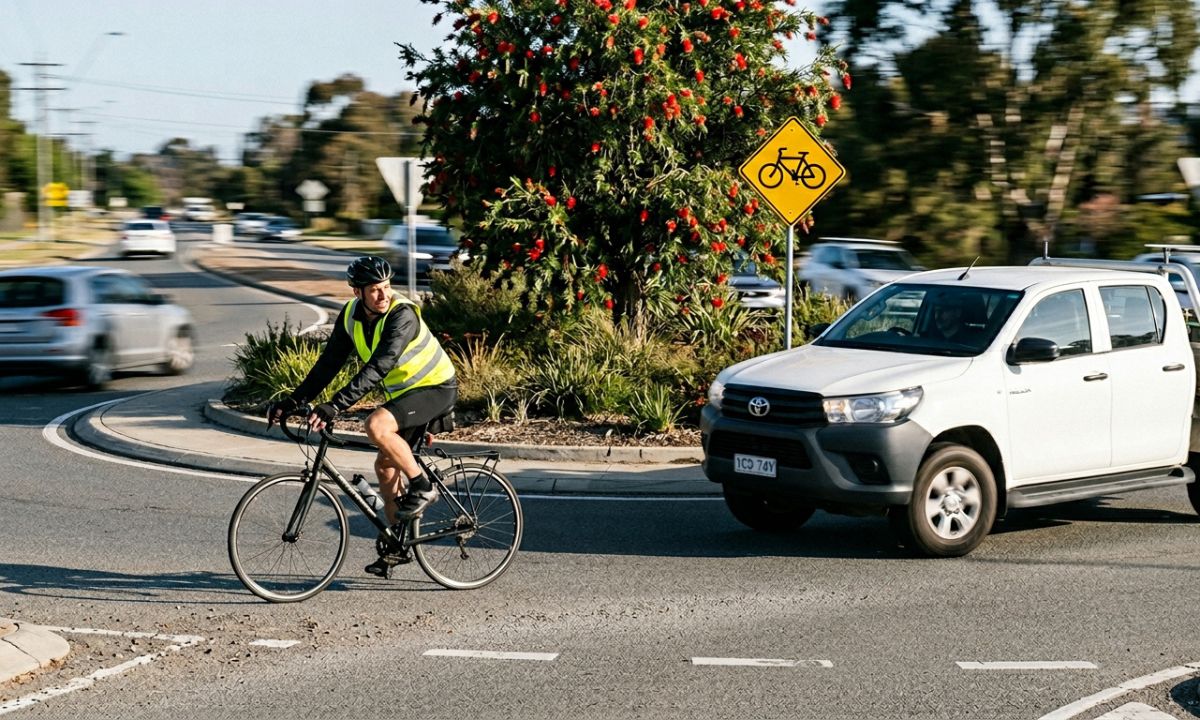
As you can imagine, multi-lane roundabouts make the problem even worse. A cyclist riding in the left lane who wants to go straight through can end up crossing the path of vehicles in the right lane that are also going straight. Worse still, drivers may turn left across the cyclist’s path without even seeing them.
Some councils have started adding separate cycling paths around roundabouts, removing bikes from the circulating traffic entirely. It's expensive, but it works. The Queensland Government's cycling infrastructure guidelines increasingly recommend separated paths for roundabouts on busy roads.
Also read: Drivers vs Cyclists: A Growing Divide
Design Matters More Than You Think
Not all roundabouts are created equal, and Queensland is home to an extensive range that come in all shapes and sizes.
There are tiny neighbourhood roundabouts where the centre island is basically a painted circle that trucks drive straight over. There are medium suburban roundabouts with landscaped islands and questionable sightlines, thanks to overgrown shrubs. And there are large multi-lane roundabouts on arterial roads that require genuine skill to navigate.
Research from Austroads has shown that roundabout geometry, the entry angle, the size of the central island, the width of the circulating road, and the deflection imposed on entering vehicles directly affect crash rates.
The best-designed roundabouts force you to slow down whether you want to or not. The worst-designed ones let you sail through at 50km/h and hope for the best.
So What Actually Helps?
A few things are proven to make roundabouts safer.
Better signage and road markings. Clear lane arrows, visible give way lines, and well-maintained signs reduce confusion. Signs, over time, fade and become essentially invisible to road users.
Raised approaches. Speed bumps or raised platforms on the approach to a roundabout force drivers to physically slow down, which buys reaction time.
Lighting. Plenty of roundabout crashes happen at night or dusk. Adequate lighting, especially illuminating the centre island and the pedestrian/cyclist paths, can make a huge difference.
Education that goes beyond the driving test. Most drivers learn roundabout rules once, pass their test, and never think about them again. Given how many rules are being broken daily, periodic refreshers through licensing renewals are one option.
And for the rest of us? Next time you approach a roundabout, indicate your exit, focus on the circulation of traffic, give yourself plenty of time to slow down in the approach, and be wary of cyclists. These are a few simple things you can do to make that little circle of chaos just slightly less chaotic.