In many cases, yes. WorkCover Queensland covers some injuries that happen while you are travelling to or from work.
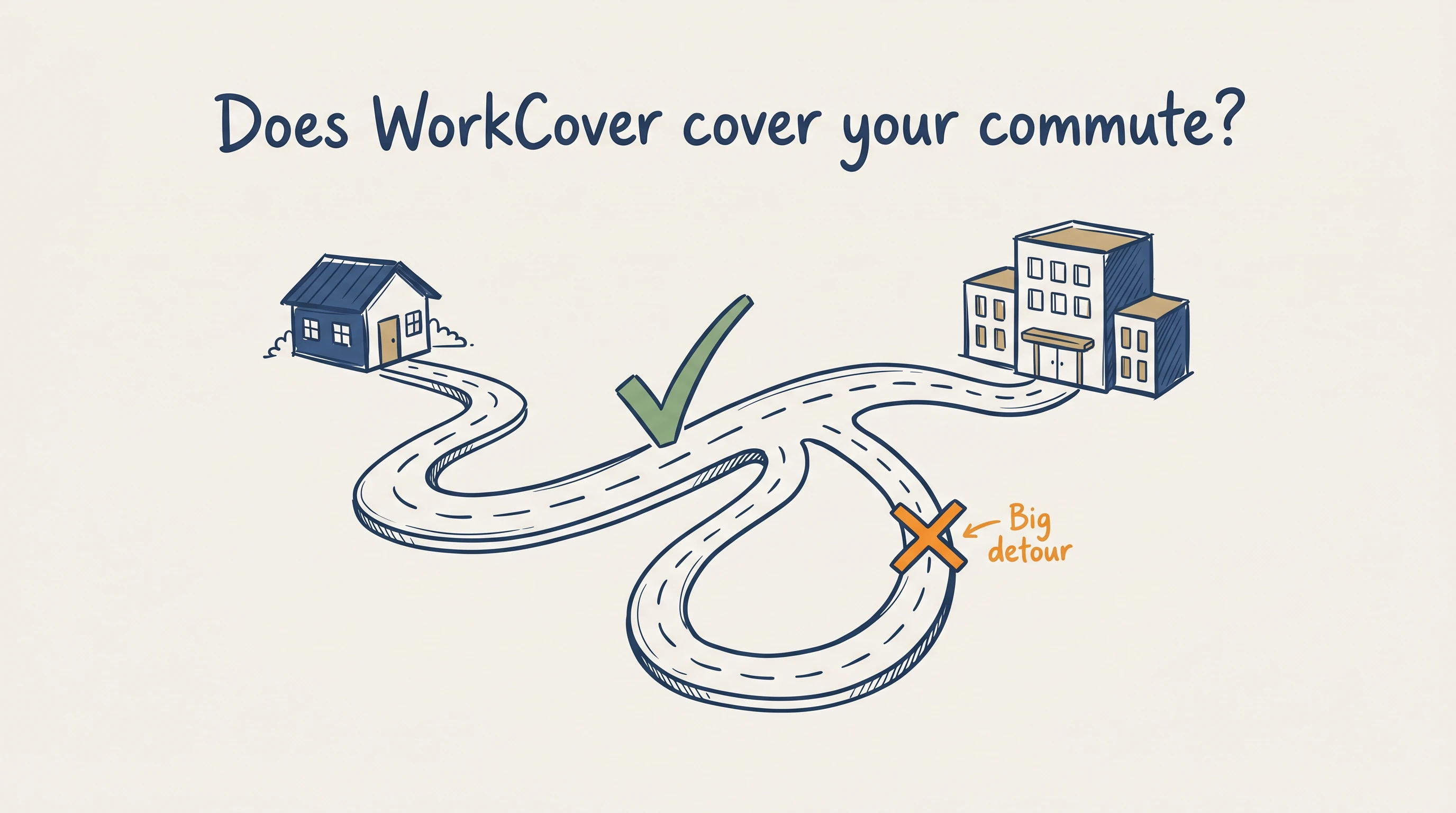
This is known as a journey claim. To be covered, you generally need to be on a direct trip between home and work, with no big delays or detours.
This article will look at what a journey claim is, whether you are covered and some scenarios that might fit your specific case.
Understanding Journey Claims in Queensland
A journey claim is a workers' compensation claim for an injury that happens while you are travelling to or from your workplace, rather than at the workplace itself.
Most people assume workers' compensation only covers you once you clock in. Actually, according to WorkSafe Queensland, you may be covered for an injury on the trip between your home and your place of employment.
The trade-off is that the trip has to be a genuine, direct journey. The moment you turn a work commute into a personal outing, or a pop down the shops, the cover can be voided.
When Does the Journey Start and Finish?
Your journey home starts, and your journey to work finishes, at the boundary of the land where your home is.
If you slip on your porch step leaving your home, this wouldn’t be considered part of the journey and you wouldn’t qualify for a journey claim.
What Kinds of Travel Are Covered
Journey claims in Queensland cover more than just the daily commute.
You may be covered while travelling for several work-related reasons, as long as the trip is direct.
Travel that can be covered:
- The direct trip between your home and your workplace.
- The trip to or from approved trade, technical or other training your employer expects you to attend.
- Travel for work reasons, such as to a work meeting or conference, locally, interstate or overseas.
- Travel to and from medical treatment or rehabilitation that is part of an existing WorkCover claim.
What you must do to protect your cover:
- Travel directly, without a substantial delay before you set off.
- Avoid substantial interruptions or detours unrelated to your work.
- Seek medical attention and a workers' compensation medical certificate as soon as possible.
- Report the injury to your employer in writing.
For the full list of what WorkCover pays once a claim is accepted, see ‘What Payments Does WorkCover Queensland Cover?’
Covered vs Not Covered: A Quick Comparison
Whether an injury that occurs during a journey is covered usually depends on how direct the trip was.
This table shows the common situations:
The line between a ‘minor break’ and a ‘substantial deviation’ is where most disputes happen, so the exact facts of your trip matter.
The Legal Framework Behind Journey Claims
Journey claims sit inside the Workers' Compensation and Rehabilitation Act 2003 (Qld), the law that governs workers' compensation across the state.
Section 35 sets out the journeys that can be treated as connected to your employment, including the trip between home and work, trips to approved training, and travel to get treatment for an existing claim.
Section 36 then sets out when a journey injury is not covered. Your injury may not be treated as work-related if there was a substantial delay before you started, or a substantial interruption of or deviation from your normal route.
Cover can also be suspended if you are in control of a vehicle and a serious breach of the law occurs, such as drink-driving or drug-driving.
What this means for you
The most viable journey claim is the result of a direct, ordinary trip. The more your trip looks like a personal outing, or if it can be shown that a driving offence was committed, it becomes much harder to make a valid claim.
Common Scenarios and Questions
Am I covered if I crash my car while driving to work?
Often, yes, if it happened on a direct trip to work. A motor vehicle crash on your normal route to or from work can be a journey claim. The crash does not have to be your fault. But if the trip involved a big detour, or a serious driving offence on your part, cover can be affected.
What if I stopped for coffee or fuel on the way?
A short, minor stop may not break your cover, but a substantial deviation can. The test is whether the stop caused a substantial interruption or deviation from your normal route, and whether it materially increased the risk. A quick stop close to your usual route is different from a long trip across town to run errands.
What if I dropped my kids at school first?
It depends on how far the school run takes you off your normal route. A small, regular detour may be treated differently from a long deviation. Because this is exactly the kind of fact insurers scrutinise, it is worth getting advice before you assume you are, or are not, covered.
Am I covered while driving home after a work function or following overtime?
Possibly, if you were on a direct trip home. Working late or attending a work event does not invalidate cover by itself. What matters is whether the journey home afterwards was direct, and whether any delay before leaving was substantial.
Does WorkCover cover me if I was speeding or on my phone?
A serious offence can cancel your cover, but not every breach counts. Breaking road rules, such as drink-driving or drug-driving, may affect your eligibility for WorkCover. Whether this applies depends on the specific circumstances of your accident, so it's best to seek advice rather than assume your claim will be rejected.
What if I work from home or from a different site?
Different rules can apply when your workplace is not fixed. If you work from home or from another location, the journey rules can change. We cover this separately in ‘Does WorkCover Cover Me If I’m Working from Another Location?’
Can I claim WorkCover and a car accident claim at the same time?
Sometimes, yes. If your injury was caused by a motor vehicle crash, you may have two separate claims. One is your WorkCover journey claim for statutory benefits like wages, medical costs and rehabilitation. The other is a CTP (Compulsory Third Party) claim, which is a separate claim against the at-fault driver's insurer for damages.
You cannot be paid twice for the same loss, and WorkCover can recover what it paid if you later succeed in the CTP claim. You can read more about road crash claims on our motor vehicle injuries page.
How long do I have to lodge a journey claim?
You generally have 6 months from the date of injury to lodge a WorkCover claim. If you were involved in a car accident, a separate CTP claim has its own deadline, usually 9 months from the date of the accident.
These deadlines are strict, so it is best to start early. Our guide on ‘How to make a WorkCover claim’ walks you through the steps.
When to Seek Legal Advice
Journey claims are one of the most disputed parts of Queensland workers' compensation. This is essentially because of how difficult it is to assess how ‘direct’ a trip was.
It is worth getting legal advice if:
- Your journey claim has been rejected because of an alleged delay, interruption or deviation.
- Your injury happened in a car crash, so both a WorkCover and a CTP claim may apply.
- You are unsure whether a school drop-off, errand or stop counts as a substantial deviation.
- A driving offence is being raised as a reason to refuse your claim.
Key Takeaways
- Queensland still allows journey claims for injuries travelling to or from work in defined circumstances, unlike some other states.
- Directness is everything. A substantial delay, interruption or deviation can invalidate your cover.
- Cover also extends to approved training trips and to medical appointments for an existing claim.
- A serious drink or drug driving offence can jeopardise a journey claim.
- A road crash on the way to work can give you both a WorkCover claim and a separate CTP claim.
- Deadlines apply: generally 6 months for WorkCover and 9 months for a CTP claim, so act early.
Get Help Now
If you’d like to understand more about making a journey claim or would like to discuss your options following an injury while commuting to work, Smith’s Lawyers offers a no-obligation review of your situation with no upfront costs. A member of the team will assess your rights, explain your options and let you know the best course of action.
Contact Smith's Lawyers today:
- Call 1800 960 482 for a free, no-obligation consultation about your situation
- No upfront costs: We operate on a No Win, No Fee, No Catch® basis; you only pay if we secure compensation for you
- Or request a call back: Use the form below to have our experienced team get in touch at a time that’s convenient for you.