If you get hurt while working in Queensland, WorkCover pays a set of no-fault benefits called statutory compensation, regardless of who or what caused the injury.
It covers part of your wages while you are unable to work, as well as your medical and hospital treatment, rehabilitation, travel to appointments and a lump sum if you are permanently impaired.
You don’t need to prove anyone was at fault for your injury to claim these payments.
Quick Answer Box
Key points:
- WorkCover covers five main things: weekly wages, medical and hospital costs, rehabilitation, travel and a lump sum in the case of permanent impairment
- Weekly payments replace a percentage of your regular earnings, not the full amount
- Reasonable, approved medical and rehabilitation treatment is paid on top of your wage replacement
- A lump sum for permanent impairment will only be assessed when your injury stabilises
- Statutory benefits are separate from a common law claim, which is made through a lawyer if negligence was involved in the injury
Who pays? Either WorkCover Queensland or your employer's self-insurer, and only once your claim has been accepted.
What do you get? Weekly wage payments, medical and hospital expenses, rehabilitation costs, reimbursement for travel and a possible lump sum in cases involving permanent impairment.
What don't you get? WorkCover statutory benefits don't provide compensation for pain and suffering or future economic losses. Those are only available via a separate common law claim.
Next best action: if you have not yet lodged a claim, see a doctor and ask for a workers' compensation medical certificate. There's more information in our guide on making a WorkCover claim.
Understanding WorkCover Statutory Benefits
WorkCover statutory benefits are payments made to an injured worker while they recover. They are designed to keep you afloat while you are unable to work, cover any treatment you require and help you get back to work.
What "statutory" means
Statutory compensation is compensation set out in the Workers' Compensation and Rehabilitation Act 2003 (Qld). The amounts paid out and rules that govern them are set by that law, which means WorkCover applies the same formula to everyone. You don’t have to prove your employer did anything wrong to get it.
Who administers your payments
For the majority of workers in Queensland, payments come from WorkCover Queensland, the state insurer. Certain large employers, such as major supermarket chains, are self-insured, which means they pay claims directly, and the processes and entitlements are the same.
The five things WorkCover pays
Each claim involves the same categories of benefit: weekly wage payments, medical and hospital expenses, rehabilitation, travel and related costs and a lump sum in cases involving a permanent impairment.
The table below sets out what each one covers.
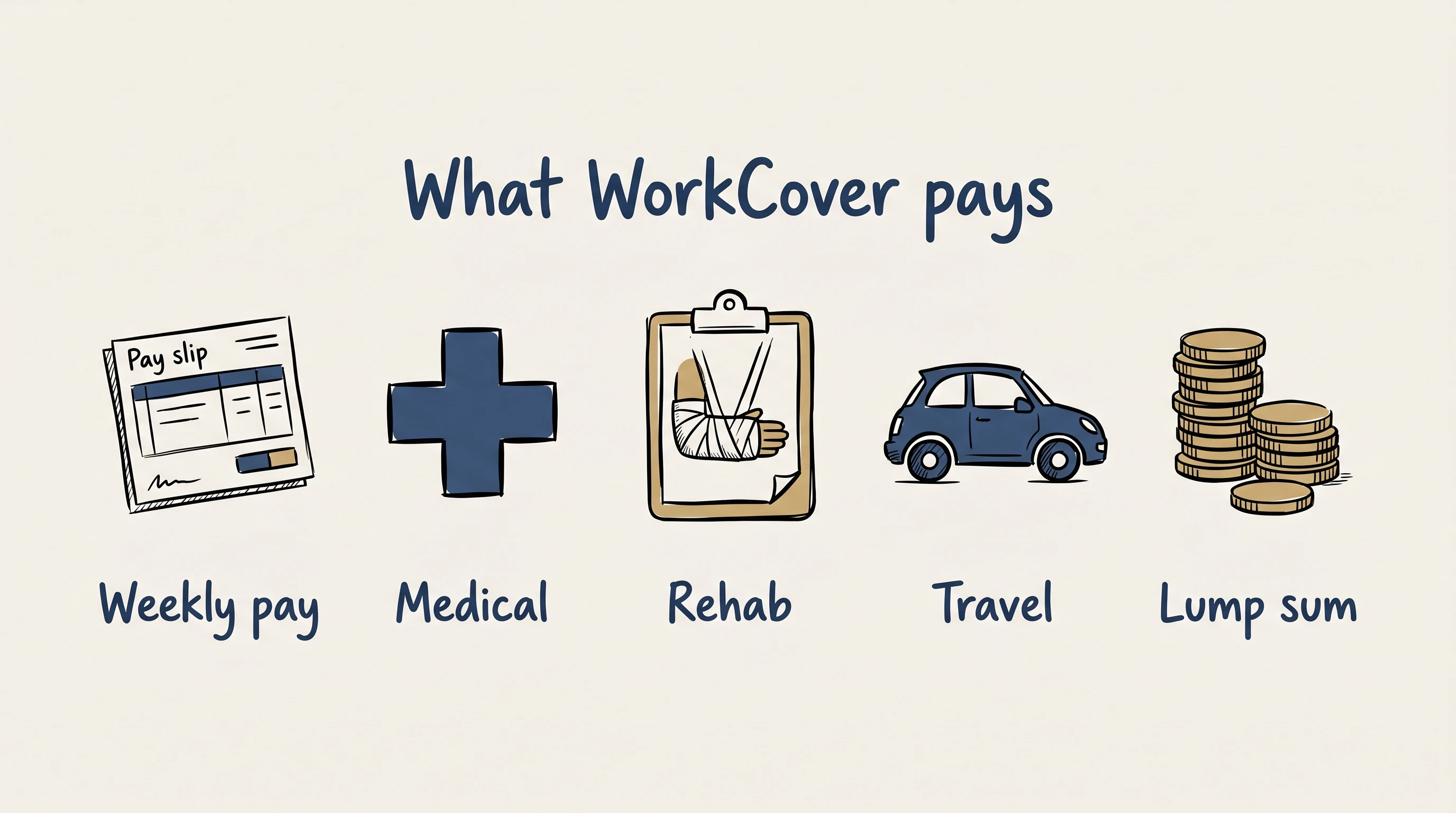
What Workcover Pays: The Benefit Categories
WorkCover statutory benefits fall into five categories that are all paid on top of the other. This means an injured worker undergoing treatment can receive weekly payments, medical costs and travel reimbursement all at the same time.
| Benefit | What WorkCover pays | Key limit or note |
|---|---|---|
| Weekly compensation | A percentage of your normal weekly earnings while you cannot work or are on reduced hours | Reduces over time; capped at your normal weekly pay |
| Medical and hospital | Doctors, physiotherapy, specialist appointments, surgery, medication, dressings and equipment such as crutches | Must be reasonable and related to the work injury; paid at set table-of-costs rates |
| Rehabilitation | Treatment and services to help you recover and return to work, including occupational therapy and psychological support | Coordinated through a return-to-work plan |
| Travel and related costs | Reasonable travel to and from approved medical and rehabilitation appointments | Must be necessary, reasonable and approved by WorkCover |
| Permanent impairment lump sum | A one-off payment if you are left with a lasting impairment | Only assessed once the injury stabilises |
Travel and other out-of-pocket expenses are reimbursed where they are necessary, reasonable and approved in advance, so be sure to keep receipts and check with your claims manager before booking longer trips.
Your Weekly Wage Payments Explained
Weekly compensation replaces part of your income while you are unable to work because of your injury. It doesn’t cover all of it, and the percentage you’re paid gets lower the longer you’re off work.
How much you receive
The rate you’re paid is calculated from your Normal Weekly Earnings (NWE), which is more or less your average pay before the injury and a benchmark figure called Queensland Ordinary Time Earnings (QOTE). WorkSafe Queensland updates QOTE each financial year, and for 2026-27 it’s $1,994.50 per week.
For the first 26 weeks of your injury, WorkSafe Queensland pays the greater of 85% of your NWE or 80% of QOTE, but never more than your actual normal weekly pay. Workers covered by an award or industrial instrument might receive the rate set out in that instrument during this early period, which is often higher than NWE or QOTE.
After 26 weeks and until 104 weeks, the rate goes down to the greater of 75% of your NWE or 70% of QOTE.
These percentages, timeframes and the QOTE figure are set by legislation and change with indexation, so check the current-year rates before relying on them.
How long payments last
You won’t receive weekly payments indefinitely. Under section 144A of the Workers' Compensation and Rehabilitation Act 2003 (Qld), they stop once the first of three things happen: you are no longer incapacitated, the maximum statutory amount is reached or five years of weekly payments have been paid.
There is also an important checkpoint at 104 weeks, which is when weekly payments generally only continue if there is a medical opinion that your injury may result in a permanent impairment of more than 15%.
For a complete breakdown, see our guide on how long WorkCover pays in Queensland.
The Permanent Impairment Lump Sum
If an injury suffered at work leaves you with a lasting problem, you may be eligible for a one-off lump sum for permanent impairment that’s separate from your weekly payments and medical costs.
How it is assessed
Once WorkCover decides that your injury has stabilised, which is called reaching Maximum Medical Improvement, you are assessed for your Degree of Permanent Impairment (DPI). A doctor assigns a percentage using the official Queensland guides, and that percentage decides the size of the lump sum.
The higher your DPI, the larger the offer. For 2025-26, the maximum statutory lump sum payable at 100% impairment is $431,111, calculated as 216.15 times QOTE. (Double check the current maximum as it indexes each year.)
The choice at 20%
Your DPI percentage brings you to a key fork in the road. If your DPI is assessed below 20%, you must choose between accepting the statutory lump sum or pursuing a common law claim. You cannot do both. If your DPI is 20% or more, you can accept the lump sum and still pursue a common law claim on top.
It’s worth seeking legal advice before you sign anything here.
Statutory Benefits Are Not the Same as a Common Law Claim
A lot of injured workers incorrectly assume that WorkCover is the only compensation available to them. However, it is only the starting point, not necessarily the end of the story.
WorkCover statutory benefits are the no-fault payments discussed above. Every injured worker starts by opening a WorkCover claim which pays wages, treatment and for rehabilitation while you recover.
A common law claim is a separate legal claim made by a lawyer on your behalf. It seeks damages when your employer's negligence caused your injury.
It is for compensation that statutory benefits don’t cover, including pain and suffering and future loss of earnings. You’ll need to have an open WorkCover file, and you can see the process for common law claims on the WorkSafe Queensland website.
You don’t choose between the two options at the beginning. In the majority of cases, workers receive WorkCover benefits during recovery, and once the injury stabilises they can pursue a common law claim through a lawyer.
The point at which you choose is during the DPI assessment stage described above.
Common Scenarios and Questions
How much does WorkCover pay in QLD?
WorkCover pays a percentage of your normal weekly earnings, not your full wage. For the first 26 weeks, it is generally the greater of 85% of your normal weekly earnings or 80% of QOTE ($1,994.50 per week for 2026-27), capped at your normal pay. It then drops after 26 weeks. Medical, rehabilitation and travel costs are paid on top.
Does WorkCover pay for physiotherapy?
Yes, physiotherapy is covered as a medical and rehabilitation expense. WorkSafe WorkCover pays for reasonable physiotherapy costs related to your work injury at a set rate. Your physiotherapist will bill WorkCover directly in most cases, so you won’t normally be out of pocket for approved sessions. Other health services, such as occupational therapy and psychological services, are covered the same way.
Does WorkCover pay 100% of my wage?
No, WorkCover replaces a percentage of your earnings, not the full amount. The rate starts higher and falls the longer you are off work. It is capped at your normal weekly pay. This shortfall is one reason workers with a serious injury caused by negligence also pursue common law claims, which can recover lost earnings that aren’t covered by statutory payments.
Does WorkCover pay a lump sum?
Only if you are left with a permanent impairment. Once your injury stabilises, you will be assessed for a degree of permanent impairment, and the percentage you get decides your lump sum offer. If your impairment is below 20%, accepting that lump sum may mean you can no longer make a common law claim, so it is always worth getting advice before you accept an offer.
Does WorkCover pay for travel to my appointments?
Yes, if the travel is necessary, reasonable and approved. WorkSafe Queensland will reimburse you for reasonable travel expenses to and from approved medical and rehabilitation appointments. Make sure you keep your receipts and confirm longer trips with your claims manager in advance because pre-approval is important for reimbursement.
What if I worked for more than one employer?
You may be entitled to payments that reflect your combined earnings. How WorkCover treats your normal weekly earnings when you have/had more than one job affects how much you receive, and you may be underpaid if this is missed. See our guide on a WorkCover claim with multiple employers.
When To Get Legal Advice
WorkCover works well for straightforward claims, but there are cases where advice is vital. It’s always a good idea to seek legal counsel for WorkCover claims, especially if:
- You have received a permanent impairment lump sum offer, especially one below 20% DPI, because accepting can mean you’re no longer able to make a common law claim.
- Your weekly payments have been reduced, suspended or stopped and you disagree with the reason.
- WorkCover disputes whether your injury is work-related, or rejects your claim.
- You are being pushed to go back to work before you feel ready, or to perform duties that do not suit your injury. Our guide on suitable duties and returning to work explains your position.
- Your injury was caused by unsafe work and you want to know whether you have the potential to pursue a common law claim.
Why early advice matters. Insurers and self-insurers know that an unrepresented worker is unlikely to take a dispute to court, which gives them little reason to improve on a low offer. With a lawyer involved, the insurer knows the matter can be escalated if it isn’t resolved fairly. Most claims are still settled without a hearing, and getting advice before you sign a lump sum offer means you know what you may be giving up.
You can read more about workplace injury claims on our workplace injuries page.
Key Takeaways
- WorkCover pays five things: weekly wages, medical and hospital costs, rehabilitation, travel and a permanent impairment lump sum.
- Weekly payments replace a percentage of your income, starting higher and dropping down over time. They are capped at your normal pay.
- Medical, rehabilitation and travel costs are paid on top of your weekly payments, as long as they’re reasonable and approved.
- A lump sum is only assessed once your injury stabilises, and a DPI below 20% forces a choice between the lump sum and a common law claim.
- Statutory benefits are separate from a common law claim, which can cover pain and suffering and future losses that WorkCover does not.
- Get advice before responding to a lump sum offer because the decision can be difficult to reverse.
Get Help Now
If you have been injured at work in Queensland and are unsure what you can claim or whether an offer is fair, Smith's Lawyers can help.
Call 1800 960 482 or enquire online. All our cases are handled under a No Win, No Fee, No Catch® promise.
When you get in touch, we will talk through your situation and explain your options in plain English, with no obligation. You can also use the form below to request a free case review.