Only certain subcontractors are covered by WorkCover in Queensland.
Whether you’re covered depends on whether you meet the legal definition of a worker, not on your job title, your ABN or having the word "subcontractor" in your contract.
If you work as an individual and are treated like an employee for Pay-As-You-Go (PAYG) tax, you are usually counted as a worker and therefore covered.
What "worker" means under Queensland law
Whether you are covered comes down to one simple definition. WorkCover covers workers, and Queensland law is very clear about who counts as one.
The PAYG test
Under the Workers' Compensation and Rehabilitation Act 2003 (Qld), a worker is an individual who works under a contract and, in relation to that work, is an employee for the purpose of PAYG withholding.
In simple terms, if the business you work for should be taking tax out of your pay the way it would for an employee, you are almost certainly a worker.
According to WorkSafe Queensland, this is the starting point for deciding who an employer should provide cover for.
You must be an individual
A worker can only be a person, not a company, partnership or trust.
If you are contracted through your own Pty Ltd company, that company is the contracting party, and you are generally not considered a worker under someone else's policy.
A sole trader is treated differently. Sole traders are individuals, which means they can still be a worker depending on how they actually work.
"Subcontractor" is just a label
The most common misunderstanding is that simply calling someone a "subcontractor" settles the issue, but in reality it does not.
A person described as a subcontractor can still be considered a worker in the eyes of the law, even if they have an ABN, charge an hourly rate, send invoices and/or work from home.
The substance of the arrangement is what counts, not the paperwork or label attached to it.
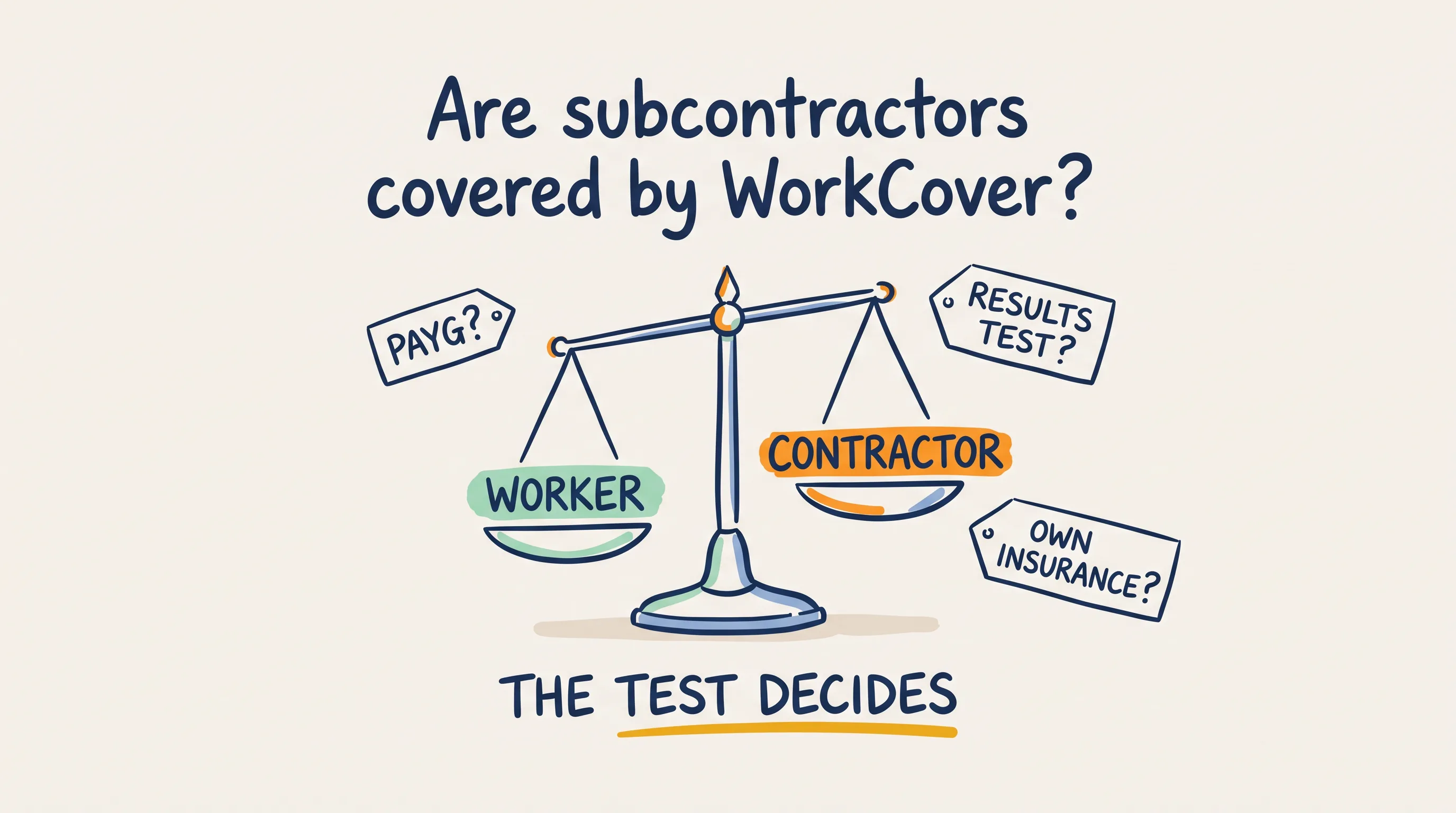
Worker or genuine contractor? The indicators
When making a decision about whether someone is an employee-type worker or a genuine independent contractor, WorkCover takes the whole arrangement into account and applies the Australian Taxation Office's (ATO) common-law factors.
If the ATO decides you are a contractor, WorkSafe Queensland will accept their decision for insurance and claims purposes.
The table below sets out the main signals. No single factor decides it; the overall picture is taken into account.
You can tick some "contractor" boxes and still be considered a worker. Having an ABN or invoicing for your hours does not move you across the line by itself.
Your rights and obligations
Where this test places you changes both what you are entitled to and what you must do in the event you need WorkCover.
If you are a worker, you are entitled to:
- Weekly compensation while you are unable to work.
- Reasonable medical, hospital and rehabilitation costs stemming from the injury.
- A lump sum if you are left with a permanent impairment.
- The right to claim even if the injury was partly your own fault, because WorkCover is a no-fault scheme.
If you engage your own workers, you must:
- Hold a WorkCover accident insurance policy for anyone you employ or who works for you as a worker, even if they refer to themselves as subcontractors.
- Declare their wages and keep the policy current.
- Check the status of each person you engage, rather than assuming an ABN removes your obligation.
Common scenarios and questions
I have an ABN, so I'm not covered, right?
Not necessarily. An ABN does not decide whether you are a worker. Many people with an ABN are still considered to be workers because they are paid for their labour, do the work themselves and are directed by the business. Run the arrangement through the worker test rather than relying on the ABN.
The company said I'm a subcontractor and not covered, is that true?
Only if the arrangement genuinely makes you a contractor. A business cannot remove your WorkCover rights just by labelling you a subcontractor in a contract. If you work like an employee, you may be considered a worker and therefore covered, regardless of what the document says. Get advice before accepting that you have no claim.
I'm a sole trader injured on someone else's site, what should I do now?
You may have options even if WorkCover does not cover you. A genuine independent contractor cannot claim WorkCover for their own labour, but if someone else's negligence caused your injury, you may be able to pursue a separate common law claim against the party at fault, such as a head contractor or site occupier. These claims are about fault, and the time limit is generally 3 years from the date of injury.
Do subcontractors need their own insurance?
Genuine contractors usually do. If you are a true independent contractor, you cannot insure your own labour through WorkCover, which means you’ll usually require personal accident or income protection cover for your own injuries. Principals also usually require subcontractors to hold public liability insurance, often between $5 million and $20 million, to cover injury or damage you might cause to others.
I hire my own subbies, do I have to cover them?
In most cases, yes. If the people you engage are considered to be workers under the test, you must provide them with a WorkCover policy, even if they invoice you and hold their own ABN. The safest approach is to assess each person's arrangement on an individual basis rather than assume the label "subcontractor" ends your obligation.
Legal framework
Coverage for workers, contractors and subcontractors in Queensland is set by the Workers' Compensation and Rehabilitation Act 2003 (Qld).
Section 11 defines a worker as an individual who works under a contract and is an employee for PAYG withholding purposes. Schedule 2 lists specific groups that are included as workers (Part 1) and specific groups that are excluded (Part 2), such as certain company directors, trustees and partners.
What this means for you: the Act, not the wording of your contract, is what decides whether you have coverage. If the definition is unclear for a specific situation, WorkCover applies the ATO's factors and will accept the ATO decision tool’s result.
You can check who is behind a business using the free ABN Lookup service, and read WorkSafe Queensland's own worker determination tests for full detail.
When to get legal advice
The worker-versus-contractor line is where many valid claims are written off incorrectly. It’s always a good idea to seek legal advice at the earliest opportunity, especially if:
- You have been told you are "just a subcontractor" and therefore not covered.
- You were injured on a worksite and are not sure who, if anyone, insures you.
- Your WorkCover claim was rejected on the basis that you are a contractor.
- Someone else's negligence caused your injury, which means you may have a common law claim.
- You engage subcontractors and are unsure if you must cover them.
Why early advice matters: insurers and principals treat people who understand their position differently because an unrepresented person is less likely to challenge a rejection or take a disputed matter further.
Working out your status early, before a deadline passes or you accept being told you're not covered, protects options that disappear for good once the time limit runs out.
Key takeaways
Remember these essential points:
- Coverage follows the "worker" test, not the label. Having the word "subcontractor" in a contract does not decide it.
- An ABN alone won’t exclude you. Many people with an ABN still count as workers.
- Genuine contractors are usually not covered by a principal's WorkCover policy, so they need their own cover.
- If you engage workers, you must insure them, even if they call themselves subcontractors.
- No WorkCover does not mean no claim. A negligence claim against the party at fault may still be open (it has a 3-year time limit).
Get Help Now
If you have been told you are "just a subcontractor" and not covered, or your claim has been rejected on that basis, it costs nothing to have your situation reviewed. Speak with the team at Smith's Lawyers to find out where you actually stand under our No Win, No Fee, No Catch® promise..
Call 1800 960 482 to request a free case review, or use the form below.
When you get in touch, we’ll listen to what happened, work out whether you are a worker or a contractor and tell you plainly whether you have a claim worth pursuing.