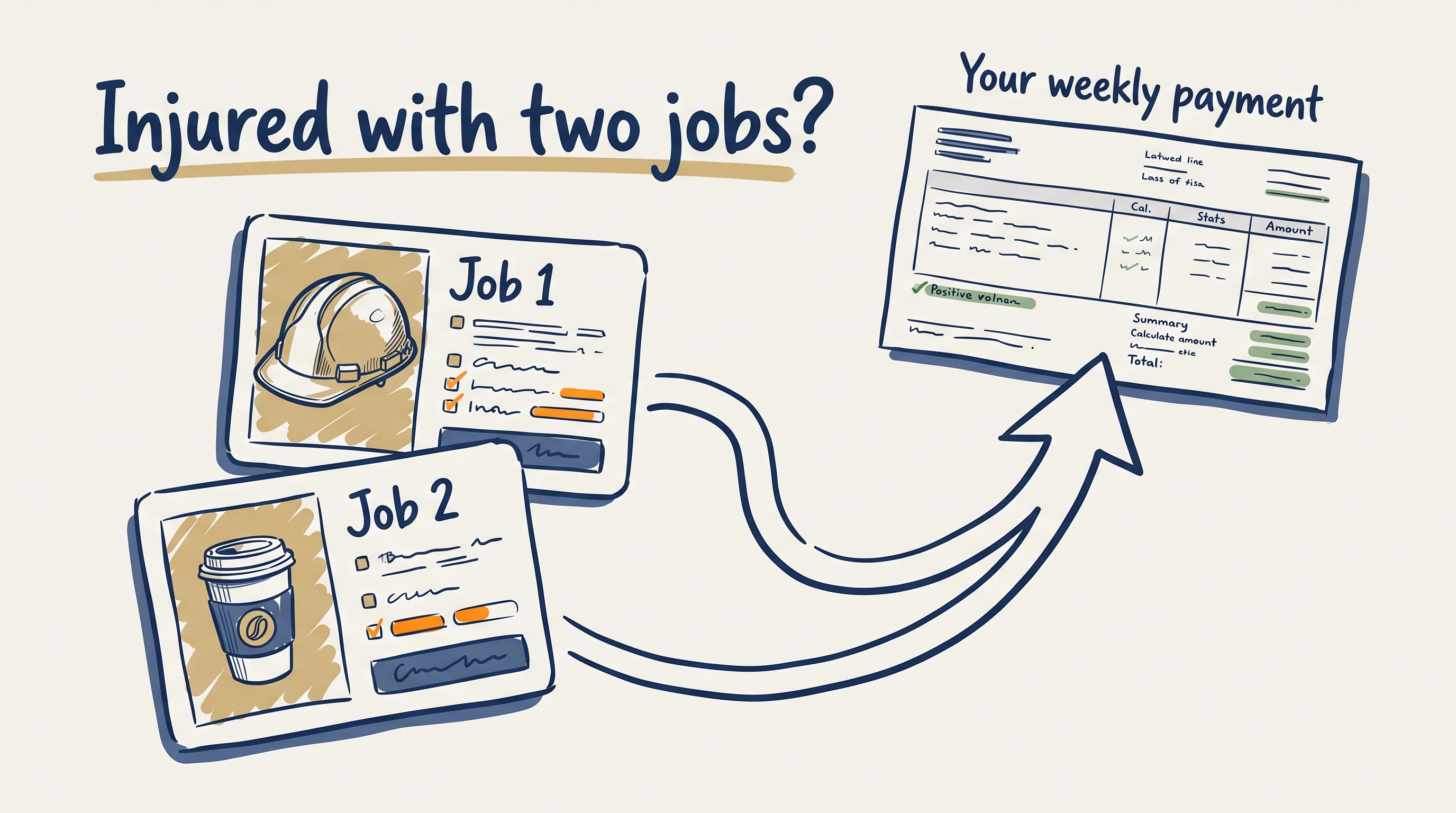
Claiming WorkCover When You're Employed by Multiple Employers

Hold multiple jobs? No problem. In Queensland, you can still claim with WorkCover. Where it gets tricky is that you must lodge your claim against the specific employer whose work activities contributed to your injury. Get this wrong, and it could mean extensive delays in claiming the benefits you are owed. 

This guide explains how to:

  • Identify the correct employer to claim against when you work multiple jobs
  • Gather the necessary evidence to support your claim
  • Follow the critical steps to protect your rights while employed in more than one role

Ready? Let’s get started.

Quick Answer Box

Can I claim WorkCover when I have multiple employers?

Yes, but you must claim against the specific employer whose work caused your injury.

Which employer do I claim against?

  • For single-incident injuries: The employer you were working for when you were injured
  • For injuries that appear over time: The employer whose work contributed most substantially

Key timeframes:

  • Notify all employers within 30 days of injury
  • Lodge your claim within 6 months

The steps you need to take:

  1. Seek medical attention immediately
  2. Notify all employers about your injury
  3. Gather shift schedules and pay records from all jobs
  4. Contact WorkCover Queensland or get legal advice to identify the liable employer

Understanding WorkCover for Multiple Employers

Who is the ‘liable employer’ when I have multiple jobs?

The liable employer is the business whose work activities directly caused or substantially contributed to your injury. 

In Queensland, you must identify which employer is liable so WorkCover can respond to your claim. Claiming work injury compensation from more than one employer is not impossible, but it takes very special circumstances. For example, if you’ve moved between jobs frequently, or multiple positions have aggravated your condition. 

Identifying the employer for different types of injuries

  • For immediate injuries (e.g., slipping on a wet floor), it's simple: claim against the employer you were working for at the moment the injury happened.
  • For gradual or cumulative injuries (e.g., repetitive strain, back pain), you must identify which employer’s work was the primary contributing cause.

Real-world examples:

  • Scenario 1: You work as a cleaner for Company. A three days per week and Company B two days per week. You slip and fall while mopping at Company A's worksite. 

Claim against Company A: This is an immediate injury. There was no gradual build-up over time.

  • Scenario 2: You work as a cashier at Supermarket A (25 hours per week) and stack shelves at Warehouse B (20 hours per week). You develop carpal tunnel syndrome from repetitive scanning and lifting. Medical evidence shows the heavy lifting at Warehouse B was the primary cause. 

Claim against Warehouse B: While there were various contributory factors, the evidence suggests that it was the lifting that was more to blame.

How does the ‘state of connection’ affect my claim?

If you work for employers in different states or territories, Queensland applies a national ‘state of connection’ test to determine which state's WorkCover scheme covers you. 

This five-step test determines your claim's jurisdiction based on where you usually work, where you're based, and where your employer mainly operates from.

This matters because WorkCover benefits and processes vary between states. However, a 2022 Supreme Court case confirmed that if you’re injured working in a different state, Queensland WorkCover may still cover you if your employment has stronger connections to this state.

Your Rights and Your Obligations

What you're entitled to:

  • Full WorkCover benefits regardless of whether you work casual, part-time, or have multiple employers. All workers within Queensland covered by WorkCover insurance have the same rights to compensation.
  • Weekly payments are calculated across all employment; your pre-injury earnings from all jobs are considered when calculating compensation, not just wages from the liable employer.
  • Medical expenses and rehabilitation are covered by the liable employer's WorkCover insurer, including treatment, medications, and approved travel costs.
  • To continue working for other employers while claiming WorkCover. You're not prohibited from working your other jobs if medically cleared to do so, though this will affect your weekly payment amounts.

What you must do:

  • Notify all employers within 30 days of your injury, even if you believe only one employer is responsible. Failure to notify can breach your obligations under the Workers' Compensation and Rehabilitation Act 2003.
  • Disclose all employment relationships on your Certificate of Capacity and WorkCover claim forms, including voluntary work, second jobs, and any other sources of income. Important: Non-disclosure is the leading cause for a WorkCover claim to get rejected.
  • Provide evidence of all employment, including contracts, work schedules, timesheets, and pay records from every employer for at least six months before your injury.
  • Report any new employment or income to WorkCover Queensland if you start another job or change hours while receiving benefits. Be aware that your weekly payments will be adjusted accordingly.

Common Scenarios and Questions

I was injured while working for one employer, but I also work elsewhere. Does my second job affect my claim?

The short answer: Your second job doesn't prevent you from claiming WorkCover, but you must disclose all employment as it affects the way your compensation is calculated.

What to do:

  • Inform your doctor about all work activities so they can assess your capacity for each job separately.
  • List all employers on your Certificate of Capacity, including job duties and hours worked at each.
  • Provide pay records from all jobs to WorkCover when calculating your weekly earnings. This ensures your compensation reflects your actual loss in earnings.

Important note: Failing to disclose secondary employment can result in penalties and can even be considered fraud. Even if your other job wasn't related to your injury, you're legally required to declare it.

I have an injury that’s come on over time (like back pain or RSI) from doing similar work at multiple jobs. Who do I claim against?

The short answer: Claim against the employer whose work was the ‘substantial contributing factor’ to your injury, based on medical evidence and your work activities. It’s rarely a 50/50-type scenario. 

What to do:

  • Keep a detailed diary documenting which tasks caused pain or aggravated symptoms at each workplace.
  • Obtain a medical opinion specifically addressing which employer's work activities primarily caused your condition (this includes duties at all jobs).
  • Compare the physical demands: hours worked, weight lifted, repetitiveness, and intensity at each employer.
  • Consider when symptoms first appeared and which job you were working at most during that period.

Important note: If multiple employers substantially contributed to your injury, you typically claim against the employer where symptoms became apparent or worsened significantly. This is known as a ‘substantial contributing factor’ test. 

I work for several companies in different states. Which state's WorkCover covers me?

The short answer: Your ‘state of connection’ determines coverage, based on where you usually work, where you're based, and your employer's main place of business.

What to do:

  • Apply the five-step state of connection test in order and identify: 
    • Where you usually work 
    • Where you're usually based 
    • Your employer's main place of business 
    • Special rules if you work at sea 
    • Where the injury occurred.
  • Document where you perform most of your work hours: if 60% of your time is in Queensland, then this would be your usual work state
  • Identify where you receive work instructions and where you report to: this establishes where you're ‘based’.
  • Check your employer's main place of business (the head office location, not just ABN registration address).

Important note: Recent case law, including Covill v WorkCover Queensland, shows that courts take into account your entire employment relationship, not just where you happened to be injured.

Can I claim from multiple employers if they both contributed to my injury?

The short answer: No, Queensland's WorkCover system doesn't allow you to lodge separate claims against multiple employers for the same injury.

What to do:

  • Identify which single employer's work was the main cause of your injury using medical evidence.
  • If truly unable to determine the primary cause, consult with WorkCover Queensland or a lawyer before lodging your claim. Lodging against the wrong employer wastes time and may put your benefits at risk.
  • Consider the fact that your weekly payments will reflect wages from all jobs, even though you're claiming against one employer's insurer.

Important note: While you can only claim against one employer's WorkCover insurance, that employer's insurer may later seek a contribution from the other employer if both substantially caused the injury.

What if I'm a casual employee working for multiple businesses and need to claim?

The short answer: Casual employees are fully covered by WorkCover and have the same rights as permanent employees when injured at work.

What to do:

  • Keep copies of every work schedule and include text messages or emails confirming shifts. 
  • Retain all payment records showing PAYG withholding, which proves you're an employee rather than a contractor.
  • Document your regular pattern of work for each employer over the preceding six months. This helps calculate your average weekly earnings.
  • Obtain written confirmation of your duties from each employer if you don't have formal job descriptions.

Important note: Casual workers with multiple employers are more likely to have claims rejected due to inadequate employment records. Start collecting evidence from your first day of employment. Don’t wait until you get injured.

I work as a contractor for multiple businesses. Am I covered by WorkCover?

The short answer: Possibly, it depends on whether you're truly an independent contractor or, in fact, a worker under Queensland law, regardless of what your contract states.

What to do:

  • Determine if you're paid as an employee for PAYG purposes at any of your engagements. PAYG withholding is a good indicator of worker status.
  • Assess whether you're working under a ‘contract of service’ (employee) or ‘contract for services’ (true contractor). Key factors include who controls how the work is done, whether you can subcontract, and whether you operate as a genuine business.
  • If you have an ABN but work exclusively for one or two businesses without genuine independence, you may still be considered a ‘worker’.
  • Check if your ‘employers’ hold WorkCover insurance that covers contractors. Some industries include contractors in their policies.

Important note: Don't assume that having an ABN means you're not covered. Queensland courts have confirmed that workers with multiple contracting arrangements may still be classified as employees if they lack genuine business independence and are subject to others.

Step-by-Step Process

  1. Seek immediate medical attention - Visit your GP or hospital within 48 hours of becoming injured. Explain that your injury is work-related and provide details about all jobs you perform, including duties and hours at each workplace.
  1. Notify all employers in writing - Within 30 days, give written notice to every employer you work for, even if you're certain only one caused the injury. Include the date, time, location, and nature of your injury.
  1. Identify the liable employer - Determine which employer's work caused your injury by considering: which employer you were working for when you were injured (single incident) or which employer's work contributed substantially, likely over time (gradual injury).
  1. Gather comprehensive employment evidence - Collect work schedules, timesheets, pay slips, employment contracts, and position descriptions from all employers for at least six months before the injury. Document in detail the duties at each job.
  1. Complete your Certificate of Capacity accurately - Work with your doctor to complete the certificate, ensuring Section 7 lists all your employment activities, hours worked, and duties at each job. Provide your doctor with written details about all jobs.
  1. Lodge your WorkCover claim - Submit your claim to the liable employer's WorkCover insurer within six months. Include all employment documentation, even for jobs not directly related to your injury.
  1. Continue to disclose - If you start new employment, change jobs, or take on additional work while on WorkCover, immediately notify WorkCover Queensland and your insurer. Your weekly payments will be adjusted based on your new income.

Documents you'll need:

  • Employment contracts from all employers. If you don’t have written contracts, use offer letters, texts confirming employment, or statutory declarations.
  • Work schedules for the six months before the injury, including timesheets, shift confirmations, or diary entries to show when and where you worked.
  • Pay records with PAYG withholding, including payslips, payment summaries, bank statements, and superannuation statements from each employer.
  • Duty statements for each job, outlining key physical tasks, equipment, weights, and repetitive activities. Create your own if none exist.
  • Medical evidence linking your injury to specific work, including doctors’ reports on how the injury occurred, when symptoms started, and which job contributed most substantially.

Key deadlines:

  1. Within 48 hours: Seek medical attention and document your injury
  2. Within 30 days: Give written notice to all employers about your injury
  3. Within 6 months: Lodge your WorkCover claim with the liable employer's insurer
  4. Within 3 years: Commence any common law claim for negligence (if applicable)

Legal Framework

Primary legislation: The Workers' Compensation and Rehabilitation Act 2003 (Qld) governs all WorkCover claims and rights to compensation in Queensland, including determining which employer is liable when workers have multiple jobs.

What this means for you:

  • You're considered a ‘worker’ if you're an individual working under a contract where you're an employee for PAYG withholding purposes. This includes most casual and part-time employees, not just permanent full-time workers.
  • Cross-border workers are covered by national ‘state of connection’ provisions that determine which state's WorkCover scheme applies when you work across multiple jurisdictions.
  • You must notify employers within statutory timeframes and disclose all employment relationships. These are legal obligations with consequences for non-compliance.

Red Flags To Be Aware Of

  • Your employer refuses to provide an incident report number or claims they don't have WorkCover insurance (all employers in Queensland are required by law to hold WorkCover insurance).
  • You're pressured to hide your injury, not report it, or told you're not covered because you're a casual worker or have multiple jobs. This is incorrect and potentially unlawful.
  • You receive conflicting advice about which employer to claim against, and deadlines are approaching. Incorrect initial claims can waste months and risk you losing your entitlements altogether.
  • Your insurer reduces or stops payments without properly considering your earnings from all employment. After all, benefit calculations must reflect your total income loss from all jobs.

Top 5 things to avoid

  • Thinking you can’t claim because you’re casual, part-time, or have multiple jobs. Your work status doesn’t affect your right to WorkCover.
  • Only notifying one employer. You must notify all employers within 30 days to protect your legal rights.
  • Not disclosing all jobs on medical certificates and claim forms. Non-disclosure can lead to rejection, suspension, or fraud concerns.
  • Claiming against the wrong employer. Double-check before lodging to avoid delays and missed deadlines.
  • Working other jobs without telling WorkCover. You must declare all income, so payments can be adjusted to match your actual earnings.

When to Seek Legal Advice

Get advice as early as possible, especially if:

  • You're unsure which employer to claim against because you do similar work for multiple businesses, and your injury developed gradually over time.
  • Your claim involves working across state borders, and you're receiving conflicting information about which state's WorkCover scheme covers you.
  • Your employer disputes that you're a worker, claims you're an independent contractor, or argues they don't need to hold WorkCover insurance for you.
  • Your claim has been rejected, especially if it relates to non-disclosure of other employment or disputes about which employer caused your injury.
  • Your weekly payments don't reflect your actual income loss from all jobs, or your insurer isn't properly calculating your entitlements.
  • You need to change jobs while on WorkCover and are uncertain about your obligations or how this affects your claim.

Why early advice matters:

  • Understand your full rights and entitlements across all your employment relationships and ensure you're claiming against the correct employer's insurance.
  • Access rehabilitation and support services sooner to maximise your recovery and get back to work quickly
  • Protect your compensation claim from common pitfalls specific to multi-employer situations, particularly evidence gathering and disclosure requirements.
  • Get expert guidance before time limits expire. Many workers with multiple jobs don't realise they should have notified all employers within 30 days, until it's too late.

Key Takeaways

  • You can claim WorkCover with multiple jobs, but you must lodge your claim against the employer whose work caused the injury. In only certain circumstances can you claim from various employers, i.e., long-term aggravations or complex work histories.
  • For single-incident injuries, claim against the employer you were working for at the moment of injury. For gradual injuries, use medical evidence to identify which employer’s work was the substantial contributing factor.
  • Notify all employers within 30 days, even if you believe only one caused the injury, and disclose every employment relationship on claim forms and medical certificates.
  • Your WorkCover weekly payments are calculated using wages from all jobs, not just the liable employer, ensuring compensation matches your actual income loss.
  • Cross-border workers are assessed using the state of connection test, which considers where you usually work and the employer’s main place of business.
  • Casual and part-time workers have the same WorkCover rights as permanent staff under Queensland law.
  • Keep detailed employment records, including work schedules, payslips, and duty statements. Poor records are a common reason for rejected multi-job claims.

Get Help Now

If you've been injured while working multiple jobs and need guidance on which employer to claim against, getting early legal advice can help you understand your entitlements, navigate complex situations, and avoid common pitfalls that could jeopardise your claim.

Contact Smith's Lawyers today:

  • Call 1800 960 482 for a free, no-obligation consultation with our experienced WorkCover lawyers who understand the complexities of multi-employer claims.
  • No upfront costs: We operate on a No Win, No Fee, No Catch® basis, meaning you don't pay unless your claim is successful.
  • Request a callback: Use the form below to have our team contact you at a time that suits you.

Our team has extensive experience helping workers in Queensland with multiple employers get to grips with WorkCover claims, identify liable employers, and secure the compensation they deserve. We'll review your employment arrangements across all jobs and provide clear, practical advice on the best path forward for your specific situation. 

Get expert advice today

To check your compensation entitlements, request a free case review with our expert car accident lawyers. We can explain your options to road accident injury claims so you are clear on your rights during this difficult time.

Take our 2-minute free claim check

Fill in the form below to find out if you have a claim.

Last updated:

Disclaimer: This information is designed for general information in relation to Queensland compensation law. It does not constitute legal advice. We strongly recommend you seek legal advice in regards to your specific situation. For help understanding your rights, please call 1800 960 482 or request a free case review to talk to one of our lawyers today.

Back to Knowledge Base
Our company and team are members of