The short answer is yes. In Queensland, you keep accruing annual leave, sick leave and long service leave while you are on WorkCover, and you can take that leave during your claim.
Section 119A of the Workers' Compensation and Rehabilitation Act 2003 (Qld) makes this clear. This legislation also overrides the federal rule that would otherwise bring your leave to an end.
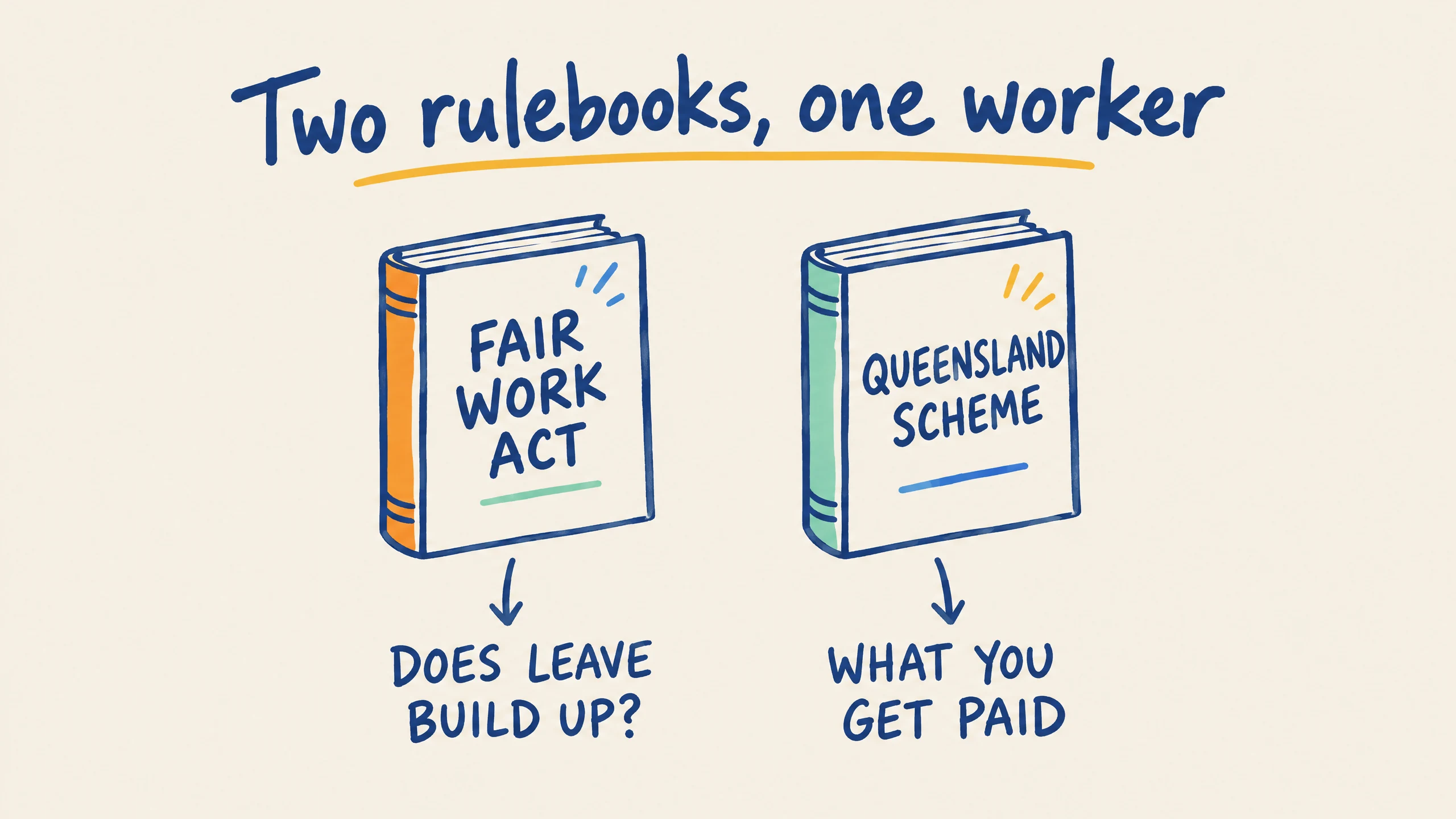
Why This Question Is Confusing: Two Rulebooks, Two Different Answers
Leave and workers’ compensation are governed by two separate laws that often seem to point in opposing directions. Working out which set of rules applies to your situation is an important first step.
The federal rule says no
Legislation concerning leave, for most Australian employees, comes from the National Employment Standards in the Fair Work Act 2009 (Cth). That Act is federal, so it applies in every state.
Section 130(1) of this Act says an employee is not entitled to take or accrue any leave or absence under those standards while off work with an injury they are being compensated for.
Paid or unpaid, it makes no difference. Read on its own, that would mean losing the leave you had accrued for the entire claim.
Section 130(2), however, is a convenient escape hatch. It states that the restriction doesn’t apply if a workers' compensation law permits the leave.
Queensland's law uses that escape hatch
Queensland's scheme takes full advantage of s 130(2).
Section 119A of the Workers' Compensation and Rehabilitation Act 2003 (Qld) is titled ‘Compensation entitlement does not restrict taking or accrual of leave’.
In this section, it says that a worker with the right to compensation ‘is entitled to take or accrue annual leave, sick leave and long service leave under an Industrial Act or industrial instrument during the period to which the compensation relates.’
For most people, that Industrial Act is the Fair Work Act 2009 (Cth).
For entitlements under the Fair Work Act 2009 (Cth), s 119A, as mentioned above, removes the restriction on accruing leave under s 130(1) of that Act.
This is why generic national advice is unreliable when it comes to states such as Queensland. Every state and territory runs its own scheme and leave is treated differently in each.
Your WorkCover payments are insurance, not wages
The Fair Work Ombudsman puts it plainly: the amount paid to an employee on workers' compensation ‘is an insurance payment and not a wage’.
This distinction goes a long way to understanding the legislation. Your leave balance belongs to the employment relationship, which continues while you are on a claim. Your weekly compensation belongs to the insurance claim.
In other words, it’s two separate things, run by two different parties.
What Accrues, and What You Can Take
Firstly, it’s worth mentioning that Section 119A applies to any worker entitled to compensation. This means that accrual works the same way whether your insurer is WorkCover Queensland or a self-insured employer.
Here is a breakdown of each type of leave and where it sits in relation to a claim made in Queensland:
Section 119A protects the three types of leave it specifically names. It does not cover compassionate leave or community service leave, so s 130(1) still prevents you from taking those types of leave in these circumstances.
Check with your employer before assuming either one is available.
Also read: What payments WorkCover covers in Queensland
Your Rights and What You Must Do
It’s important to take into account not only the rights you have, but what you must do to ensure your obligations are fulfilled.
What you are entitled to:
- 4 weeks of paid annual leave a year under the National Employment Standards, or 5 weeks for a defined shift worker that will still accrue while you are on compensation.
- 10 days of paid personal/carer's leave a year, accruing progressively and accumulating year to year.
- 8.6667 weeks of paid long service leave after 10 years’ continuous service under s 95(2) of the Industrial Relations Act 2016 (Qld), then a further 4.3333 weeks after another 5 years.
- An employer must not unreasonably refuse a request to take paid annual leave, under s 88(2) of the Fair Work Act 2009 (Cth).
What you need to do:
- Request leave in the way that has been established by your employer. Your employer still has to agree to the dates that you’ve requested.
- Tell your insurer before you take leave, so nothing is treated as a return to work.
- Check your payslips. Accrual that quietly stops is the first sign something has gone wrong.
- Keep a copy of every leave balance you are given, before and during the claim.
Frequently Asked Questions
Can I take annual leave or go on a holiday while I'm on WorkCover?
Yes, if your employer agrees to the dates. Section 119A entitles you to take annual leave during the period your compensation relates to. The usual rules about agreeing dates still apply.
Importantly, just because you’re on a claim, it doesn’t mean you’re under house arrest. Two practical points matter, though. Your treatment and rehabilitation obligations do not pause. Be aware of how travel may affect your appointments and tell your insurer your plans before you book anything.
Do my WorkCover payments stop if I take annual leave?
Usually not, but confirm it in writing first. In Queensland, if your employer approves annual or long service leave, WorkCover continues paying your weekly benefits while you are on leave, and your employer adjusts your leave balance accordingly. This is the scheme’s reported practice rather than a rule written into the Act.
Section 148 of the Workers' Compensation and Rehabilitation Act 2003 (Qld) allows an insurer to reduce your weekly payments by the value of a payment you receive independently of the Act. It says the insurer ‘may’ reduce your payments, not that it ‘must’. So ask your insurer what will happen to your payments, and get the answer in writing, before you book anything.
If your employer is self-insured, they make that decision themselves.
Be careful with advice you find online. Other states handle this differently, and material written for another scheme circulates widely.
Can my employer make me use my annual leave instead of lodging a WorkCover claim?
No. A work-related injury goes through the workers’ compensation scheme. Your accrued leave is a separate entitlement you have earned. Being asked to drop the claim so it stays off your employer's record is a warning sign, not something you should accept.
What to do: Say in writing that you want the injury reported and a claim lodged, and keep a copy. You can lodge a claim yourself rather than waiting for your employer.
Do I accrue sick leave while I'm on WorkCover?
Yes. Sick leave is one of the three types of leave covered by s 119A, so it continues to accrue at the normal rate while you are receiving compensation.
Using it is a different matter. Your workers’ compensation already covers the time you are off work because of the injury, so there is usually no need to use sick leave for that period.
That said, sick leave may still be relevant if you need time off for an unrelated illness, or while your claim is still being decided.
One important distinction: Queensland’s Act does not use your sick leave balance to top up your workers’ compensation payments. Some workers may instead receive accident pay, which the Fair Work Ombudsman describes as the difference between their normal pay and their workers’ compensation.
This comes from certain awards and enterprise agreements and is paid by the employer, not the insurer. Check your award or agreement to see whether it applies to you.
Does long service leave keep building up while I'm off?
Yes. Long service leave is the third kind of leave protected by s 119A, so it keeps accruing during the compensation period.
Queensland’s policy on long service leave derives from the Industrial Relations Act 2016 (Qld), not the workers' compensation scheme, and it covers private-sector employees as well as state employees.
If you take long service leave while receiving compensation, the same rules apply to your weekly payments as they do when you take annual leave.
Do I get paid for public holidays while I'm on WorkCover?
No, not as a separate payment. The Fair Work Ombudsman states that employees on workers’ compensation are not entitled to public holiday pay under the Fair Work Act 2009 (Cth). Your weekly compensation for a week that contains public holidays is worked out the same way as any other week.
There is more detail on this in our guide to public holidays while on workers' compensation in Queensland.
I used my own leave before my claim was accepted. Do I get it back?
Ask, and ask in writing, because Queensland's Act has no specific answer for this. Some workers use annual leave or sick leave to cover the gap while a claim is being decided. The Workers' Compensation and Rehabilitation Act 2003 (Qld) contains no provision requiring that leave to be credited back once the claim is accepted. Some other states handle this differently.
What to do: Raise it with your employer and your insurer in writing as soon as the claim is accepted. Ask specifically whether the leave will be restored and the period paid as compensation instead. Do not assume it happens automatically.
Warning Signs Your Leave Is Not Being Handled Properly
- Your payslip shows annual leave or sick leave accrual has stopped since the claim was lodged.
- You are told, in Queensland, that ‘you don't accrue leave while you're on workers’ comp’. That is the federal default. Section 119A says otherwise.
- Your employer asks you to use annual leave instead of lodging a claim.
- You are told to take leave rather than be offered suitable duties as your capacity improves.
- Your leave balance drops for the days when you were already receiving weekly compensation.
Common mistakes to avoid:
Watch out for these common mistakes made by workers across the country:
- Booking leave without telling the insurer first.
- Accepting a verbal answer about your balances rather than getting it in writing.
- Assuming compassionate leave works the same way as annual leave. Section 119A does not name it.
When to Get Advice, and Who From
A leave or pay dispute is an employment matter rather than an injury claim. For accrual, balances, awards or accident pay, the Fair Work Ombudsman's Infoline on 13 13 94 is your first point of call. Queensland long service leave enquiries go to the Queensland Government's Industrial Relations Infoline on (07) 3406 9999.
Consider speaking to a compensation lawyer if the leave issue is part of a wider problem with your claim:
- You were pushed to use leave instead of lodging a claim, and the time to make a claim has now passed.
- Your claim has been rejected, or your weekly payments stopped, and you are being told to live off leave that you’ve accrued.
- You have a Notice of Assessment or a lump sum offer and are unsure about what options may be closed off if you accept.
- Someone else's negligence caused the injury. This can open a separate claim on top of the statutory one.
- You are being managed towards an exit from the job while the claim is open.
Why early advice matters here:
The leave question is often the visible edge of a much bigger issue: whether you may also have a common law claim in addition to your statutory workers’ compensation claim.
Getting legal advice can make a real difference. If a common law workers’ compensation claim is an option, you can make an informed decision about whether to take the matter further rather than treating that option as a theoretical possibility.
It is also important to be aware of workers’ compensation claim deadlines. Time limits under the Queensland scheme can continue to run while you are still recovering from your injury.
If you think your leave issue may be connected to a wider problem with your Queensland workers’ compensation claim, it is worth getting advice before you make any decision that could affect your rights.
Key Takeaways
Remember these essential points:
- Three types of leave will keep accruing. Annual leave, sick leave and long service leave all build up while you are on WorkCover in Queensland, under s 119A of the Workers' Compensation and Rehabilitation Act 2003 (Qld).
- The federal default is the opposite, which is why so much general advice is wrong for workers in Queensland. Section 130(1) of the Fair Work Act 2009 (Cth) would stop your leave. Section 119A removes that restriction.
- Approved leave does not normally stop your weekly payments. WorkCover keeps paying for the duration of approved annual or long service leave. That is the reported practice rather than a rule in the Act, so get your insurer's position in writing before you book.
- Section 119A names three kinds of leave only. Compassionate leave and community service leave are not among them. Unpaid parental leave is protected separately, by s 130(3) of the Fair Work Act 2009 (Cth).
- Nobody should be asking you to use leave instead of lodging a claim. If that has happened, get advice before more time goes by and deadlines pass.
Get help now
If your leave is being handled wrongly, or you want to know whether your claim is being run properly, call Smith's Lawyers on 1800 960 482 for a free claim review. You can also use the form below this article to have someone call you back.
We act for injured workers across Queensland. Someone from our team will listen carefully to your situation, explain your options in plain terms, and tell you what the next step involves. We operate on a No Win, No Fee, No Catch® basis.