If a drunk driver injured you in Queensland, their drinking does not automatically reduce the compensation you can claim.
Compulsory third party (CTP) insurance covers injuries caused by the at-fault vehicle, including when the driver was over the legal alcohol limit.
The insurer may later recover its costs from the drunk driver, but that doesn’t reduce your compensation.
The criminal charges are separate from your personal injury claim. A drink driving charge or conviction does not, by itself, change your right to seek compensation for injuries caused by the crash.
Why a Person’s Drink Driving Charge Does Not Change What You Can Claim
Queensland's CTP scheme is structured so that compensation for the injured person is dealt with separately from any consequences for the at-fault driver.
The claim is against the insurer, not the driver
Your Queensland CTP claim is made against the CTP insurer of the at-fault vehicle, under section 37(1) of the Act.
If the matter goes to court, the driver and insurer are joint defendants under section 52(1). However, section 52(4) requires judgment for the injury claim to be given against the insurer, not the driver.
This means your CTP compensation does not depend on the at-fault driver having money, a job or assets. The insurer is responsible for making the payment.
There is one exception: a court can award exemplary or punitive damages against the driver under section 55 if their conduct is considered so ‘reprehensible’ that such an award is justified.
Courts rarely make these awards, and section 55(2) excludes them from the CTP indemnity. Any such amount therefore has to be recovered from the driver personally.
Click here to read more on how CTP insurance works in Queensland.
Why the driver’s drink driving does not get the insurer off the hook
The fact that the driver was breaking the law does not cancel your CTP claim.
Section 52(5) prevents the CTP insurer from relying on the insured driver's breach of a contractual or statutory obligation as a defence to your claim. Driving over the legal alcohol limit is a breach of a statutory obligation, so the insurer cannot use that breach to avoid its liability to you.
In other words, the driver's drink driving is the driver's problem, not a reason for the insurer to reject your injury claim.
The insurer recovers its costs from the driver
Section 58(3) allows the CTP insurer to recover certain costs from the driver as a debt where alcohol or non-medicinal drugs prevented the driver from exercising effective control of the vehicle. The recovery is limited to costs reasonably attributable to the driver's loss of control.
This is a matter between the insurer and the driver. It does not affect your entitlement to compensation.
The Criminal Case and Your Claim Are Two Different Things
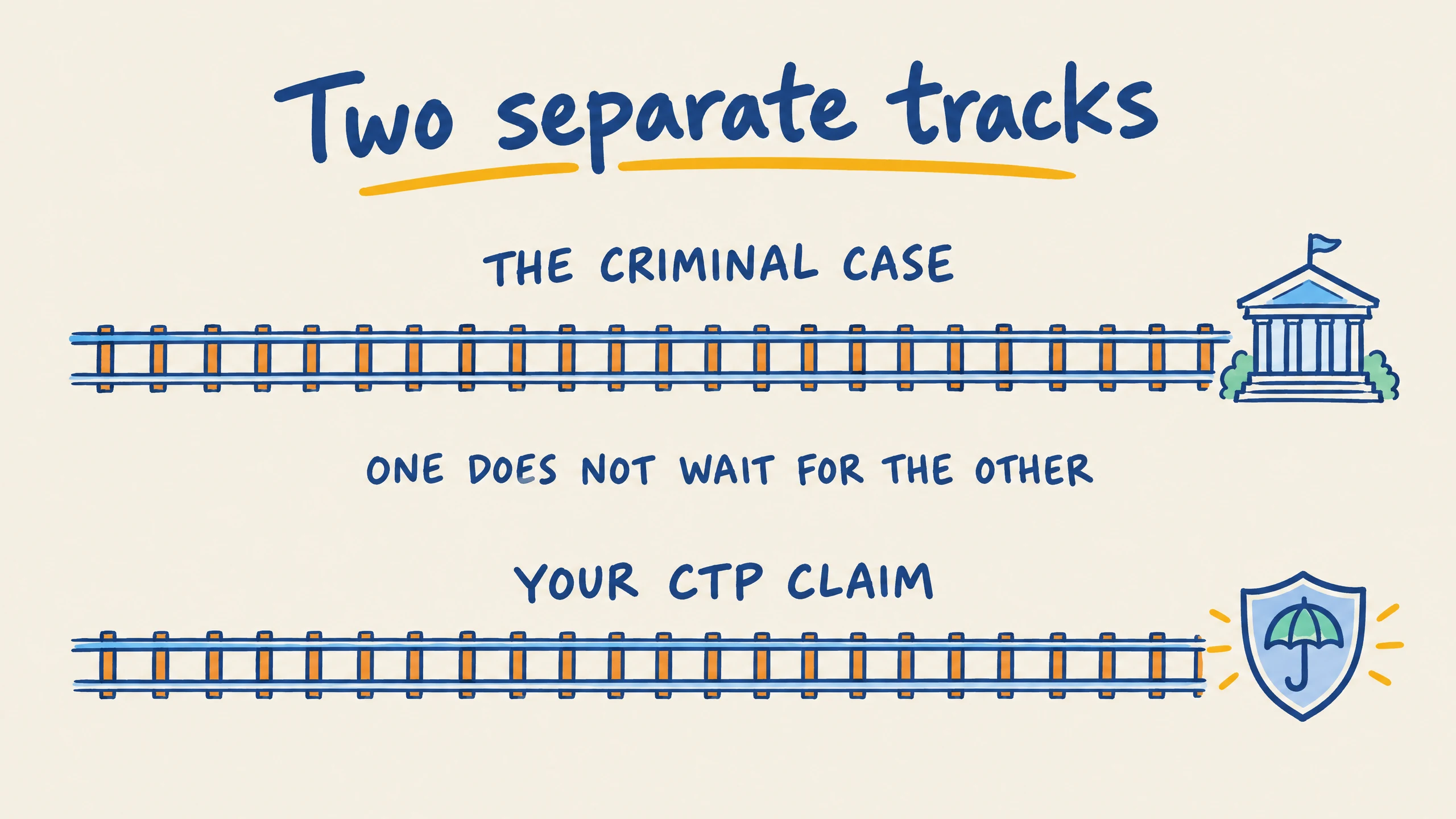
The police may charge the drunk driver with a drink driving offence. That criminal case determines whether the driver is fined, loses their licence, or faces a prison sentence. It does not compensate you for your injuries, and you do not need to wait for the criminal case to finish before starting a CTP claim.
Drink driving offences are covered by section 79 of the Transport Operations (Road Use Management) Act 1995 (Qld).
The general alcohol limit is 0.05, with higher penalties applying at the middle limit of 0.10 and the high limit of 0.15. Any fines or other penalties are paid to the State, not to you as the injured person.
A conviction helps your claim, but not in the way people expect
Section 79 of the Evidence Act 1977 (Qld) allows a drink driving conviction to be used as evidence in a civil case to demonstrate that the driver committed the offence.
Once the conviction is proved, the law treats the offence as having been committed by the driver, including the acts and state of mind that made up the offence, unless the contrary is proved.
This applies whether the driver pleaded guilty or was found guilty after a hearing. It can also apply where a finding of guilt was made, but no conviction was recorded.
A drink driving conviction is therefore strong evidence that the driver was over the legal alcohol limit. But it does not, by itself, prove that the driver caused your injuries. You still need to establish that the driver was legally responsible for the crash and your injuries.
This is why the police report, crash scene evidence and medical records can all be important to your CTP claim.
When (Your Own) Drinking Affects a Claim
If it is shown to be the case that you were under the influence of alcohol, the provisions that reduce compensation are aimed at you (the injured person), not the driver at fault.
If you were intoxicated, or accepted a lift from someone you knew was, the Civil Liability Act 2003 (Qld) presumes you contributed to your own injury and sets a floor on the reduction.
Remember, a reduction is not a refusal: a claim reduced by 50% is still a claim.
Challenging the presumption
The presumption that your intoxication contributed to your injuries only applies if the insurer alleges that your own actions contributed to what happened.
Under section 47, you can challenge the presumption by showing that your intoxication did not contribute to what happened or was not self-induced (having your drink spiked, for example).
Under section 48, you can challenge the presumption by showing that you could not reasonably have been expected to avoid relying on the intoxicated person for a lift (an emergency, or being dependent on that individual, for example).
It’s worth pointing out that ‘Intoxicated’ is a defined term: Schedule 2 sets it at being under the influence of alcohol, a drug, or drugs to the extent that your capacity to exercise proper care and skill is impaired.
As the injured party making a claim, Section 48(5) works in your favour: it removes the old defence of voluntary assumption of risk, so the insurer cannot argue you accepted the whole risk by getting in the car.
You can read more on claiming compensation when you were partly at fault here.
If the Drunk Driver Was Unregistered or Drove Off
Queensland has a statutory body for exactly this kind of situation.
The Nominal Defendant, set up under the Motor Accident Insurance Act 1994 (Qld), is the insurer under section 31(1)(c) where the vehicle was not insured, and under section 31(1)(d) where the vehicle or its insurer cannot be identified.
Section 33(1) gives it the same liability as a CTP insurer would have had, and section 60 lets it recover its costs from the owner or driver of an uninsured vehicle.
The deadline is the thing to watch. Section 37(2)(a) requires notice within 3 months of the accident where the vehicle cannot be identified, and section 37(3) bars the claim outright if nothing is given within 9 months. That bar is absolute: section 39(8) says the Nominal Defendant cannot waive it, and a court cannot give leave to proceed despite it.
An identified but uninsured vehicle falls under the ordinary 9-month rule, and the Motor Accident Insurance Commission's Can I claim? guidance sets out the same two timeframes. At the start, you may not know which category applies because a vehicle that drove off may still be identified. If there is any doubt, it is safer to work to the shorter three-month deadline while the police try to identify the vehicle.
For an unidentified vehicle, you also need to show a genuine effort to find it. Section 31(2) presumes a vehicle cannot be identified only where proper inquiry and search have been made and have failed.
You can find out more about this in our article on what happens when the other driver is uninsured.
What to Do, and By When
It’s often the case that what you do is just as important as by when you do it, especially with injury claims due to negligence. Here is our step-by-step guide:
- Get medical attention and tell the doctor how the injury happened. That clinical record is what links your injuries to the crash.
- Make sure the police are aware of the crash, and ask for the traffic incident number. Section 93(4) of the Transport Operations (Road Use Management) Act 1995 (Qld) requires a driver to give their information to police where someone is killed or injured, within 24 hours except in exceptional circumstances. Section 34 makes it your responsibility to ensure police have been notified before you claim.
- Do not wait for the breath or blood result, or for the court case. Criminal matters regularly run past 9 months, and your deadlines run from the accident, not the charge.
- Lodge the notice of accident claim. Do this within 9 months of the accident or of when symptoms first appeared, or within 1 month of first consulting a lawyer, whichever comes first (section 37(2)(b)). Late notice is not always a disaster, but section 37(3) requires a reasonable excuse for the delay. If the vehicle cannot be identified, you have only 3 months (absolute bar: 9 months).
- Expect a written liability decision within 6 months of the insurer receiving your notice of claim. Section 41(1) requires it to say whether liability is admitted or denied, and to state any contributory negligence as a percentage. Once liability is admitted, section 42 obliges it to pay private hospital, medical and pharmaceutical expenses reasonably and appropriately incurred. Section 51 covers rehabilitation.
- Court proceedings within 3 years. Section 11 of the Limitation of Actions Act 1974 (Qld) runs from the date the cause of action arose, ordinarily the accident date.
See also lodging a CTP claim in Queensland.
Common Scenarios and FAQs
What happens if a drunk driver hits my car?
Two separate things happen; only the second of these involves you. (1) Police deal with the charge and (2) your injury claim goes to that vehicle's CTP insurer. CTP covers personal injury only, so damage to your car is a matter for your own insurer: see does CTP cover damage to vehicles or property.
What if I was a passenger in the drunk driver's car?
You can still claim, and the same CTP insurer covers you. What changes is contributory negligence: if you were 16 or over and knew, or should reasonably have known, that the driver was intoxicated, sections 48 and 49 apply the floors in the table we discussed above. That presumption can be rebutted, though. See passenger compensation after a car accident.
What if the drunk driver died in the crash?
The claim continues against the CTP insurer. Section 52(2)(b) allows the action to be brought against the insurer alone where the insured person has died.
How long do I have if I was a child at the time?
Longer, but the claim still has a timeframe. If the person injured is under 18, the usual time limits are suspended while they are a child. Section 40 of the Motor Accident Insurance Act 1994 (Qld) suspends the notice requirements during this period.
Once the child turns 18, the limitation period begins. Under section 29(2)(c) of the Limitation of Actions Act 1974 (Qld), there are generally 3 years from that point to start court proceedings. This means proceedings would ordinarily need to be started by the individual’s 21st birthday.
Legal Framework
- Motor Accident Insurance Act 1994 (Qld) sets up the CTP scheme: section 37 the notice deadlines, section 52 the defences the insurer cannot run, section 58 its recourse against an intoxicated driver, sections 31, 33 and 60 the Nominal Defendant.
- Civil Liability Act 2003 (Qld) governs negligence and damages. Sections 46 to 49 are the intoxication provisions, all aimed at the injured person rather than the driver at fault.
- Evidence Act 1977 (Qld), section 79, makes a conviction admissible in a civil claim and presumes the facts of the offence unless the contrary is proved.
- Transport Operations (Road Use Management) Act 1995 (Qld) sets the alcohol limits in section 79 and the duty to report an injury crash in section 93.
- Limitation of Actions Act 1974 (Qld), section 11, gives 3 years to sue, with narrow extensions under sections 29 and 31.
When to Seek Legal Advice, and the Warning Signs
Get advice before you respond to the insurer if any of these apply:
- You were intoxicated, or you accepted a lift from someone who was.
- The insurer sets out a contributory negligence percentage early. Section 41(1) requires them to state a figure. That doesn’t make the figure correct.
- You are asked for a recorded statement about your own drinking. Answer factually, but get advice first.
- You are told the claim has to wait for the criminal case. It does not, and the longer you wait, the quicker the deadlines will appear.
- You are told the driver had no insurance, so there is nothing to claim. The Nominal Defendant exists exactly for this purpose.
- Nobody reported the crash to police. Section 34 makes that your responsibility before claiming. Fix this quickly by speaking with your local police department.
- Your injuries have not settled, or you are not back at work.
- More than 6 months have passed with no notice of claim lodged.
Why early advice matters
Getting advice early can help you protect your claim while the evidence is still available and before important deadlines approach.
Evidence can disappear or become harder to obtain over time. CCTV footage may be overwritten, witnesses can become harder to contact, and police records may be easier to obtain while the criminal proceedings are still underway.
Finally, early advice also gives you a clearer idea of what evidence you need, which deadline applies to your claim, and how to respond if the insurer alleges contributory negligence.
Key takeaways
- The at-fault driver’s drinking does not reduce your entitlement, and the insurer cannot raise the driver’s breach of their own agreement against you.
- You still have to prove negligence. A conviction is strong evidence of the offence, not proof the crash was the fault of another driver.
- The criminal case pays the State, not you. Because of this, you shouldn’t wait for any criminal proceedings to take place or conclude before you make a claim.
- Your own intoxication is what reduces a claim. As indicated in the table above, if the insurer alleges it and you cannot rebut it, there are reductions in the amount you can claim. A reduction is not a refusal, though.
- If the vehicle of the negligent driver was unregistered or cannot be identified, the Nominal Defendant covers it. Work to a deadline of 3 months to be safe, as the 9-month bar for an unidentified vehicle cannot be waived or excused.
Get help now
If you were injured by a drunk driver in Queensland, call Smith’s Lawyers on 1800 960 482 to talk through where your claim stands and which deadline applies to you. There is no cost to ask, and no obligation to go further.
Smith's Lawyers runs Queensland injury claims on a No Win, No Fee, No Catch® basis. You pay no upfront costs, and the No Catch® promise covers your outlays, court costs and the other side’s costs if the claim does not succeed.
You can also use the form below this article to request a free claim check.