Usually not. WorkCover pays a percentage of your normal earnings, and that percentage tends to fall the longer your claim continues.
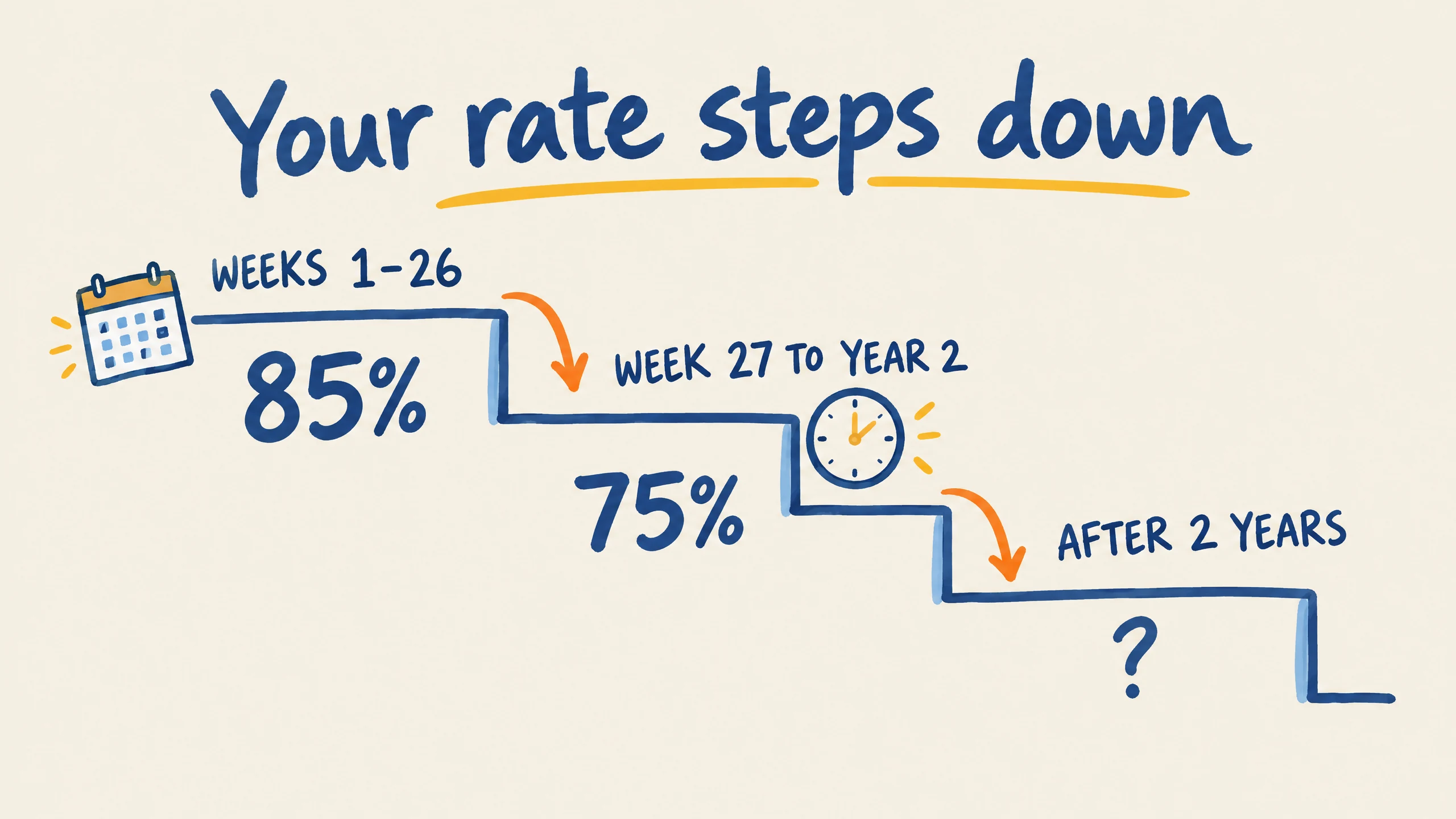
For the first 26 weeks, you receive the greater of:
- 85% of your normal weekly earnings, or
- a minimum amount.
If an award or registered agreement covers you, that minimum can be the full weekly wage rate. This means some award-covered workers may receive their full wage for the first six months.
After the first 26 weeks for both WorkCover and an award:
- From week 27: the payment rate drops to 75%.
- After two years: a reassessment of the rate based on DPI is possible.
What Your Weekly Payment Is Actually Based On
Your WorkCover payment is based on your normal weekly earnings (NWE).
NWE is generally based on what you earned from employment in the 12 months before your injury. Section 106 of the Workers' Compensation and Rehabilitation Act 2003 (Qld) sets out this provision.
The calculation changes if:
- You worked for less than 12 months: in this case, your NWE is based on the period you were employed.
- Your earnings cannot reasonably be worked out: for example, because you had only recently started the job. In this situation, section 107 of the Workers' Compensation and Rehabilitation Regulation 2025 (Qld) requires the insurer to consider what a comparable worker on comparable terms earns.
What counts toward your NWE
Under section 106(1) of the Regulation, overtime, higher duties, penalties and allowances for work required by your employer can be included, but only if both of these are true:
- the amounts were of a regular nature, and
- they would have continued if you had not been injured
A pattern of regular Saturday overtime is a good example of a fixed and regular duty that was required by your employer. Working the odd extra shift, or overtime every so often, is not likely to count.
What does not count
Section 106(2) of the Regulation excludes the amounts listed in Schedule 6 of the Act under the definition of wages, paragraphs (a) to (d). What does this mean in practice:
- Expense allowances are excluded outright. The Act names travelling, car, removal, meal, education, living in the country or away from home, entertainment, clothing, tools and vehicle expenses.
- Superannuation contributions are excluded from the compensation calculation.
- Lump sums paid on termination for superannuation, accrued holidays, long service leave or any other purpose are excluded.
- Payments your employer makes during the excess period are also excluded. The excess period is the initial period after your injury when your employer is responsible for paying your compensation under section 66 of the Act.
This is an important distinction: an allowance that reimburses you for a work-related expense is not included when calculating your normal weekly earnings. So, seeing an allowance on your payslip does not necessarily mean it forms part of your NWE.
The Rate at Each Stage of Your Claim
Fundamentally, the rate is a numbers game, again, set out by sections 150 and 151 of the Workers' Compensation and Rehabilitation Act 2003 (Qld). Which section applies depends on whether an industrial instrument, meaning an award or registered agreement, governs your employment.
A deeper look into QOTE
QOTE is the Queensland full-time adult ordinary time earnings figure declared by the Australian Statistician, which the Regulator notifies before the start of each financial year under section 10A of the Act.
Under section 10A(1)(b), it cannot go down: if the new figure is lower than the previous year's, QOTE stays where it was. For 2026-27 it is $1,994.50 per week, effective 1 July 2026.
On that figure:
- 80% of QOTE is $1,595.60 per week, the floor for the first 26 weeks if no industrial instrument covers you
- 70% of QOTE is $1,396.15 per week, the floor from week 27
There is one cap on your WorkCover weekly payments, and which cap applies depends on how your employment is covered.
If an industrial instrument, such as an award or registered agreement, covers you, section 150(2) says your payments after the first 26 weeks cannot be higher than the amount you would have received during those first 26 weeks.
If no industrial instrument covers your employment, section 151(2) says your WorkCover payment cannot exceed your normal weekly earnings (NWE).
You are subject to only one of these caps, not both.
The two-year mark
If you reach the two-year mark, your WorkCover payment may change to the single pension rate. Whether this happens depends on whether you can demonstrate to the insurer that your injury could result in a degree of permanent impairment (DPI) of more than 15%.
If you and the insurer disagree about whether you meet this threshold, section 160 provides that the DPI can only be determined by a medical assessment tribunal. In that situation, the insurer must refer the matter to the tribunal.
Also read: How is Permanent Impairment Calculated in Queensland WorkCover Claims
Your Entitlements and What You Must Do
Apart from highlighting your rights, it’s important to consider exactly what your obligations are in terms of submitting information or keeping the various stakeholders up to date.
What you are entitled to:
- A weekly payment at the percentage rate fixed by the Act for your stage of claim, which the insurer does not set
- A payment calculated on a 12-month earnings history that can include regular overtime, higher duties and penalties
- A top-up while you are on suitable duties, if you are earning less than you did before the injury
- A written decision you can have reviewed if you disagree with the calculation
What you must do:
- Give the insurer information about your employment and earnings during any period of partial incapacity if they ask for it in writing. Under section 167 of the Act, you have 10 business days. The insurer may suspend your payments until you comply.
- Inform the insurer if your earnings change while you are on reduced dutiesCommon Scenarios and FAQs
Do I get topped up if I am back at work on light duties but earning less?
The short answer: Yes. This is partial incapacity, and section 163 of the Act allows for a weekly payment. It’s based on your maximum compensation rate multiplied by your loss of earnings as a proportion of your NWE.
What to do: Compare what you are earning now with your pre-injury normal weekly earnings (NWE). Include any regular overtime or penalty rates you were receiving before your injury.
For example, if you normally worked night shifts and earned overtime but your employer has moved you to day shifts with no overtime, the difference between your old and new earnings is your loss of earnings.
Important note: The top-up cannot exceed what you would have received if you had been totally incapacitated.
Will my overtime be included if I was doing a lot before I was hurt?
The short answer: It can be, under section 106(1) of the Regulation, if the overtime was regular and would have continued.
What to do: Pull 12 months of payslips before the injury date. Look for patterns that show regularity rather than periods of overtime that seem ad-hoc.
Important note: This is one of the most common underpayments, because a calculation done on base rate alone can understate NWE substantially for anyone who worked consistent overtime or shift penalties.
What should I do if my payments just dropped and nobody told me why?
The short answer: If you have passed week 26, the drop is the statutory step-down under section 150(1)(b) or 151(1)(b) to the greater of 75% of NWE or 70% of QOTE.
What to do: Count the weeks from the start of your incapacity. If the drop lines up with week 27, it is the Act working as it should, not an error.
Important note: If the timing does not line up, ask the insurer in writing for the calculation.
Does my employer have to make up the difference between WorkCover and my normal pay?
The short answer: No, not under the Act. The Act does not automatically require your employer to top up your WorkCover payments. An enterprise agreement can provide for additional accident pay, but the relevant amount must first be approved by the Regulator (sections 107D and 107E).
What to do: Read your enterprise agreement or contract, or ask your union. A top-up under an individual employment contract is a separate contractual question the Act does not deal with.
How long can weekly payments continue?
The short answer: Three potential events put an end to your weekly payments (section 144A): your incapacity ends, you have received five years of weekly payments, or your compensation reaches the statutory maximum. Different rules apply to a latent onset injury that is a terminal condition.
What to do: If you are approaching any of these, get advice before you reach it, because your options narrow afterwards.
Important note: There is also an overall statutory cap on weekly compensation. Under section 140(1)(a), the maximum total amount of weekly payments for one injury is 216.15 times QOTE, which is $431,111.18 for 2026–27. This is a cap on the total payments over the life of the claim, not the amount you can receive each week.
What can I do if I think the calculation is wrong?
The short answer: You can apply to the Workers' Compensation Regulator for a review of a decision to increase or decrease a weekly payment, but you have only 3 months from written notice of the decision under section 542.
What to do: Ask the insurer in writing for a written breakdown of how your NWE was calculated, including which payments were counted and which were excluded. Do this before approaching the Regulator.
Steps to Check Whether You Are Being Paid Correctly
- Get your payment advice. Ask the insurer in writing for the NWE figure they used and the percentage applied.
- Gather 12 months of payslips from before your injury date, not after.
- Add up the regular components. Base pay, plus overtime, higher duties and penalties that were regular and would have continued.
- Remove the exclusions. Expense allowances, superannuation contributions and termination lump sums do not count.
- Work out which stage you are at. Count the weeks of incapacity and find your row in the table above.
- Compare. If the insurer's figure is materially lower than yours, ask for the calculation in writing before doing anything else.
Documents You Will Need
- Payslips for the 12 months before your injury: this is the most obvious evidence when calculating NWE
- Your award or enterprise agreement: determines whether section 150 or section 151 applies, and whether a contractual top-up exists
- Your WorkCover payment advices: show the rate actually applied for each period
- Your medical certificates: establish the period and degree of incapacity
- Any suitable duties plan: shows what you are able to earn during partial incapacity
Legal Framework
Most of the relevant provisions come from the Workers' Compensation and Rehabilitation Act 2003 (Qld):
- s 106: defines normal weekly earnings (NWE).
- ss 150 and 151: set the payment rates and step-downs at 26 weeks, 2 years and 5 years.
- s 163: sets the partial incapacity formula for top-up payments.
- s 140(1)(a): sets the overall cap on weekly payments at 216.15 times QOTE.
- s 144A: sets out when weekly payments stop.
- s 167: sets the 10-business-day deadline for providing earnings information and allows payments to be suspended.
- s 542: sets the 3-month deadline for applying for a review of a decision.
- s 10A: sets out how QOTE is determined each financial year and provides that it cannot decrease.
The other key legislation is the Workers' Compensation and Rehabilitation Regulation 2025 (Qld), particularly ss 105–109, which prescribe how NWE is calculated.
What this means for you: your rate is set by statute, not negotiated.
There are two places where the figures can move:
- the NWE calculation itself, and
- whether you are within your first 26 weeks, beyond 26 weeks, beyond two years, or beyond five years.
Red Flags: What to Watch Out For
- Your NWE looks like your base rate, with no overtime or penalties included
- Your payment dropped and the timing does not match week 27 or the two-year mark
- The insurer has not given you a written calculation despite it being requested
- You have been on suitable duties for months with no top-up
- You are approaching five years of weekly payments and nobody has discussed what happens next
- You received a written decision about your payments more than 3 months ago and still disagree with it
Common mistakes to avoid:
- Assuming the 85% figure applies for the life of the claim. It applies only to the first 26 weeks.
- Assuming a payslip allowance counts toward NWE. Expense allowances are excluded.
- Missing the 10-business-day deadline to give the insurer earnings information during partial incapacity. Doing so will allow them to suspend payments.
- Waiting until the claim is closing to question a calculation that has been wrong from the start.
When to Seek Legal Advice
Get advice if:
- You have made any of the common mistakes above, particularly if your payments have been suspended or your NWE appears to have been calculated incorrectly.
- You are being asked to accept a lump sum and are unsure how it will affect your weekly payments or your overall claim.
- You are approaching an important payment milestone, such as the two-year or five-year mark, and want to understand what will happen to your payments.
Why early advice matters:
An NWE figure set incorrectly at the start of a claim is carried through every payment that follows, so the arrears will keep compounding quietly. It’s far easier to correct things early on than trace back steps months or even years later.
What to Take Away
Remember these essential points:
- WorkCover does not pay full wages. It pays a percentage of your normal weekly earnings, set by statute.
- 85% applies to the first 26 weeks only. From week 27, the rate is the greater of 75% of NWE or 70% of QOTE. After two years, it can fall again, but it depends heavily on DPI.
- Regular overtime, higher duties and penalties can count toward your NWE if they would have continued despite getting injured.
- Expense allowances and superannuation contributions do not count under Schedule 6 of the Act.
- Weekly payments stop at five years, when incapacity ends, or when compensation reaches 216.15 times QOTE, whichever happens first.
Get Help Now
If something looks amiss with your WorkCover payments, our team of specialists here at Smith’s Lawyers can check how your normal weekly earnings were calculated and whether the right rate is being applied for your stage of claim.
Call 1800 960 482 for free initial advice. We work on a No Win, No Fee, No Catch® basis.
When you call, we’ll ask what you were earning before the injury, how long you have been off, and what the insurer has told you in writing.
You can also use the form below this article to request a callback and a free review of your case.