Dog bites to a person or to your pet can be extremely distressing and potentially serious, however, there is no automatic payout for people who are bitten by a dog in Queensland.
To recover compensation, you have to show that the person responsible for the dog at the time was negligent, which usually means they failed to take reasonable care to stop a foreseeable attack.
Money for payouts like this generally comes from the dog owner's home and contents public liability cover, not their own pocket.
The legal basis for a dog bite claim
This is the part most dog bite pages don’t include, and it’s what decides everything else.
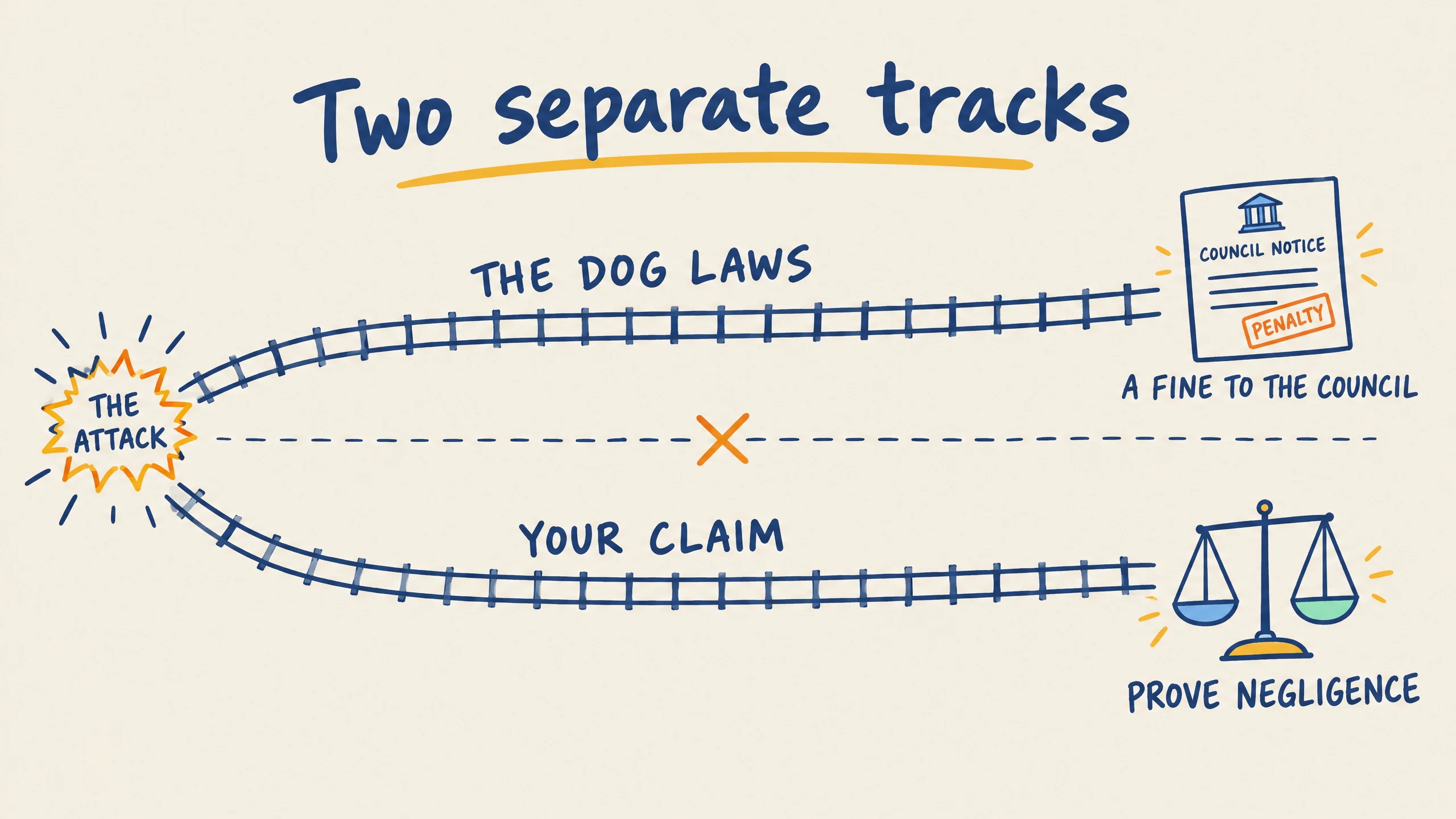
The Animal Management (Cats and Dogs) Act 2008 (Qld) regulates dog ownership, creates offences, allows councils to declare dogs dangerous or menacing and sets penalties.
It does not give an injured person a right to compensation.
Section 7 of the Act states this directly:
- The Act "does not limit a civil right or remedy that exists apart from this Act, whether at common law or otherwise"
- “Compliance with this Act does not necessarily show that a civil obligation that exists apart from this Act has been satisfied or has not been breached"
- “A breach of an obligation under this Act does not, of itself, give rise to an action for breach of statutory duty or another civil right or remedy"
When read together, those three subsections mean your claim exists completely outside the dog laws, making it an ordinary negligence claim. The dog legislation supplies evidence rather than entitlement.
The second point is worth looking at a little closer, as it means an owner who complied with every registration and fencing rule can still be found negligent because compliance is not a defence.
What you have to prove
- A duty of care was owed. A person responsible for a dog owes a duty of care to people who may foreseeably be hurt by it.
- That duty was breached. They failed to take the care a reasonable person would have taken.
- The breach caused your injury.
- You suffered damage, meaning a real injury with real consequences.
These claims are won or lost on whether a breach can be proven.
Strong evidence includes proving a known history of aggression; a previous complaint or declaration; a gate or fence that failed to contain the dog; a dog off lead where it should not have been; and/or a dog left with someone unable to control it.
Who actually pays
The majority of dog bite claims are paid by an insurer, not the owner.
Home and contents policies usually include public liability cover, which comes into play where a member of the household is legally liable for an injury to someone else.
That is the fund a dog bite claim is normally paid from, and it is what makes claims against neighbours, friends or a relative's household realistic without having to pursue an individual for their own assets.
There are two qualifications for this:
- Cover depends on the wording of the policy, as some policies exclude specified breeds or dogs that have already been declared dangerous.
- If the attack happened on business premises or involved a working dog, a different policy may be used.
An injury to your own pet is not a personal injury claim. Veterinary costs for a dog or other pet attacked by another dog are a separate matter and not dealt with here.
What the dog laws do, and why they still matter
The Act has three categories for different types of dog. They are used as evidence in a negligence claim, so it’s worth understanding them.
A declaration made before the attack is powerful evidence because it establishes that the risk was known and documented.
Under section 193 of the Act, a relevant person for a dog (meaning its owner or a responsible person for it) must exercise effective control of it in a public place, unless they have a reasonable excuse for not doing so.
The maximum penalties rise based on the harm caused by the incident, and are higher for a regulated dog or a repeat offender, reaching 600 penalty units or even imprisonment if an attack causes death or grievous bodily harm.
Section 193 covers public places, while section 194 applies wherever the attack happened, including on private property. It requires a relevant person to take all reasonable steps to ensure the dog does not attack or act in a way that causes fear to a person or an animal. Section 195 prohibits allowing or encouraging an attack.
A prosecution under either section is not your claim, it is evidence that supports it.
Common scenarios and questions
The dog had never bitten anyone before, can I still make a claim?
The short answer: yes. The fact it’s the first bite won’t prevent a claim because negligence hinges on whether the risk was foreseeable and what precautions were reasonable, not on whether the dog had a record of biting.
What to do: focus on the circumstances. Was the dog contained, on a lead, supervised or in a place it should not have been? That’s what is important for a successful claim.
Important note: a known history makes a claim stronger, but its absence does not make it hopeless.
It was a friend's dog, do I have to sue my friend?
The short answer: in practice, you are usually claiming against their home and contents insurer, which is what the public liability section of those policies exist for.
What to do: ask your friend if they hold home and contents cover before deciding not to pursue a claim.
Important note: people often abandon valid claims in order to avoid a personal dispute, without realising an insurer is actually the one who pays.
I was bitten at work, is this different?
The short answer: yes. Injuries sustained at work go through the workers' compensation scheme under the Workers' Compensation and Rehabilitation Act 2003 (Qld), which has its own process and deadlines.
What to do: report the incident to your employer and lodge a claim with WorkCover.
Important note: a separate claim against the dog owner may also be available depending on the circumstances of the incident. It’s important to get professional advice before choosing a path.
The council prosecuted the owner, does that mean I get compensation?
The short answer: no. The Act says that a breach of the dog laws does not create a civil remedy by itself.
What to do: get the council's file, because the investigation, any declaration and the outcome of the prosecution are valuable evidence for your own negligence claim.
Important note: a fine paid to the council is not compensation to you.
I provoked the dog, or I was on their property, will this affect my claim?
The short answer: not necessarily, but it can reduce what you recover through contributory negligence, and where you were and why will be a factor in proceedings.
What to do: be straightforward and honest about the circumstances from the outset. A version that changes later does far more damage than an unhelpful fact that’s disclosed early on.
Important note: provocation is a defence to prosecution, but it does not decide your civil claim because the two are kept separate under the Act. A council deciding not to prosecute does not count as a finding against you.
My child was bitten, does that change anything?
The short answer: the negligence principles remain the same if a child is involved, but the standard of care expected of an adult supervising a dog around a child is assessed in that context, and the limitation position is different for children.
What to do: seek advice specific to the child rather than assuming an adult deadline still applies.
Steps to take after a dog attack
- Seek medical treatment as soon as possible. Dog bites carry a high risk of infection, and medical records are the first evidence of your injury.
- Report the attack to the local council. This triggers an investigation and creates an independent record. It is the single most useful step for a later claim.
- Identify the dog and the person responsible. Their name, address and contact details are key. Note the dog's breed, size and colour.
- Photograph everything. Ensure you capture your injuries before they heal, the location of the incident, the fence, gate or lead, and any warning signs.
- Get details of any witnesses, including anyone who has seen the dog behave aggressively before.
- Keep every receipt and record of time off work.
- Get advice early. The 3 year limit in s 11(1) of the Limitation of Actions Act 1974 (Qld) is the outer edge, and the PIPA notice of claim has to be given well before this. Once a complying Part 1 notice is given in time, s 59 of the PIPA allows proceedings to begin even after the 3 years have elapsed.
Documents you will need
- Medical records from the treating hospital or GP: the injury and its treatment
- Photographs of the injuries over time: scarring evolves, and early images are important
- The council report and investigation file: independent evidence of the attack and the dog's status
- Witness details and statements: particularly about the dog’s prior behaviour
- Proof of expenses and lost income: what the injury has actually cost you financially
- Any record of prior complaints about the dog: this supports foreseeability
What this means for you: dog laws will tell you whether an offence was committed. The negligence claim is what recovers money, and it is a separate process with its own specific requirements.
Red flags and warning signs
- You are told there is no claim because the dog had never bitten anyone before.
- You are offered a quick cash settlement before the wound has healed and permanent scarring is known.
- Nobody has reported the attack to the council, so there is no independent record.
- You are being told the owner has no money, without anyone checking whether a home and contents policy exists.
- The three year period is approaching and no notice of claim has been given.
Common mistakes to avoid:
- Assuming a council prosecution is your compensation, when section 7(3) says it isn’t.
- Not reporting to the council, which loses you the strongest independent evidence available.
- Settling before scarring has stabilised, which is particularly important for a facial injury or a child.
- Not photographing injuries early, which is when the wounds look their worst and are best documented.
- Treating a psychological injury as not worth mentioning. Fear of dogs after an attack is a real and claimable injury.
When to get legal advice
It’s always a good idea to seek legal advice at the earliest opportunity in cases involving dog bites, especially if:
- The injury required stitches, surgery or has left scarring
- A child was bitten
- There is any psychological effect, including anxiety or avoidance
- The owner denies responsibility or disputes what happened
- You are unsure whether an insurer stands behind the owner
- The attack happened at work, where two separate processes may apply
Why early advice matters: the evidence that decides these claims, which includes the council record, the photographs and the witnesses, is best in the days after the attack and degrades quickly. The legal deadline is three years after the incident, but the practical window for evidence is much shorter.
Key takeaways
Remember these essential points:
- Queensland has no automatic dog bite payout. You must prove negligence.
- A breach of the dog laws is not a claim. Section 7(3) of the Animal Management (Cats and Dogs) Act 2008 (Qld) says this expressly.
- Compliance is not a defence either. Under s 7(2), an owner who followed the rules can still be considered negligent.
- The owner's home and contents public liability cover is usually what pays, not the owner personally.
- Report the incident to the council and photograph the injuries. These are the two steps that strengthen a claim the most, and both need to happen early on.
Get help now
If you have been bitten by a dog in Queensland, we can tell you whether the circumstances support a negligence claim and who is likely to stand behind it.
Call 1800 960 482 for free initial advice under our No Win, No Fee, No Catch® promise.
When you call, we will ask where the attack happened, who was responsible for the dog, whether the council was told and what treatment you have had.
You can also use the form below this article to request a free case review.