You make a WorkCover claim in Queensland by seeing a doctor for a work capacity certificate, then lodging your claim with WorkCover Queensland (or your employer's self-insurer) through the Worker Assist portal or app.
You must lodge a claim within 6 months of the date your entitlement to compensation arises.
You do not pay anything to start a claim, and you do not need to prove your employer was at fault. If your employer was negligent, this would be grounds for a common law claim.
Understanding WorkCover in Queensland
WorkCover Queensland is the state's workers' compensation insurer, the scheme that pays your wages, medical costs, and rehabilitation while you recover from a work-related injury or illness.
Here are some things you need to know:
It is a no-fault scheme
WorkCover is no-fault, which means you do not have to prove anyone did anything wrong to receive statutory benefits (i.e., that your employer was negligent).
If you were injured in the course of your work, you can claim, even if the injury was partly or fully your fault.
This is different from a common law claim, which does depend on negligence. We’ll cover this in more detail below, as the distinction between the two is very important.
Who is covered
Most workers in Queensland are covered, including full-time, part-time, and casual workers.
Some large employers, such as Woolworths and Coles, are self-insurers, so you lodge with the employer's own scheme rather than WorkCover Queensland, but the rules work the same way.
If you’re unsure whether you’re covered by WorkCover or not, you can contact your HR team, or use WorkSafe’s list of self-insurers.
Both physical injuries and psychological injuries (such as work-related stress or trauma) can be claimed, though psychological claims are usually assessed against a higher standard.
Your Rights and Obligations as a Worker
Once your claim is accepted, you have a clear set of entitlements and several obligations that are needed to keep your claim on track and ensure you get what you deserve.
What am I entitled to?
- Weekly compensation while you cannot work: the greater of 85% of your normal weekly earnings for the first 26 weeks, then 75% after that, according to WorkSafe Queensland (minimum and maximum limits apply).
- Reasonable medical and hospital costs related to the injury.
- Rehabilitation and support to help you return to work.
- Travel costs for approved treatment in some cases.
- A lump sum offer if you are left with a permanent impairment.
What things must I do?
- Report the injury to your employer, in writing where possible.
- Get a work capacity certificate from a doctor or nurse and give copies to your employer and insurer.
- Attend medical appointments and rehabilitation sessions as instructed by your treating physician
- Tell WorkCover if your circumstances change, such as returning to work or starting other paid work.
Step-by-Step Process
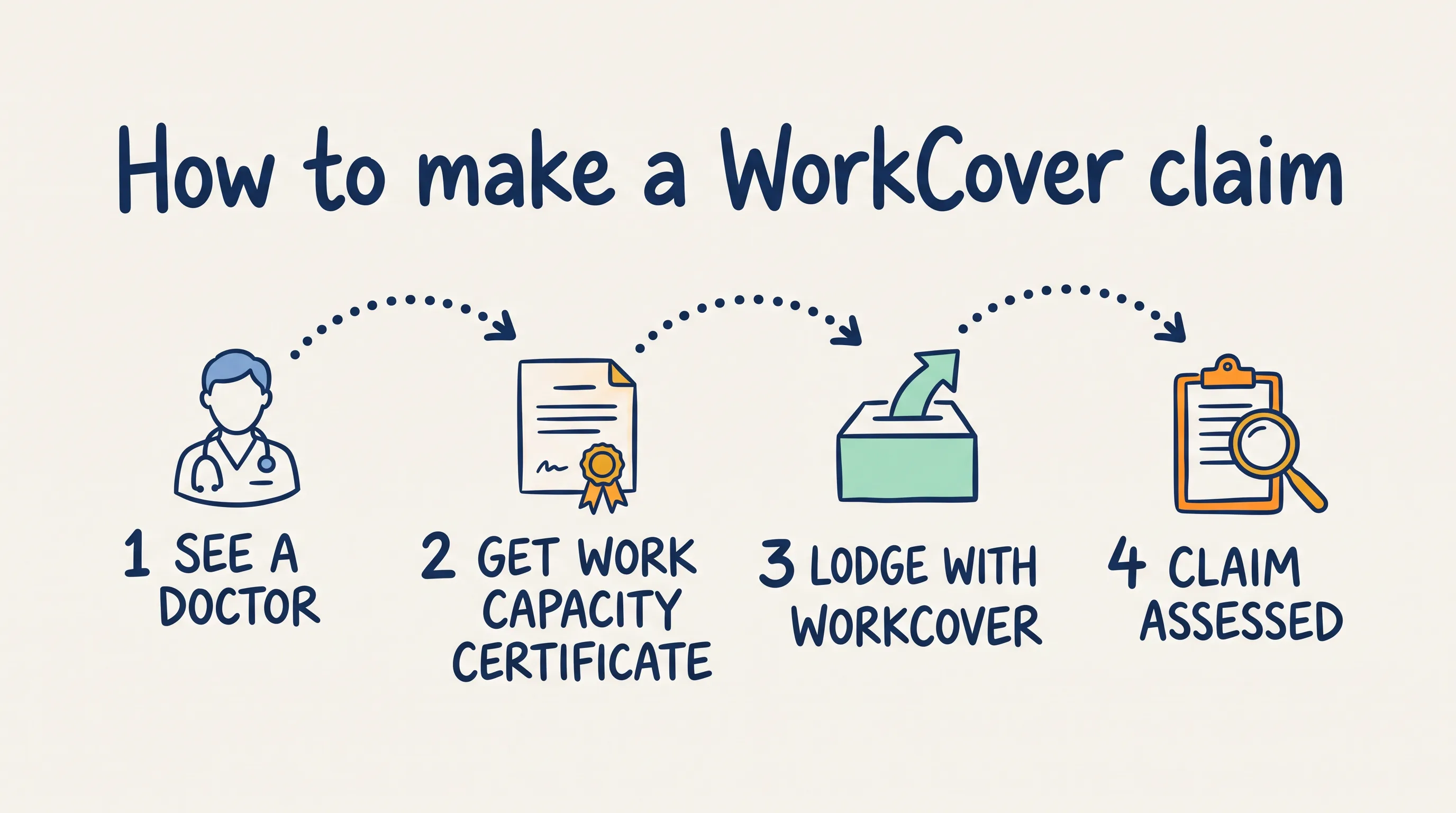
The steps below outline the WorkCover claim process in the correct order in which they should be followed. The first two protect your claim, while the others ensure your claim progresses successfully.
- Report the injury to your employer. Tell your employer as soon as you can, in writing if possible, so there is a record of when and how the injury happened. Your employer must report it to their insurer within 8 business days.
- See a doctor and get a work capacity certificate. Book a GP (or nurse practitioner for a minor injury, or dentist for an oral injury) and ask for a work capacity certificate. WorkCover will not accept a certificate from a physiotherapist or psychologist, so it must come from a registered medical practitioner.
- Lodge your claim through Worker Assist. Since 1 July 2025, your doctor can no longer initiate your claim simply by sending your certificate to WorkCover. You must lodge the claim yourself online through the Worker Assist portal or app, or by phone.
- Lodge within the deadline. Aim to lodge within 20 business days of your entitlement arising to protect your back-pay, and within 6 months to keep the claim valid.
- Wait for the decision. WorkCover generally aims to decide your claim within 20 business days of receiving a valid application. Be aware that someone may contact you or your doctor for more information.
- Start receiving benefits. If accepted, weekly payments and approved medical costs begin. If rejected, you have the right to ask for a review.
Documents You'll Need
Having these ready makes lodging faster and reduces the chance of delays.
- Work capacity certificate: The medical document that confirms your injury and your work capacity. Get it from your treating doctor. Your claim is not valid without it.
- Personal and employment details: Your name, contact details, employer, and where and when the injury happened.
- Bank details: So weekly payments can be paid to you.
- Evidence of the injury: Photos, incident reports, or names of witnesses, where relevant.
- Receipts: For any medical costs or travel you have already paid.
WorkCover vs Common Law: How They Fit Together
A common point of confusion is whether you can claim for WorkCover, a common law claim or both. To put it simply, WorkCover is always the first step, and a common law claim is a separate option that may come later. For this reason, claiming with WorkCover should always take precedence.
Let’s take a look at the key differences:
If negligence was involved, you may also be able to pursue a common law claim through a lawyer, on top of your WorkCover claim. An open WorkCover file is a prerequisite if you go down that route.
Further down the line, there’s usually another choice for claimants. If your permanent impairment is assessed below 20%, you must choose between accepting the statutory lump sum (WorkCover) or pursuing a common law claim. At 20% or above, you can do both.
Common Scenarios and Questions
Can I still claim WorkCover if I’m a casual worker?
Yes. Casual, part-time, and full-time workers are all covered by WorkCover Queensland. Your weekly payments are worked out from your normal weekly earnings, so they reflect your actual hours and pay.
What if my employer tells me not to lodge a claim?
Lodge anyway. It is your legal right, not your employer's decision. You claim against the insurer, not your employer directly, and it is unlawful for an employer to punish you for making a claim. Report the injury in writing and lodge through the Worker Assist platform.
Does WorkCover still pay if I end up losing my job?
Your weekly payments are tied to your incapacity, not your job. If you are dismissed while claiming, your entitlement to weekly compensation can continue based on your medical capacity, subject to the scheme's limits. Get advice quickly if this happens, as termination often leads to complications with your claim.
Can I claim for a psychological injury?
Yes, but the test is stricter. For a psychological injury, your work must be assessed as the major contributing factor, and claims arising from reasonable management action are generally excluded (e.g., giving feedback, allocating a new role). A work capacity certificate from a doctor is still required.
What if my injury built up over time?
You can claim for gradual-onset injuries, such as a back injury from years of manual work. For these, the 6-month clock often starts from the date a doctor assesses and links your condition to your work, not from a single incident.
Legal Framework
Your WorkCover claim is governed by the Workers' Compensation and Rehabilitation Act 2003 (Qld). These are the areas that are most relevant for claimants:
Section 131
Under section 131, an application for compensation is valid only if it is lodged within 6 months after the entitlement to compensation for the injury arises. That date is usually the date of injury, or the date a doctor assesses your injury and links it to your work.
Twenty business days
If you lodge your claim more than 20 business days after your entitlement begins, your insurer will usually only back-pay you for up to the 20 business days before you lodged the claim.
In limited cases, a late claim can still be accepted where the Medical Assessment Tribunal finds special circumstances of a medical nature explaining the delay.
What Red Flags Should I Be Aware of?
Watch for these signs. It might mean that your claim requires closer attention:
- Your employer discourages you from lodging, or delays reporting the injury.
- You are pressured to return to work before your doctor clears you.
- You are asked to sign documents you do not understand.
- Your claim is rejected without a clear reason.
- An insurer's doctor's report conflicts with the report from your treating doctor.
Common mistakes to avoid:
Try to avoid the following common issues:
- Waiting past the 6-month deadline, or letting the 20-business-day back-pay window slip.
- Assuming your doctor's certificate started the claim (since 1 July 2025, you must lodge it yourself).
- Accepting a lump sum offer for permanent impairment without understanding the effect this can have on a common law claim.
When to Seek Legal Advice
Statutory WorkCover claims are designed to be lodged without a lawyer. Legal advice becomes valuable at these points:
- Your claim has been rejected and you want a review or appeal.
- You have been assessed with a permanent impairment and received a lump sum offer.
- Negligence may have caused your injury, opening a possible common law claim.
- You have been dismissed while claiming with WorkCover, or feel pressured to return to duties you or your treating doctor deem unreasonable.
Why early advice matters:
Insurers deal with unrepresented workers differently, because an unrepresented worker is less likely to take a disputed matter to court.
Getting advice before you accept a lump sum or miss a deadline protects certain options that may be lost forever once those routes are closed.
Key Takeaways
Remember these essential points:
- WorkCover is a no-fault scheme. You can claim without proving your employer did anything wrong.
- You need a work capacity certificate from a doctor, nurse practitioner, or dentist for a valid claim.
- You must lodge the claim yourself through Worker Assist from 1 July 2025. The certificate alone does not mean the process has begun.
- Lodge within 6 months, and ideally within 20 business days to protect your back-pay.
- WorkCover comes first, common law later. You do not choose between them at the start.
You can also read our Workers' Compensation Benefits Guide for more on what you can claim.
Get Help Now
If your WorkCover claim has been rejected, you have been offered a lump sum, or you think negligence formed part of your injury, it costs nothing to have your situation reviewed. Speak with the team at Smith's Lawyers to understand your options, with clear, plain-English advice tailored to your specific situation.
Contact Smith's Lawyers today:
- Call 1800 960 482 for a free, no-obligation consultation about your situation
- No upfront costs: We operate on a No Win, No Fee, No Catch® basis; you only pay if we secure compensation for you
- Or request a call back: Use the form below to have our experienced team get in touch at a time that’s convenient for you.
Get in touch and we’ll listen to what happened, explain where you stand, and tell you simply whether you have a claim worth pursuing.