There is no single expiry date on compensation from a WorkCover claim in Queensland, but there is a limit to how long you can receive weekly payments.
WorkCover can pay weekly benefits for a maximum of five years (260 weeks) from the date of injury, and the amount you’re paid reduces at 26 weeks and then again at 104 weeks.
Most workers stop receiving weekly payments long before five years pass because they recover, return to work or finalise their claim.
What "how long" actually means
There are two important things to consider alongside the question "how long can I be on WorkCover?"
The first is how long you receive the weekly payments WorkCover pays while you are unable to work. These have a limit of five years from the date your injury occurred.
The second is how long your claim remains relevant. A claim can influence your situation well beyond five years because a lump sum payout for permanent impairment or a common law claim can be finalised after you stop receiving weekly payments
Weekly payments replace part of your wage during recovery. Normal Weekly Earnings (NWE) is the figure WorkCover uses as your baseline wage, and QOTE (Queensland Ordinary Time Earnings) is a state-wide average that sets the upper and lower limits on what you can be paid.
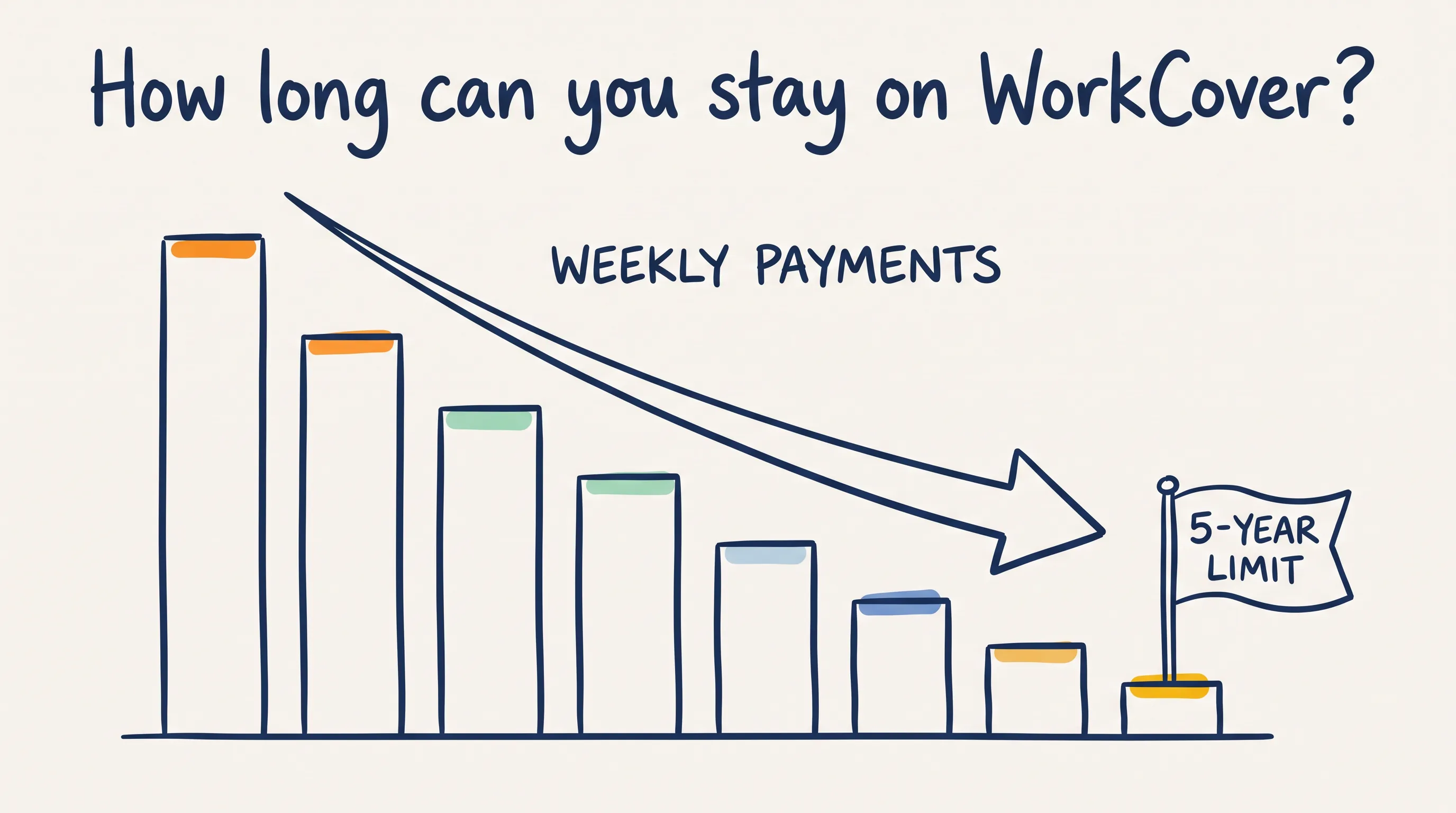
How the payment steps down over time
Your weekly payments don’t remain the same throughout the time you receive them. They reduce at set milestones, which means the longer you are on WorkCover, the lower the rate tends to be.
The table below shows the three stages. QOTE for 2025-26 is $1,953.70 per week, confirmed by the Queensland Law Society in QLS Proctor and effective from 1 July 2025.
The 104-week mark is the most significant. At that point, your Degree of Permanent Impairment (DPI), a percentage that measures how much lasting damage the injury caused, is used to decide whether your weekly payments continue near their previous level or drop significantly.
What happens at the five-year limit
Weekly payments are stopped when the first of several things happens, whichever comes first. Under section 144A of the Workers' Compensation and Rehabilitation Act 2003 (Qld), the upper limit is five years of weekly payments for that injury.
In practice, payments usually end for one of these reasons before the five year limit is reached:
- You recover enough to return to your normal or modified duties.
- Your injury stabilises and your claim moves to a permanent impairment assessment.
- You finalise the claim through a lump sum or a common law settlement.
- You reach the legislated maximum amount payable.
The Queensland Law Handbook sets out these end points and the five-year rule in section 144A.
Common questions about WorkCover duration
Does WorkCover keep paying me if I get sacked?
Your weekly payments do not automatically stop in the event you lose your job. WorkCover pays you based on your incapacity, not whether you are still employed. This means an accepted claim can continue paying even after a dismissal.
Section 232B of the Workers' Compensation and Rehabilitation Act 2003 (Qld) also provides protection here. In the 12 months after you suffer the injury, your employer cannot dismiss you solely or mainly because you are not fit for your role due to that injury. If this happens to you, read our guide on whether you can return to your job after a workers' compensation claim.
What happens after two years if my impairment is low?
If your DPI is assessed below 15% at the 104-week mark, your weekly payments will drop to the single Age Pension rate. This is usually a large reduction for most people, and it is often the point at which workers first realise their statutory support is running down.
A low DPI does not herald the end of your claim, but it’s a good point at which to look at whether a common law claim for your employer's negligence is available, which is a separate process with its own compensation.
Can WorkCover cut off my payments early?
Yes, WorkCover can end weekly payments before five years if it decides you have the capacity to work or that your injury is now stable. These decisions are usually based on medical reports, including independent medical examinations arranged by the insurer.
You can dispute a decision to stop or reduce payments, but the time limits to lodge a review are strict so you should get advice quickly if you disagree with being cut-off.
Does the five year cap reset if I have a new injury?
No, the five-year cap applies to the incapacity from that injury. A genuinely new injury is a separate claim with its own entitlements, but an aggravation of the existing injury is generally treated as part of the original claim, so it doesn’t reset the limit.
How WorkCover and common law claims fit together
WorkCover common law claims aren’t two options you choose between at the start of the process. WorkCover is always the first step, and common law claims are made separately by a lawyer on top in the event your employer's negligence caused the injury.
You do not make a choice between them early on. In most cases you receive WorkCover benefits during recovery, and a common law claim is considered once your injury has stabilised and your permanent impairment has been assessed.
You have to make a choice when your DPI is assessed. Under section 189 of the Workers' Compensation and Rehabilitation Act 2003 (Qld), if your DPI is assessed below 20% you will need to make an irrevocable decision between accepting the statutory lump sum offer and pursuing common law damages.
If your DPI is 20% or higher, you can accept the lump sum and still pursue a common law claim.
A common law claim has its own limitation period, so reaching the end of your weekly payments does not mean you’re out of options.
Red flags while you are on WorkCover
There are several signs that suggest your claim is being wound down faster than it should be, or that a decision needs closer scrutiny, such as:
- You are pressured to attend repeated independent medical examinations arranged by the insurer.
- Your payments are reduced or stopped without a clear written explanation.
- You are pushed to return to duties your treating doctor has not cleared.
- You are asked to accept a lump sum offer without advice on whether a common law claim is possible.
Common mistakes to avoid:
- Assuming your payments will run for the full five years and not planning for the reductions.
- Accepting a low DPI lump sum before checking whether a common law claim is worth more.
- Missing the review deadline after a decision to cut off payments.
When to get legal advice
Some points in a WorkCover claim carry more weight than others, and these are worth a conversation with a lawyer. It’s always a good idea to seek legal advice at the earliest opportunity, especially if:
- Your weekly payments are about to step down at 104 weeks and your DPI is borderline.
- WorkCover has moved to stop or reduce your payments.
- You have received a permanent impairment assessment and a lump sum offer.
- Your injury was caused or made worse by your employer's negligence.
Early advice is important because the amounts at stake in a common law claim are usually far larger than for statutory benefits, and the two run on different timelines. Insurers also tend to offer less to workers without representation because an unrepresented worker cannot credibly take the matter to court.
Representation changes the negotiation, not just the paperwork.
Key takeaways
Remember these essential points:
- Weekly payments are capped at five years (260 weeks) from the date of injury under the Workers' Compensation and Rehabilitation Act 2003 (Qld).
- The rate drops down at 26 weeks and 104 weeks, and after 104 weeks it depends on whether your DPI is 15% or more.
- Losing your job does not end your payments, and you have 12 months of dismissal protection under section 232B.
- A DPI of 20% is the key threshold for whether you can pursue common law and keep the statutory lump sum.
- The end of weekly payments is not the end of your claim because a common law claim runs on its own timeline.
Get Help Now
If you are unsure how long your WorkCover payments will last, or you think a decision to reduce or stop them is wrong, Smith's Lawyers can review your situation at no cost.
Call 1800 960 482 to request a free case review, and a member of the team will talk through your current payment stage and your options under our No Win, No Fee, No Catch® promise.
You can also use the form below to request a free case review.